For many user experience (UX) practitioners, the greatest hurdle in their career is not the mastery of design tools or research methodologies—it is the challenge of organizational advocacy. While individual skill is essential, true design impact is an organizational characteristic. When an organization lacks UX maturity, even the most talented designers find their work sidelined, underfunded, or ignored.
To create meaningful, long-term impact, practitioners must transition from being individual contributors to becoming organizational architects. By understanding the frameworks of UX maturity and employing strategic tactics, designers can foster a culture where user-centricity is a business pillar rather than an afterthought.
The Framework of UX Maturity
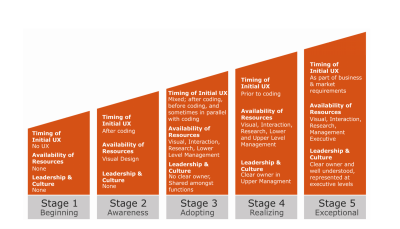
UX maturity refers to the level of sophistication with which an organization integrates user experience into its product development, business strategy, and corporate culture. As Chapman and Plewes (2014) famously noted, “Achieving great UX design is not just a function or talent of individuals; it is an organizational characteristic.”

Defining the Stages
While there is no single, globally accepted model, maturity is generally viewed as a continuum. At the lowest level (often called "Beginning" or "Ad-hoc"), UX is nonexistent or performed by non-specialists with little budget. At the highest level ("Exceptional"), UX is fully integrated into the DNA of the company. In these environments, leadership understands the value of design, resources are abundant, and cross-functional teams share a unified, user-first philosophy.
The reality for most practitioners lies somewhere in between. Navigating these middle stages requires moving beyond theory and into the tactical application of influence.
Tactic 1: Cultivating UX Champions
One of the most effective ways to break through the "beginning" phase of maturity is to identify and empower UX champions. A champion is an enthusiastic advocate for innovation who works within the company’s social and political structures to secure resources and buy-in.
Identifying the Right Advocate
Champions do not need to be design experts; in fact, they are often product managers, engineers, or stakeholders in positions of influence. A strong champion possesses:
- A strong network: They know how to navigate the internal hierarchy.
- Credibility: They are trusted by leadership and peers.
- A "Why": They are often frustrated by current processes or see the immediate business potential of a better-designed product.
The Power of Informal Influence
In early-stage organizations, you cannot simply demand a new department. Instead, you must identify a potential champion—perhaps a product owner struggling with high churn or a developer tired of building unusable features—and provide them with the ammunition they need to succeed. By educating them on UX outcomes and helping them achieve a "quick win" on a project, you gain an internal ally who can open doors that were previously closed.
Case Study: Logistics Transformation
Consider a recent case study at a large international logistics firm. The company was undergoing a massive backend technology migration but lacked a cohesive UX strategy. Despite the company’s stated goal of being "customer-first," UX was treated as a luxury.

By performing a stakeholder analysis, the consulting team identified a key product owner who was highly motivated to see their product succeed. This individual became the project’s UX champion. They weren’t an executive, but they had the ear of those who were. Within three months, this partnership led to the establishment of a formal UX research process, a permanent headcount for a UX designer, and a backlog of user-focused improvements that eventually influenced the entire organization’s approach to the platform migration.
Tactic 2: Demonstrating the ROI of UX
In boardrooms, the language of design must be translated into the language of business: Return on Investment (ROI). While many practitioners prefer to talk about "usability" and "delight," executives are primarily concerned with profit, efficiency, and risk mitigation.
Overcoming the ROI Myth
A common myth is that UX cannot be measured. On the contrary, if a product is data-driven, UX can be tied to key performance indicators (KPIs). By calculating the cost of design interventions against the gain in efficiency or revenue, practitioners can present a compelling business case for continued funding.

Metrics That Matter
Depending on the industry, the "value" of UX can be quantified in several ways:
- Efficiency: Measuring the reduction in time-to-task completion for internal tools.
- Support Costs: Tracking the decrease in support tickets or help-desk calls following a redesign.
- Conversion: Monitoring the impact of usability improvements on cart abandonment or sign-up flows.
- Customer Satisfaction: Utilizing NPS or CSAT scores as a benchmark for design success.
Case Study: Insurance Provider Turnaround
A large medical insurance provider struggled after a software rollout that caused agents to abandon the new platform in favor of manual processes. The call center was flooded with complaints, and the project was stalled.
The UX team introduced a "usability workstream" focused on benchmarking. They conducted interviews and testing, setting a "line in the sand" for metrics like task success and user satisfaction. By presenting a dashboard of these metrics to the executive committee, the team demonstrated that UX-led fixes directly correlated to a reduction in call volume and increased agent adoption. The result? A multi-year commitment to UX funding and a cultural shift where user testing became a mandatory prerequisite for all future digital releases.

Implications for Future Growth
Growing UX maturity is a long-term commitment that requires patience, persistence, and strategic thinking. It is not enough to be a great designer; you must be an educator. When you successfully elevate the UX maturity of your organization, you are doing more than just improving a product—you are building a sustainable ecosystem where design can thrive.
A Roadmap for Practitioners
- Map your environment: Understand your current maturity stage using established models.
- Find your allies: Look for champions who have the influence to advocate for change.
- Speak the language of business: Collect data that reflects the financial and operational impact of your work.
- Document and share: Create a repository of your successes to show that "customer-focused" is not just a buzzword, but a measurable business strategy.
By applying these tactics, you move from being a recipient of organizational culture to an agent of it. While the challenges of scaling UX are significant, the rewards—more efficient products, happier users, and a more robust, mature design practice—are well worth the effort.
This article is the first in a three-part series. In the next installment, we will explore the internal processes required to document UX work and the importance of mentorship in building a lasting design culture.