Your website should be the hardest-working sales representative in your organization. Yet, for many companies, it functions more like a passive digital brochure—an expensive, static asset that consumes budget while failing to capture the intent of its visitors. In an era where digital noise is at an all-time high, the difference between stagnant growth and a thriving pipeline often comes down to one fundamental shift: moving from a "show-and-tell" web philosophy to a conversion-centric strategy.
The reality is that you do not need a million-dollar site redesign or a multi-month engineering project to unlock latent revenue. By implementing precise, data-backed optimizations, marketing teams can reclaim control from development backlogs and drive measurable ROI today.
The Case for Conversion-First Design
Social media and paid advertising are essential for reach, but your website remains the "home base" where the conversion actually occurs. When a visitor lands on your site, they are actively signaling interest. If they leave without taking action, you have lost a qualified prospect who already cleared the highest hurdle: discovery.
Most websites suffer from a "museum effect"—they are aesthetically pleasing but lack the interactive elements that encourage engagement. Research indicates that even minor adjustments, such as modifying a call-to-action (CTA) button or streamlining a form, can result in triple-digit percentage increases in conversion rates. The following 16 strategies are designed to close the gap between traffic and revenue.
1. Deploy Campaign-Specific Landing Pages
The primary sin of digital marketing is driving high-intent traffic to a generic homepage. A homepage is designed to speak to everyone, which often means it speaks to no one. By contrast, a dedicated landing page is built for a single purpose: converting a specific segment of users. By stripping away navigation bars and unrelated content, you focus the visitor’s attention on the promise made in your ad, drastically reducing bounce rates.
2. Institutionalize A/B Testing
Stop relying on gut instinct. The most successful growth teams treat every element of a page—headlines, imagery, form length, and CTA copy—as a variable to be tested. As evidenced by case studies involving companies like Going, a simple change from "Sign up for free" to "Trial for free" can drive a 104% increase in conversion. This is not guesswork; it is the scientific method applied to revenue.

3. Solve Problems with Value-First Lead Magnets
The era of the "10 Tips for Success" PDF is over. Modern buyers are protective of their inbox and will only surrender their contact information in exchange for genuine value. A high-converting lead magnet addresses a specific pain point. Whether it is a proprietary ROI calculator, an industry-specific benchmarking report, or an interactive tool, the goal is to provide an immediate "win" for the user. This establishes authority and qualifies the lead simultaneously.
4. Eliminate Form Friction
Every field added to a lead capture form is a barrier to entry. While sales teams often demand exhaustive data, adding unnecessary fields leads to "form abandonment." Start with the absolute essentials—name and email—and utilize progressive profiling or follow-up email sequences to gather deeper intelligence later.
5. Harness AI-Driven Traffic Optimization
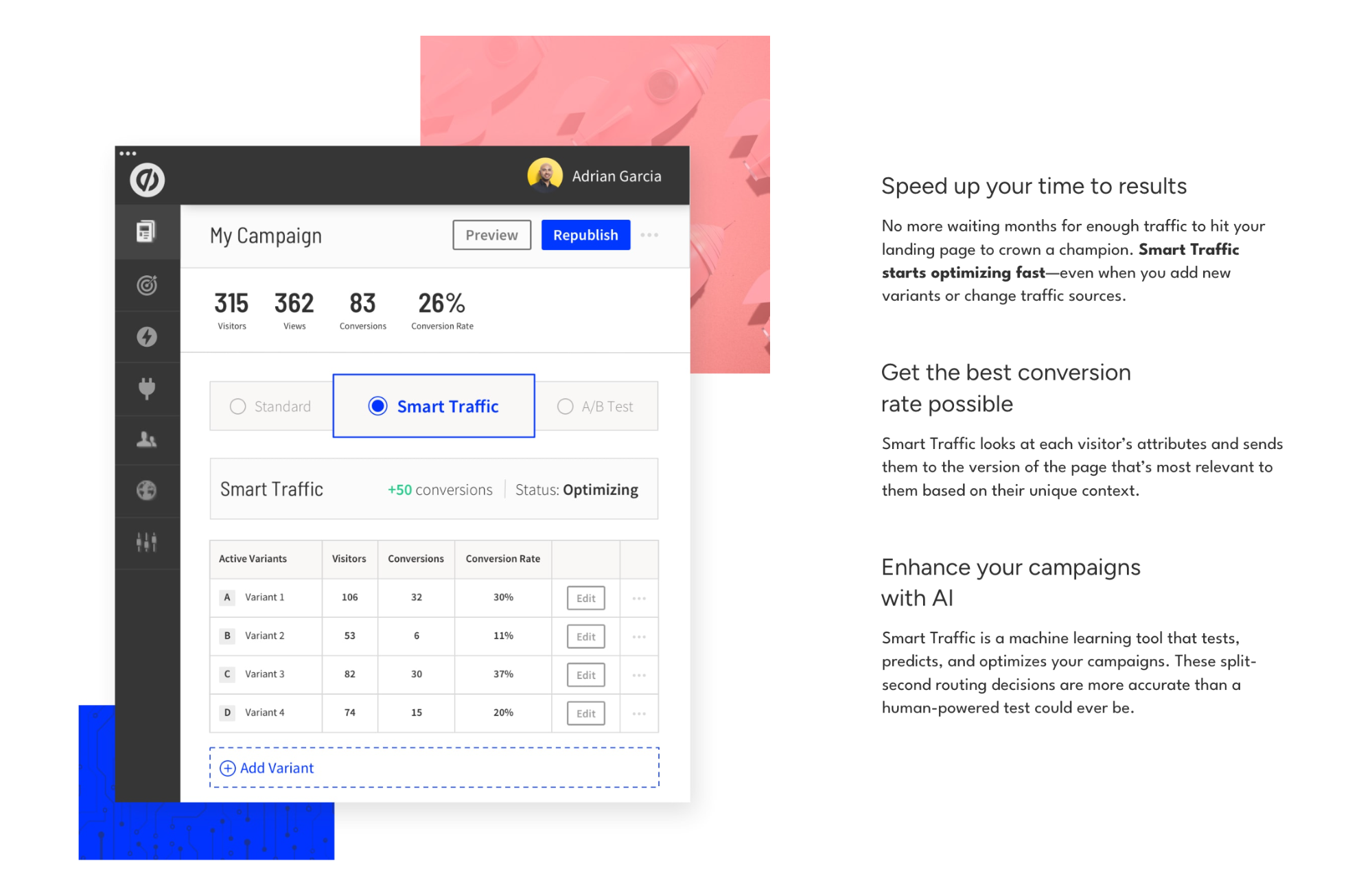
Manual A/B testing is effective but slow. The next frontier is AI-powered "Smart Traffic," which automatically analyzes visitor characteristics—such as location, device, and time of day—to route them to the specific page variant most likely to convert. This eliminates the need to wait for statistical significance, allowing for real-time performance optimization that scales with your traffic.
6. Strategic CTA Placement
A CTA button is the moment of truth. If a user has to hunt for the next step, they will simply leave. Place your CTAs where the eye naturally rests: above the fold for quick scanners, and at the end of high-value content sections for those who have invested the time to read.
7. Leverage Social Proof as a Trust Anchor
Visitors are inherently skeptical of marketing claims. Combat this with verifiable social proof. This includes more than just a carousel of testimonials; it encompasses client logos, industry certifications, "best-seller" badges, and real-time case studies that demonstrate how you have solved problems for companies similar to the visitor’s own.
8. Prioritize Page Speed
Performance is a silent conversion killer. Statistics confirm that 53% of mobile visitors will abandon a page that takes more than three seconds to load. Furthermore, conversion rates drop by approximately 4.42% for every additional second of latency. Optimizing image sizes, leveraging lazy loading, and minimizing server-side bloat are not just IT concerns—they are revenue-critical imperatives.

9. Content That Targets Pain, Not Features
Your blog should not be a corporate newsletter. It should be a resource center. By mapping content to the specific stages of the buyer’s journey, you build trust before you ever ask for a sale. When a prospect feels understood rather than "sold to," their propensity to convert increases significantly.
10. Timing and Relevance in Pop-Ups
Pop-ups are often maligned, but they are highly effective when used with restraint. An exit-intent pop-up provides a final opportunity for a visitor to engage, while a scroll-triggered pop-up ensures that you aren’t interrupting the user experience until they have already consumed your value proposition.
11. Implement Real-Time Conversational Interfaces
When a high-intent visitor has a question, they expect an answer immediately. If they can’t get one, they move to a competitor. Integrating a live chat or AI-powered chatbot ensures that the conversation continues even when your team is offline, keeping the lead "hot" and preventing them from bouncing.
12. Dynamic Content Personalization
Generic messaging is the marketing equivalent of a participation trophy. Using Dynamic Text Replacement (DTR), you can automatically adjust the headlines and copy on your landing pages to match the specific search terms or ad copy the visitor clicked. This creates a seamless, personalized experience that significantly boosts relevance.
13. The Paradox of Choice: Clarity Over Variety
Giving visitors too many options results in decision paralysis. A high-converting page should have one clear, singular goal. By removing secondary navigation and competing CTAs, you guide the user toward the only logical next step.
14. Metrics That Drive Action
Many organizations drown in data while starving for insight. Stop focusing solely on raw traffic. Instead, track metrics that inform optimization: scroll depth, form field abandonment rates, and conversion rates by traffic source. Turn these data points into concrete action items for your next design iteration.
15. The Art of the "Helpful" Follow-Up
Lead capture is not the finish line; it is the beginning of a relationship. Avoid the urge to immediately blast new leads with sales pitches. Instead, use an automated email sequence to deliver more value, answer common questions, and maintain top-of-mind awareness until the lead is ready to buy.
16. Rigorous Lead Qualification
Finally, bridge the gap between marketing and sales by implementing a lead scoring model. By filtering out unqualified traffic before it reaches your sales team, you increase the efficiency of your internal resources and foster better alignment between departments. Marketing should be held accountable for the quality of leads, not just the quantity.
Implications for Growth
The strategies outlined here represent a shift in philosophy: from treating your website as a static destination to treating it as a dynamic, evolving conversion engine. By focusing on these 16 pillars, marketing teams can stop waiting on developer resources and start driving measurable growth.
In the current digital landscape, the winners are not necessarily those with the largest advertising budgets, but those who are most effective at capturing and converting the demand that already exists. Start small, test often, and let the data guide your path to a higher-performing web presence.