In the modern digital landscape, a website is far more than a digital business card or a static repository of company information. For the high-performing marketer, it is—or should be—a relentless, 24/7 sales representative. Yet, the reality for many organizations is starkly different: websites often function like an underperforming employee, characterized by high traffic volume but dismal conversion rates.
As consumer behavior shifts toward self-directed research, the gap between a visitor’s arrival and their transition into a qualified prospect has become the most critical battleground in digital marketing. The following report outlines 16 battle-tested strategies designed to bridge this gap, enabling marketing teams to reclaim control from development bottlenecks and drive measurable return on investment (ROI).
The Strategic Shift: Why On-Site Conversion Still Reigns Supreme
Despite the rise of multifaceted social media advertising and sophisticated email automation, the website remains the "home base" of the customer journey. When a prospective client clicks an ad or follows a link from a whitepaper, they are signaling intent. They have done the hard work of finding you; the responsibility for conversion now rests solely on your digital infrastructure.
The primary obstacle is the "Museum Effect"—websites that are aesthetically pleasing but functionally inert. They fail to prompt interaction. However, data suggests that total site overhauls are rarely the solution. Instead, incremental, data-backed optimizations—such as modifying a call-to-action (CTA) button’s text—can yield exponential growth, sometimes doubling conversion rates without requiring an increase in ad spend.
16 Proven Tactics for Lead Generation Optimization
1. Deployment of Dedicated Landing Pages
The "homepage trap" is a common pitfall. Homepages are designed to cater to a broad audience, serving as a hub for navigation, brand history, and secondary product offerings. By contrast, a dedicated landing page is built for a single campaign and a singular conversion goal. This laser-focus eliminates the "buffet" distraction, keeping the user tethered to a specific value proposition. By utilizing drag-and-drop landing page builders, marketing teams can bypass IT queues, ensuring that campaign messaging remains perfectly aligned with the ads that drove the traffic.
2. The Power of Iterative A/B Testing
Guesswork is the enemy of growth. A/B testing allows marketers to make evidence-based decisions regarding headlines, CTA placement, and form structure. As seen in industry case studies, changing a button text from "Sign up for free" to "Trial for free" can result in a 104% increase in conversions. The most effective elements to test include value propositions, visual hierarchy, button color contrast, social proof placement, and form length.

3. Value-First Lead Magnets
The era of the generic "10 Tips for Success" PDF is over. Modern consumers are protective of their inboxes and require high-value incentives to part with their contact information. Effective lead magnets solve a specific, immediate problem. Whether it is an interactive calculator, an industry-specific checklist, or a proprietary data report, the lead magnet must act as an immediate "win" for the prospect.
4. Simplifying Lead Capture Forms
Friction is the primary cause of lead abandonment. Every field added to a form represents a barrier. Best practice dictates limiting initial capture to name and email. For more complex lead qualification, marketers should employ conditional logic, where additional questions appear only after the initial interaction is established, preventing the "life story" fatigue that drives users to bounce.
5. Leveraging AI for Smart Traffic
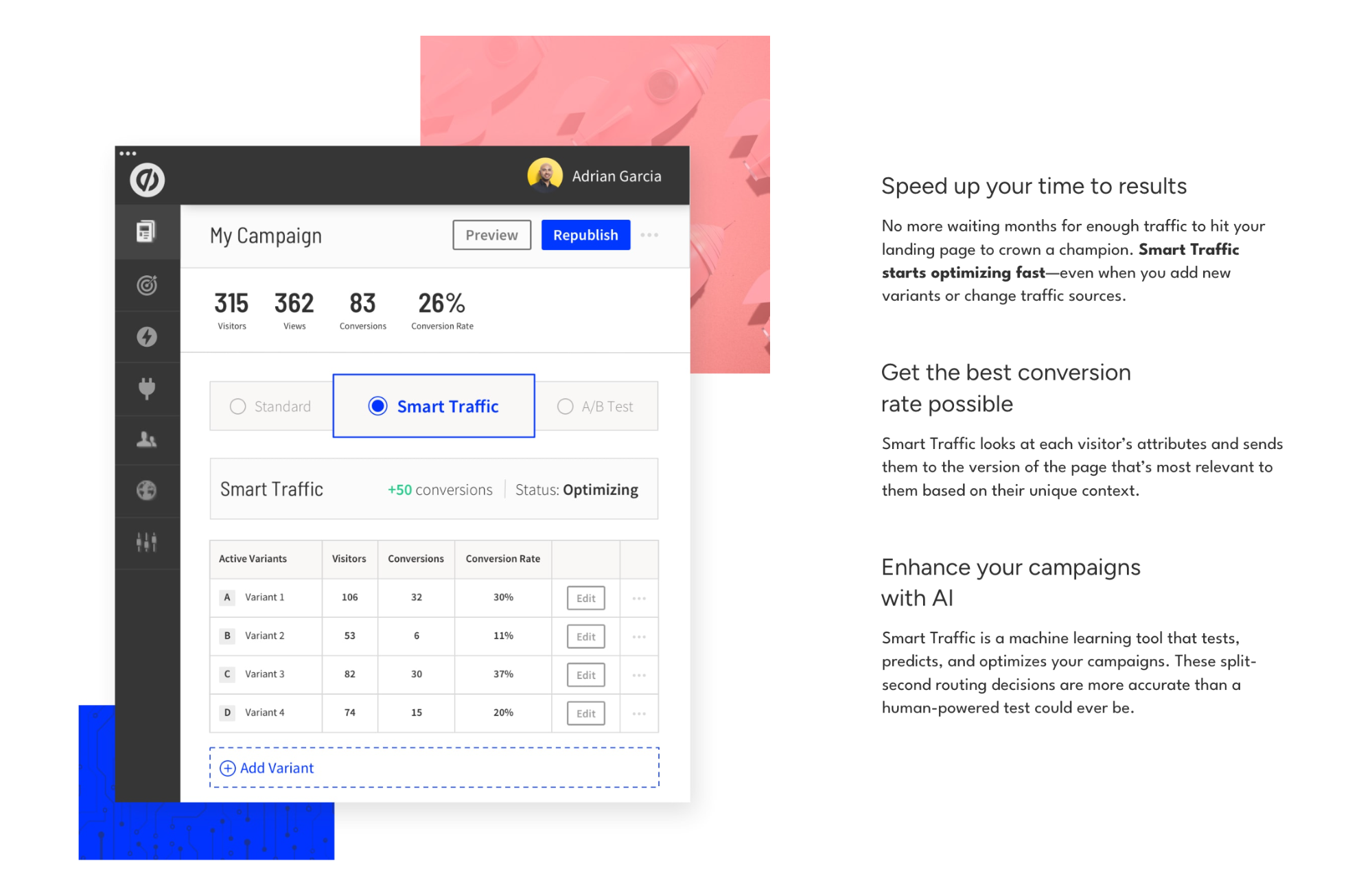
Not all visitors are equal. AI-powered tools, such as Smart Traffic, analyze visitor characteristics—including device, location, and time of day—to automatically route users to the landing page variant most likely to convert them. This removes the need for weeks of data gathering, allowing for optimization to begin after as few as 50 visits.
6. Strategic CTA Placement
A CTA button is the climax of the user journey. If it is buried, the conversion fails. CTAs should be placed in the "natural path of the eye," typically centered, at the end of key content sections, or in a "sticky" header that remains visible as the user scrolls.
7. Establishing Trust via Social Proof
Visitors harbor inherent skepticism toward unknown brands. To mitigate this, integrate authentic social proof: client logos, verified testimonials, "best-seller" tags, and case study snippets. Placing these elements in proximity to your lead capture form can significantly lower the friction of submission by reassuring the user that they are in good company.
8. Performance as a Conversion Driver
Speed is a non-negotiable metric. Research indicates that 53% of mobile users abandon a site if it takes longer than three seconds to load. Furthermore, every additional second of latency correlates with a 4.42% drop in conversion rates. Optimizing image sizes, leveraging content delivery networks (CDNs), and simplifying page architecture are essential maintenance tasks for any lead-gen strategy.

9. Content Marketing as a Resource Center
Your blog should not be a product feature showcase. Instead, it should serve as a resource hub that addresses the specific pain points of your target audience. By providing value-first content, you establish authority, which naturally nurtures the visitor toward your solution.
10. Intelligent Pop-ups and Sticky Bars
When deployed with malicious intent, pop-ups are intrusive. When deployed with strategic timing, they are helpful. Exit-intent pop-ups, which trigger when a user moves to close the tab, offer a final opportunity to engage the visitor, while scroll-triggered bars can provide subtle reminders of value without interrupting the reading flow.
11. Real-Time Conversational Interfaces
Live chat or AI-powered chatbots bridge the gap between "having a question" and "getting an answer." In the moments a potential lead is most engaged, having the ability to interact with the brand can prevent the user from looking toward a competitor.
12. Dynamic Text Replacement (DTR)
Personalization should extend to the very words on the page. Using DTR, a landing page can automatically mirror the search terms or ad copy used by the visitor. This creates a cohesive "message match," signaling to the user that they have arrived exactly where they intended.
13. The Paradox of Choice
Do not overwhelm the visitor with multiple paths. Each page should have one clear, primary goal. By minimizing distractions and focusing the user on a single "next step," you reduce cognitive load and increase the likelihood of conversion.
14. Metrics that Drive Action
Raw pageviews are vanity metrics. Instead, focus on granular data: form abandonment rates, scroll depth, and source-specific conversion quality. Data is only useful if it leads to a specific, actionable decision.
15. Nurturing via Email
The lead capture is merely the start of the relationship. Automated email sequences should focus on "mindshare"—providing continuous value rather than badgering the prospect with sales pitches. A well-nurtured lead will return when they are ready to buy.
16. Rigorous Lead Qualification
The "Sales vs. Marketing" friction often stems from poor lead quality. By implementing a basic lead scoring model—based on firmographic data or user behavior—marketers can ensure that only qualified prospects reach the sales team, thereby increasing the efficiency of the entire revenue organization.
Implications and Future Outlook
The shift toward self-service optimization tools is empowering marketing teams to move faster than ever before. By adopting these sixteen strategies, organizations can stop waiting on developer resources and begin treating their website as a dynamic, high-converting asset.
The ultimate takeaway is clear: success in modern digital lead generation is not about an increased budget, but rather the effectiveness of the conversion process. By implementing these tactics, marketers can ensure that every visitor is treated with the strategic care necessary to convert them from a casual browser into a loyal customer.