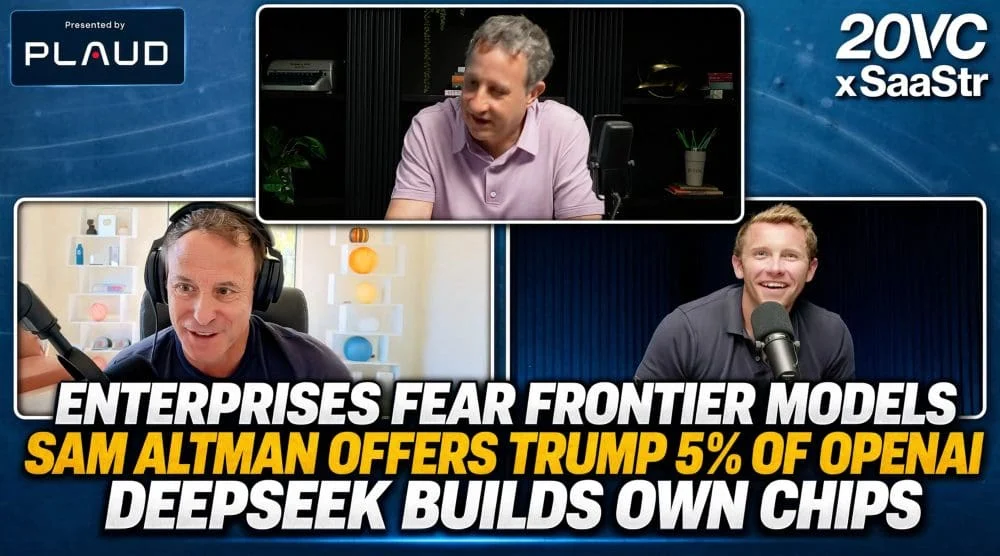
In a recent, wide-ranging dialogue, venture capital heavyweights Harry Stebbings, Jason Lemkin, and Rory O’Driscoll gathered to dissect the shifting tectonic plates of the artificial intelligence industry. From the chilling implications of federal pre-approval for software releases to the "Goldilocks" economics of hyperscale compute, the trio unpacked why the rules of Silicon Valley are being rewritten in real-time.
1. The Erosion of Software Autonomy
The conversation opened with a critique of the recent 19-day federal ban on Fable 5. While the ban was ultimately lifted, the panelists argued that the resolution is a distraction from the true structural shift: the normalization of government pre-approval.
"Six months ago, you could ship software like a free man," O’Driscoll noted. "Now, you get permission from Washington first." The consensus among the panel is that the U.S. is drifting toward a European-style regulatory burden. By normalizing a "structured pre-approval process," the government is effectively curtailing the dynamic, permissionless innovation that has defined the American economy for decades. While cybersecurity concerns offer a veneer of legitimacy, the panelists fear the precedent is setting a dangerous stage where developers must clear their business models with federal authorities before reaching the market.
2. The 5% Gambit: Alignment or Regulatory Trap?
A major focus of the discussion was OpenAI’s recent trial balloon—the suggestion that frontier AI labs should offer a 5% equity stake to the U.S. government.
Lemkin characterized this as a classic "portfolio playbook" move: selling a slice of the company to a powerful strategic partner to buy "alignment." However, O’Driscoll warned that the strategy is fundamentally flawed. Drawing parallels to the TARP era, he noted that small government stakes historically serve as an entry point for invasive oversight.
Furthermore, there is a disconnect between the "catastrophic" narrative promoted by the labs and the scale of the requested solution. If AI is truly a threat to the labor market of a $30 trillion economy, as some executives have argued, a $50 billion stake is not the solution politicians will demand—they will demand structural tax reform and massive wealth redistribution. Sam Altman’s "5% anchor" may be intended to preempt more extreme demands, but it risks validating the government’s right to interfere in the private sector’s cap table.
3. The New Normal: Dilution Insensitivity
The panelists observed a profound shift in founder psychology regarding equity. "Dilution insensitivity" has become the default. With founders now holding low single-digit percentages of their companies, the traditional "win-at-all-costs" mentality is being replaced by a focus on "optionality versus upside."
As Lemkin explained, the fear of returning a high-priced round has largely evaporated. Investors have learned to accept 1x liquidity preferences, removing the existential dread that plagued previous generations of founders. This shift has unlocked a new era of risk-taking, where the goal is to hit the trillion-dollar "prize" regardless of how many times the cap table must be sliced.
4. The Cloud Pivot: Selling the Shovel
Meta’s recent move to rent out compute capacity—MetaP Compute—marked a significant pivot in the AI arms race. Both Meta and SpaceX have adopted a similar trajectory: they built massive compute infrastructure for proprietary projects, found that the original goals were harder than expected, and pivoted to selling the excess capacity.
The market’s positive reaction—Meta stock jumping 10% on the news—suggests investors are buying into a "Goldilocks" scenario where these companies possess both short-term excess and long-term secret utility. However, the panel warned of a bleaker reality: a glut of compute sellers and only a handful of enterprise buyers (OpenAI and Anthropic). As long as enterprise revenue continues to double and triple, the spending spigot remains open, but the long-term viability of the "neocloud" business model remains tethered to one thing: sustained demand.
5. Nvidia and the "Compute-Now-Pay-Later" Risk
Nvidia is currently acting as the primary financier for the AI industry through aggressive compute-now-pay-later structures. By recognizing hardware revenue upfront while offering put-back rights to struggling neoclouds, Nvidia is essentially taking on significant contingent liability.
"Everything works right up until compute demand softens at the margin," O’Driscoll warned. The current structure is a derivative bet on continued growth. If demand slows, Nvidia will be forced to de-book prior revenue, potentially triggering a chain reaction of failures among the smaller players they have been subsidizing.
6. The Rise of Custom Silicon
Anthropic’s talks with Samsung regarding custom chips and DeepSeek’s silicon efforts signal that the industry is looking beyond Nvidia. While the narrative often focuses on "specialized needs," the panelists were blunt: this is about margin preservation. As the industry matures, companies are realizing that they must own the compute stack to recapture the massive margins currently flowing to Nvidia. It is a move to protect their bottom lines, disguised as a technical necessity.
7. The China Valuation Paradox
The discussion touched on the global AI divide, particularly the rise of Chinese models. With the top six models on OpenRouter now coming from China, it is clear that restricted access has not stifled innovation—it has accelerated domestic capability.
The panel highlighted a strange irony: the U.S. restricts China from accessing Western models, and China now floats restrictions on overseas access to its own models. This "dual-fear" cycle has created a fragmented ecosystem. If Chinese open-source models were removed from the global market, it would likely serve as a massive windfall for U.S. frontier and open-source providers, further consolidating American dominance.
8. The ROI Question and the IBM Trap
The enterprise market is currently struggling to find measurable P&L impact from AI, with studies showing 95% of pilots failing to deliver results. Despite this, tech giants like Microsoft and Amazon are pouring thousands of engineers into enterprise services, hoping to bridge the gap.
O’Driscoll framed this as the "IBM transition." Every tech company, he argued, must eventually decide if it will go bust or pivot into the next generation’s IBM—the trusted, enterprise-facing service provider. The struggle is that "intelligent answers" require both domain expertise and technical depth, a combination that is notoriously difficult to scale.
9. Employee Liquidity: The New IPO
The final takeaway centered on the changing landscape for startup talent. With IPO windows stretching to over a decade, "tender offers" have become the new proxy for public liquidity. For a hyper-talented operator, the panel suggested that joining a company without a clear path to liquidity within 24 months is a losing game.
"Employees are essentially sequential VCs," Lemkin remarked. "You have one shot at a time. Why join anything where you don’t have high confidence in liquidity?" The emergence of liquidity programs at companies like ElevenLabs and Clay has set a new standard, forcing even smaller startups to provide financial milestones to compete for top-tier talent.
Chronology of Recent Shifts
- Early July: Nvidia initiates compute-now-pay-later deals with emerging neoclouds.
- Mid-July: Fable 5 ban lifted; discussions begin regarding the implications of "pre-approval" precedents.
- Late July: Meta launches MetaP Compute, pivoting to infrastructure-as-a-service.
- Early August: OpenAI floats the 5% government stake proposal; industry skepticism mounts.
Supporting Data and Observations
- Cost Efficiency: Frontier models (Opus/Sonnet) are proving cheaper on a "total cost of ownership" basis (including developer time) compared to smaller, open-source models for complex tasks.
- Capital Efficiency: The industry is standardizing around ~50 cents per resolution, pushing companies to maximize model cost efficiency to under 25 cents.
- Market Reality: The "AI Cloud" glut is being fueled by tech giants who are effectively using their core businesses (Facebook, WhatsApp, Instagram) to subsidize the AI experiment.
Implications for the Future
The industry is currently in a state of high-stakes experimentation. The "frontier wins" when problems are complex, but the "open-source" movement dominates when problems are known and commoditized. As the hype cycles settle, the real winners will be those who can provide tangible ROI to the enterprise, manage the regulatory maze without compromising on speed, and provide the liquidity that today’s elite talent demands.
The path forward is clear: the era of "growth at any cost" is fading, replaced by a ruthless focus on capital efficiency, enterprise integration, and the preservation of competitive moats in an increasingly regulated, globally fragmented market.