In the rapidly evolving landscape of digital advertising, a profound shift is underway. For decades, the professional identity of a search marketer was built on the granular control of keyword match types, manual bid adjustments, and the relentless optimization of campaign structures. However, as Google and Meta move toward fully integrated, AI-driven ecosystems, that traditional methodology is becoming not only obsolete but a liability.
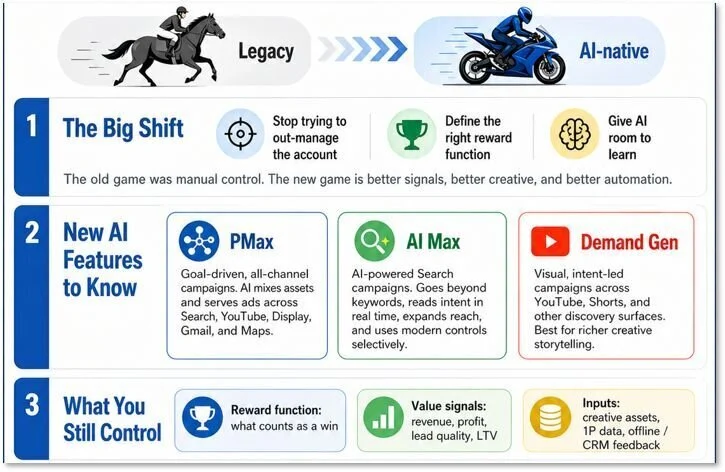
Industry experts and former insiders are now sounding an alarm: businesses clinging to manual management styles are effectively choosing to commute via horse and carriage in an age of high-performance motorcycles. The question facing modern CMOs is no longer how to "out-manage" the algorithm, but how to effectively feed the machine the high-quality data it requires to deliver exponential growth.
Main Facts: The Paradigm Shift in Performance Marketing
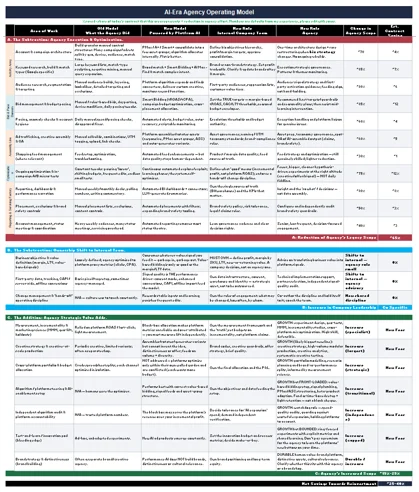
The core of this transformation lies in the transition from manual, control-heavy management to AI-native performance strategies. Google Ads has moved decisively toward "AIfying" its platform, replacing human intervention with machine learning at every layer of the funnel.
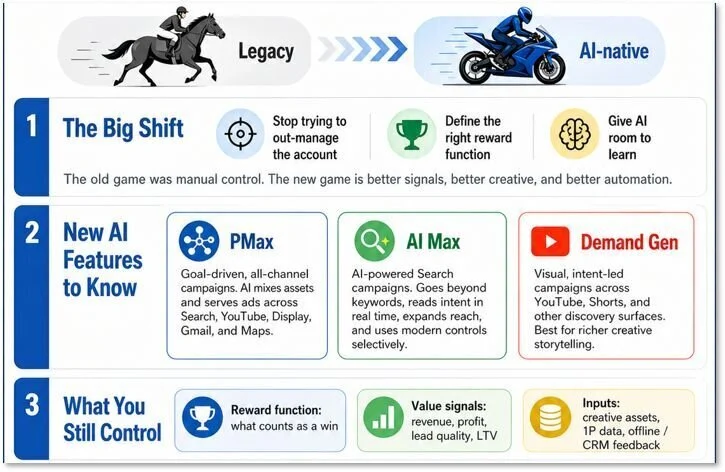
Current offerings, such as Performance Max (PMax), AI Max, and Demand Gen, represent a fundamental change in philosophy. Instead of asking marketers to define specific keyword parameters, these tools require businesses to define their "reward function"—the specific business goal or conversion value the AI should prioritize. By leveraging vast, real-time datasets that transcend simple search queries, these systems can analyze intent across Google’s entire ecosystem, including YouTube, Maps, Gmail, and the Display Network.
The implication is clear: the era of the "Search Marketer" as a tactical manual operator is ending. The new era requires the "Performance Strategist," a professional focused on data architecture, value-based signal transmission, and creative asset management.
Chronology: From Keyword Sculpting to Algorithmic Autonomy
The evolution of search marketing can be categorized into three distinct phases:
- The Era of Manual Control (2000–2015): The "AdWords Era." Success was determined by the ability to manage thousands of keywords, master exact-match bidding, and perform granular device-level adjustments.
- The Hybrid Transition (2016–2022): The introduction of Smart Bidding and automated match types. Agencies began balancing manual input with machine-learning recommendations, often leading to friction between human intuition and algorithmic logic.
- The AI-Native Present (2023–Present): The current, dominant reality. Platforms now prioritize "broad match" and AI-driven expansion. The "human in the loop" is no longer the pilot but the architect who sets the objectives, provides the assets, and validates the outcomes.
Supporting Data: The Maturity Assessment Model
To navigate this shift, organizations must move beyond vanity metrics. A robust maturity model—built on Capability and Depth—is now essential for assessing whether a company is an AI-native leader or a legacy tourist.
The Six Dimensions of Maturity
To reach the peak of performance—a score of 85 or higher on the industry maturity scale—advertisers must master six critical pillars:
- Measurement & Value Architecture (Weight: 30): The foundation of modern marketing. If the AI is not fed accurate data regarding profit margins, customer lifetime value (LTV), or lead quality, it cannot optimize correctly.
- Search Operating Model (Weight: 20): Abandoning manual bid modifiers and SKAGs (Single Keyword Ad Groups) in favor of Smart Bidding and AI Max campaigns.
- 1P Data & Audience Intelligence: Leveraging first-party data to inform the algorithm about who the "best" customers actually are.
- Surface Breadth & Campaign Mix: Utilizing the full range of automated surfaces beyond standard search.
- Creative & Landing Page Adaptability: Providing the AI with diverse, high-quality assets for testing and iteration.
- Operating Cadence & Governance: Shifting from daily manual "tweaking" to high-level strategic oversight and governance.
Official Perspectives: The Case for "Embrace and Extend"
Industry leaders, particularly those with deep historical insight into Google’s engineering culture, argue that resistance to this change is rooted in an outdated misunderstanding of how modern systems operate.
Most decisions made by these platforms are governed by principles like "Hanlon’s Razor"—the idea that what looks like a malicious attempt to squeeze more ad spend is often simply the system learning, evolving, and attempting to reach an efficiency equilibrium. The optimal strategy, according to those who have built these systems, is "embrace and extend." By feeding the machine better data and allowing it to operate within the parameters of your business goals, you effectively leverage the platform’s ability to learn faster than any human team could ever hope to.
The consensus is that while the AI will occasionally make mistakes, the net result—winning 40 times for every 4 losses—is a mathematically superior trade-off compared to the slow, error-prone manual management of the past.
Implications for Businesses and Professionals
The transition to an AI-native advertising model carries significant implications for both the bottom line and career trajectory.
For Businesses: The Revenue Multiplier
Companies that successfully pivot to an AI-native approach are seeing performance gains of 3x, 5x, or even 20x in revenue and profit. The competitive advantage no longer goes to the company that spends the most time in the dashboard, but to the company that best defines what a "win" looks like. By aligning the platform’s reward function with genuine business health—such as closed-won revenue or profit-based bidding—firms can turn their ad spend into a precise, scalable investment engine.
For Marketing Professionals: From "Monkeying" to Meaning
The traditional, repetitive tasks of the AdWords era were often described as "soul-sucking." By automating the tactical layer, AI frees up human capital to focus on higher-level strategic work:
- Data Strategy: Determining what signals are truly important to the business.
- Creative Excellence: Focusing on the quality and variety of assets (video, imagery, copy) that the AI utilizes.
- Governance: Ensuring the AI remains aligned with brand safety and long-term business strategy.
The Risk of Stagnation
The "choice" to remain in the past is no longer viable. Companies that insist on micromanaging match types or manual bid adjustments are effectively placing their career and company growth in reverse gear. The market will punish those who try to out-calculate a machine that processes billions of intent signals per second.
Conclusion: The Path Forward
The future of digital advertising is not about human versus machine; it is about human-guided machine optimization. The transition requires a cultural shift—an acceptance that the "control-first" mindset is the primary barrier to growth.
By assessing their current maturity, eliminating the "tourist" mindset, and focusing on the foundational architecture of data and value, organizations can shed the baggage of the manual era. The tools are ready. The methodology is proven. The only remaining question is whether marketing teams are prepared to stop being manual operators and start being the strategic architects of their own success.
Carpe diem—the era of the AI-native advertiser has arrived, and the competitive rewards for those who adapt are substantial.