As the UX landscape continues its meteoric rise, organizations are finding that the traditional, slow-burn approach to user research is increasingly at odds with the velocity of modern product development. While UX maturity is generally increasing, the tension between deep, generative discovery and the rapid, iterative requirements of agile sprints has become a defining challenge for research leaders. To bridge this gap, many high-performing organizations are turning to "Rapid Research"—a standardized, highly efficient framework designed to deliver actionable insights at the speed of business.
The Core Mandate: Why Speed Matters
Rapid Research is not merely about doing work faster; it is about operationalizing consistency. At its core, it is a program where research practices are standardized and templatized to provide a repeatable cadence of user insights. By removing the friction of manual setup and bespoke study design, teams can achieve a "quick-turn" environment—often delivering results within a weekly or bi-weekly sprint cycle.
This shift is a strategic necessity. As product teams grow, the demand for user validation often outstrips the supply of experienced researchers. Without a dedicated rapid program, senior researchers are frequently relegated to tactical, repetitive usability testing, which stifles their ability to conduct the complex, generative discovery work that drives long-term product innovation. By offloading these high-frequency, low-complexity tasks to a Rapid Research engine, organizations protect their senior talent while ensuring product teams never move forward in the dark.
The Pillars of Rapid Research
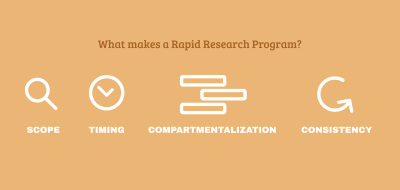
A successful Rapid Research program is built on four non-negotiable pillars: Scope, Timing, Compartmentalization, and Consistency.

1. Defining the Scope
Not all research is meant to be rapid. Teams must ruthlessly audit their methodologies to identify what can be templated. Longitudinal diary studies or complex, multi-stage interviews are rarely suitable for this model. Conversely, usability tests, A/B preference testing, and short-form user interviews are prime candidates.
The scope must also account for participant recruitment. Sourcing highly specialized participants is a bottleneck that can kill the speed of a program. Successful programs identify "broad-reach" user segments—customers who represent the majority of use cases—allowing for a faster, more reliable recruitment pipeline.
2. Mastering the Timing
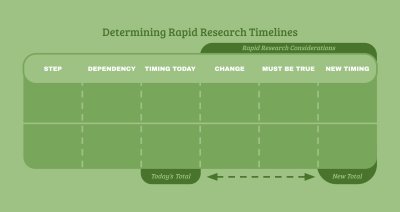
The value of the program is tied to its cadence. If an end-to-end "rapid" study takes as long as a traditional, ad-hoc study, the program has failed. Leaders should aim for a turnaround time that is at least 50% more efficient than their current benchmark. This requires a shift in mindset: if the project cannot be completed within the allotted "rapid" window, the scope must be further constrained rather than extending the deadline.
3. The Power of Compartmentalization
Efficiency is gained by breaking the research lifecycle into independent, modular parts. By decoupling recruitment from discussion guide design, and analysis from data collection, teams can move work through a pipeline. If a researcher can hand off the recruitment phase to an operations coordinator or a vendor while they focus on guide preparation, the "total time to insight" is drastically reduced.
4. The Necessity of Consistency
Expectability is the ultimate goal. If stakeholders know that a request submitted on Monday results in a readout by Friday, they will naturally align their product workflows to this rhythm. Variability is the enemy of agility; once the cadence is set, the process becomes predictable, allowing for iterative improvement.
Chronology of a Successful Implementation
Building a Rapid Research program is an exercise in organizational design. It is not an overnight fix; it is a long-term investment.
- Phase 1: The Audit (Months 1–2): Analyze the previous year of research requests. Identify the most common methodologies, the most frequent stakeholders, and the average time-to-insight. Determine the "gap"—where are product teams making decisions without data?
- Phase 2: The Pilot (Months 3–5): Select a sympathetic stakeholder group to act as your first internal client. Communicate clearly that these are "pilot" projects. Use this period to break things, identify bottlenecks in legal or compliance, and refine your templates.
- Phase 3: Scaling & Staffing (Months 6+): Once the process is proven, secure the resources to staff it. Whether through hiring junior researchers, upskilling existing staff, or leveraging external vendors, build a dedicated team that handles the Rapid Research flow while senior staff handle deep-dive discovery.
Supporting Data and Evidence
The impact of a well-executed Rapid Research program is measurable across three primary dimensions:
- Throughput Efficiency: Organizations that implement these programs often report a 2x increase in project output. By automating administrative tasks and using standardized templates, a single researcher can handle a volume of work that would have previously required two or three full-time equivalents.
- Cost Mitigation: The industry-standard "100x rule" applies here: catching a usability issue during the design phase through rapid testing is exponentially cheaper than fixing it after the code has been shipped to production.
- Generative Capacity: By freeing senior researchers from the "validation treadmill," teams report an increase in high-impact generative research, leading to better long-term strategy and product innovation.
Official Perspectives and Organizational Realities
It is important to acknowledge that there is no "one size fits all" approach. In highly regulated environments, such as healthcare or fintech, the "speed" of Rapid Research will be inherently capped by compliance and legal review cycles. In these environments, the program’s success depends on "pre-approval." By creating a bank of approved, standardized research guides and recruitment protocols that have been cleared by legal once, teams can bypass the need for per-study review, maintaining their velocity.
Furthermore, leadership must manage the "expert bias." There is often a fear that rapid research leads to "thin" insights. However, the goal is not to replace deep research but to augment it. By providing a "fast lane" for tactical questions, the research department establishes itself as a partner that can match the pace of the engineering team, thereby earning a seat at the table for more strategic conversations later.
Strategic Implications for the Future
The long-term implication of Rapid Research is the maturation of the research operations (ResearchOps) function. As these programs scale, they force organizations to build robust repositories, participant panels, and automated reporting systems.
The Pros:
- Agility: Keeps research in sync with 2-week agile development sprints.
- Democratization: Empowers junior staff to gain experience while providing immediate value.
- Focus: Allows senior researchers to tackle complex, long-term discovery.
The Cons:
- Depth Limitations: It is not suitable for complex, nuanced ethnographic work.
- Burnout Risk: Without clear guardrails, the "rapid" nature can lead to an endless, high-pressure pipeline for those running the program.
Conclusion: The Path Forward
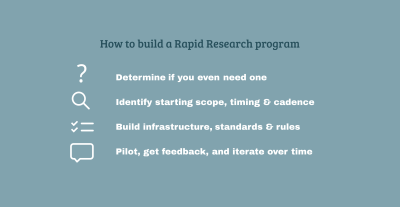
To initiate a Rapid Research program, start by asking: "Do we actually need this?" If your product teams are moving fast and your researchers are drowning in tactical requests, the answer is likely yes.
Begin with a modest pilot. Document every step of your current process, identify the friction points, and build your infrastructure around the solution. As you move forward, track your metrics—not just the speed of your studies, but the quality of the decisions those studies influence. By treating research as a scalable product, you move from being a service center to a strategic engine, ensuring that human insight remains at the center of your organization’s innovation strategy.
The move toward Rapid Research is not a concession of quality; it is an evolution of professional practice. By standardizing the "how," you clear the path to focus on the "why," ultimately propelling your organization toward smarter, faster, and more user-centric growth.