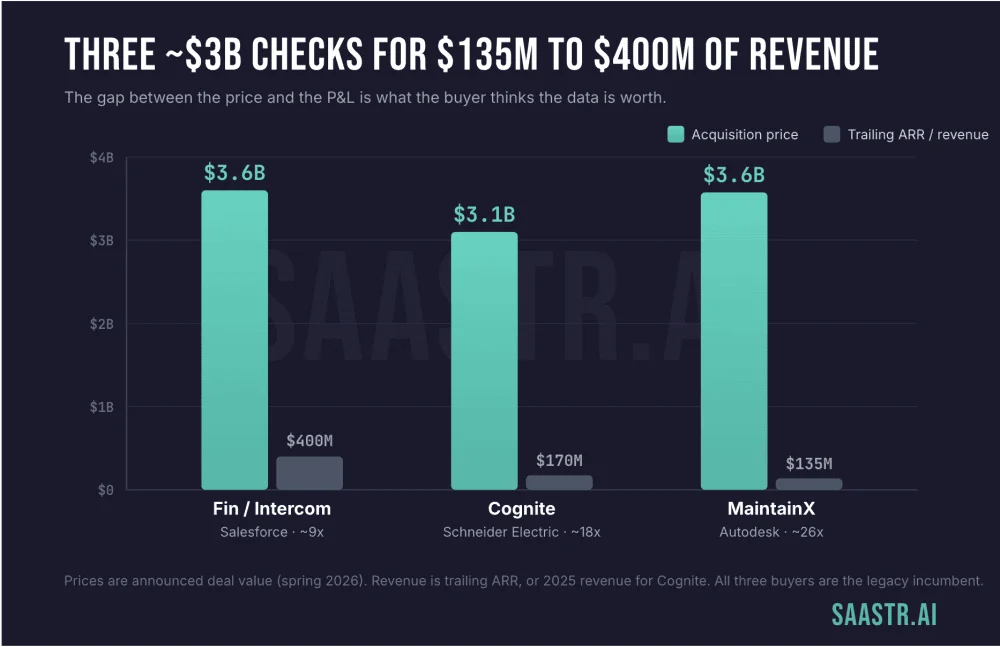
In the span of just thirty days, the B2B software landscape underwent a seismic shift. Three major acquisitions—each valued at approximately $3 billion—have sent a clear message to the tech industry. Salesforce acquired Fin (formerly Intercom), Autodesk picked up MaintainX, and Schneider Electric finalized its purchase of Cognite.
On the surface, these deals appear disparate. They involve different sectors: customer service, facility maintenance, and industrial data management. They involve different geographies and distinct buyer profiles. However, when viewed through the lens of the current artificial intelligence arms race, these deals are not merely tactical expansions; they are symptomatic of a singular, desperate strategic pivot. Legacy platforms are paying exorbitant premiums not for AI models, which are rapidly commoditizing, but for the proprietary data pipelines that make those models functional, reliable, and indispensable.
The Core Thesis: Data Is the New Moat
The central narrative uniting these three multi-billion-dollar deals is the transition from "AI as a feature" to "AI as the operating layer."
For decades, enterprise incumbents have relied on sheer scale and distribution to maintain dominance. However, the emergence of generative AI has disrupted the traditional software-as-a-service (SaaS) model. In the modern enterprise, an AI agent is only as good as the domain-specific data it ingests. A generic model can draft an email, but it cannot safely troubleshoot an industrial oil rig or resolve a complex customer support ticket without hallucinating.
These acquisitions prove that the "picks and shovels" of the AI era are not the models themselves, but the data contextualization layers that allow those models to operate within the messy, non-linear realities of physical and enterprise operations.
Chronology of a Buying Spree
1. The Transformation of Fin (Intercom)
Fin’s journey is the most illustrative of the pivot. Born in 2011 as a messaging platform, Intercom faced a growth plateau by 2022. Facing stagnant ARR and declining net new growth, the company made a radical gamble shortly after the launch of ChatGPT. They pivoted their entire workforce toward an AI-first support agent. By May 2026, the company rebranded as "Fin," and within weeks, Salesforce acquired the firm for $3.6 billion.
The deal’s headline number—$400M in ARR—masks the true strategic intent. Analysts note that while the legacy messaging business was flat, the new AI-native agent line was growing at a staggering 350%. Salesforce effectively paid a premium to acquire a high-growth, high-utility data engine that resolves 76% of support tickets without human intervention, significantly outperforming Salesforce’s own internal "Agentforce" solutions.
2. MaintainX: Modernizing the Factory Floor
On May 28, 2026, Autodesk announced its $3.6 billion acquisition of MaintainX. Founded in 2018, MaintainX targeted the "blue-collar" gap in software, building a mobile-first, Slack-like interface for factory floor operations.
While Autodesk already dominated the design and construction space (the "Design & Make" TAM), it lacked visibility into the actual lifecycle of physical assets once they left the factory floor. By acquiring MaintainX, Autodesk expanded its reach into the $40B Operations TAM. This wasn’t just a revenue play; it was a move to own the telemetry of how assets perform in the real world—context that design software alone could never capture.
3. Cognite: The Industrial Data Layer
Schneider Electric’s $3.1 billion purchase of Cognite, finalized shortly thereafter, represents the cleanest example of the "data plumbing" thesis. Cognite, a spinout of the Norwegian conglomerate Aker, spent years solving a specific, unglamorous problem: industrial data silos.
Factories and energy grids produce massive amounts of data, but it is often poorly labeled and trapped in fragmented systems. Cognite’s "Data Fusion" creates a knowledge graph that renders this data AI-ready. By folding Cognite into its industrial software arm, AVEVA, Schneider Electric is ensuring that it remains the primary vendor for AI workflows in industrial settings. They recognized that if they didn’t own the data contextualization layer, they would be relegated to a hardware vendor, forced to rely on third parties for the "intelligence" layer of their products.
Supporting Data: The Growth-Multiple Correlation
When analyzing these deals, a recurring mathematical pattern emerges: the acquisition multiple is consistently tethered to the growth rate of the AI-native component of the business, usually landing at roughly 0.5x the growth rate.
| Company | Deal Value | Growth Rate (AI Line) | Multiple |
|---|---|---|---|
| MaintainX | $3.6B | 50% | 26x |
| Cognite | $3.1B | 36% | 18x |
| Fin | $3.6B | 350%* | 9x (Blended) |
Note: Fin’s multiple appears lower due to the inclusion of legacy revenue, but the AI-native portion reflects the same premium-pricing strategy.
This suggests that institutional buyers have moved past vanity metrics like total ARR. They are now conducting sophisticated "de-averaging" of revenue to isolate and pay for the segments that demonstrate high-velocity, AI-driven growth. The scarcity of high-quality, structured, domain-specific data is driving these valuations.
Official Perspectives and Strategic Logic
The executives involved have been remarkably candid about the necessity of these deals. Autodesk CEO Andrew Anagnost emphasized that AI is only as accurate as the data it ingests. "Design software knows how an asset is supposed to work," Anagnost noted. "MaintainX knows how it actually performs in the field."
Similarly, Salesforce’s acquisition of Fin was a defensive and offensive maneuver. By integrating Fin’s proprietary "Apex" model and its 30,000-strong customer data set, Salesforce has not only removed a competitor but has significantly accelerated its internal roadmap. The message from the C-suite is clear: building these data-contextualization layers from scratch takes years of trial and error. In an era where AI capabilities change monthly, buying the incumbent is a survival strategy.
Implications for Future B2B Builders
For founders and builders in the B2B AI space, these three deals provide a roadmap for survival and success in a crowded market.
1. Don’t Build Models; Build Data Pipelines
The era of competing on model benchmarks is ending. The "model" is increasingly a commodity. The real value lies in the "knowledge graph"—the specific, proprietary way a company labels, organizes, and contextualizes data within its niche. If you are building in B2B, your moat must be the difficulty of replicating your data set, not the sophistication of your LLM implementation.
2. Focus on the "Operating Layer"
The most successful startups are not just providing insights; they are becoming the platform upon which daily work is performed. Whether it is a support agent, a maintenance app, or an industrial data fusion tool, the goal is to become the system of record. When you own the system of record, you own the data flow, and you become an inevitable acquisition target for the giants.
3. The "Legacy" Trap
Fin’s acquisition is a cautionary tale for those clinging to legacy revenue. If your business has a large, stagnant base of "old world" software, you must aggressively cannibalize it with AI-native solutions. The market is not paying for the stability of the past; it is paying for the velocity of the AI-powered future.
Conclusion: The New Rules of M&A
The $9 billion spent over these thirty days marks the end of the "experimentation phase" of enterprise AI. We have moved into the "integration phase." Incumbents have identified their blind spots—they have the hardware and the distribution, but they lack the proprietary data streams that make AI actionable.
As we look toward the remainder of the decade, expect a continued consolidation. The companies that possess the "plumbing"—the clean, labeled, and high-velocity data pipelines—will find themselves in the crosshairs of the world’s largest tech conglomerates. In this new economy, the value of a company is no longer defined by what it sells, but by the data it captures and the intelligence it can extract from it.