The Rise of the Autonomous Merchant: Meta Unveils ‘Business Agent’ at Conversations 2026 to Revolutionize Conversational Commerce
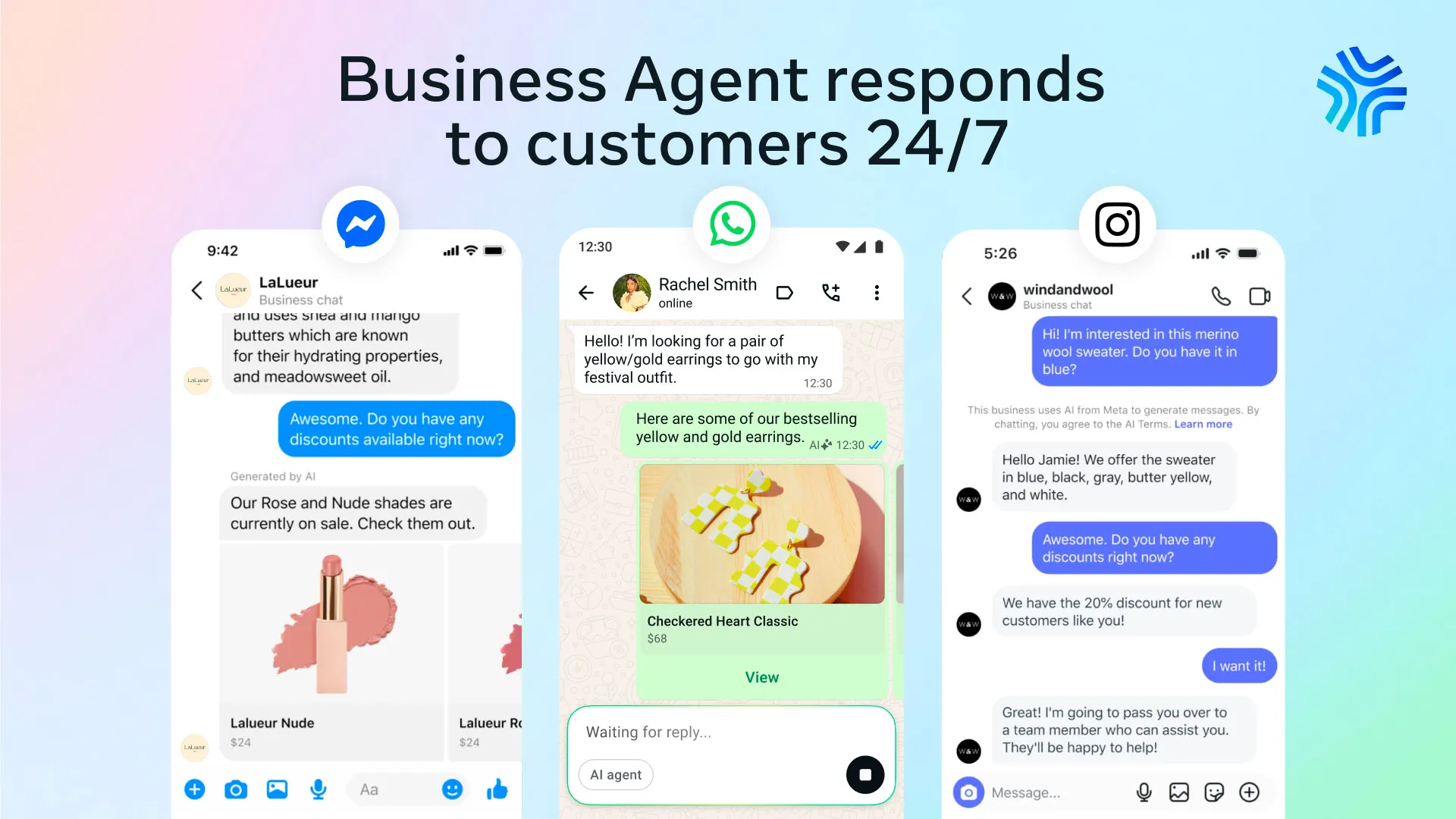
LONDON — At its flagship Conversations 2026 event in London, Meta Platforms Inc. unveiled a suite of commercial messaging tools designed to fundamentally reshape how businesses interact with consumers. The centerpiece of the event was the launch of the Meta Business Agent, an enterprise-grade, autonomous artificial intelligence agent capable of managing complex, end-to-end business operations directly within Meta’s messaging ecosystem, including WhatsApp, Instagram Direct, and Messenger.
The announcement marks a decisive shift in Meta’s monetization strategy, moving away from simple ad-delivery mechanics toward deep transactional integration. By transforming messaging threads into fully autonomous storefronts, customer service centers, and lead-generation engines, Meta is positioning itself to capture a massive share of the rapidly growing conversational commerce market.
1. Main Facts: The Launch of the Meta Business Agent
The Meta Conversations 2026 keynote signaled the end of the traditional, rule-based chatbot era. While early iterations of messaging automation relied on rigid, decision-tree logic that frequently frustrated users, the newly introduced Meta Business Agent leverages advanced generative AI to execute complex, multi-turn conversations while maintaining a consistent brand voice across multiple languages.
Core Capabilities Unveiled in London:
Autonomous End-to-End Operations: Unlike standard bots that hand off tasks to external websites, the Meta Business Agent can qualify leads, query real-time inventory through API integrations, resolve customer support tickets, and guide users through secure checkouts—all within a single chat thread.
Native Search and Discovery: Meta announced enhanced discovery features that allow users to search for and find AI-powered businesses directly through the native WhatsApp search bar, turning the messaging app into a high-intent, transactional search engine.
Dynamic Data Integration: The agent is designed to ingest data dynamically. It learns from a business’s existing Meta assets and websites, but can also be fed structured, proprietary data such as real-time pricing, catalog variations, and custom customer relationship management (CRM) variables.
Granular Human-in-the-Loop Control: To address enterprise concerns regarding AI hallucinations and brand safety, Meta introduced a centralized management console. This dashboard allows human supervisors to monitor active conversations in real-time, instantly intervene and assign chats to human representatives, and provide direct feedback to train the underlying model.
2. Chronology: The Decade-Long Evolution of Conversational Commerce
The rollout of the Meta Business Agent is the culmination of a ten-year technological journey. Understanding how the digital landscape evolved from basic automated scripts to autonomous agents provides critical context for this launch.
[2016: The Messenger Bot Boom] ──► [2020-2023: WhatsApp Business Scale] ──► [2024-2025: GenAI Integration] ──► [2026: Meta Business Agent Launch]
  - Rigid, rule-based scripts       - Manual templates & API access            - LLaMA-powered chat experiments      - Fully autonomous transactions
  - High friction, low adoption     - High enterprise adoption                 - Hybrid human-AI workflows          - Native in-app search engine
Phase 1: The Messenger Bot Era (2016–2018)
Exactly a decade ago, Meta (then Facebook) made a major push into Messenger bots. These early tools were highly deterministic, requiring developers to map out every potential user response. Because the technology lacked natural language understanding (NLU), users who strayed from the prescribed script encountered broken loops, leading to widespread consumer frustration and a temporary retreat from automated messaging by major brands.
Phase 2: The Infrastructure Buildout (2018–2023)
Recognizing the limitations of early bot frameworks, Meta shifted its focus to building robust messaging infrastructure, particularly around the WhatsApp Business API. During this period, the company focused on scale, security, and utility, enabling businesses to send structured notifications, such as boarding passes, shipping updates, and verification codes. However, these interactions remained highly transactional and required manual human intervention for complex queries.
Phase 3: The Generative AI Paradigm Shift (2023–2025)
The emergence of large language models (LLMs) fundamentally changed the capabilities of digital assistants. Meta integrated its proprietary LLaMA models across its consumer apps, laying the groundwork for businesses to experiment with conversational AI. During this phase, businesses began utilizing AI to draft replies, but these tools remained auxiliary aids for human agents rather than autonomous operators.
Phase 4: Full Autonomy at Conversations 2026
The debut of the Meta Business Agent in London represents the final step in this evolution. By combining LLM-driven natural language processing with robust, secure backend API integrations, Meta has transitioned its messaging tools from passive communication channels into proactive, autonomous economic actors.
3. Supporting Data: Inside the Technical and Commercial Ecosystem
The commercial viability of the Meta Business Agent relies heavily on its integration capabilities and the sheer scale of Meta’s user base. According to data shared during the event, conversational commerce is no longer a niche market; it is fast becoming the primary touchpoint for digital consumer acquisition.
Technical Architecture and Data Ingestion
To prevent the common AI pitfall of "garbage in, garbage out," Meta’s new architecture relies on a multi-layered data ingestion framework:
Data Layer
Source Material
Operational Function
Public Layer
Brand Websites, Meta Page Content
General business FAQs, brand tone, and baseline customer service.
Structured Layer
Inventory Databases, ERPs, CRM APIs
Real-time product availability, dynamic pricing, and order tracking.
Instructional Layer
Brand Guidelines, Operating Hours
Defining guardrails, promotional strategies, and escalation rules.
Feedback Loop
Human Agent Interventions
Reinforcement learning based on real-time corrections by human staff.
The WhatsApp Search Engine: A New Frontier for Discovery
One of the most disruptive aspects of the announcement is the enhancement of the WhatsApp search bar. In live demonstrations, users searching for generic terms like "sushi delivery London" or "boutique hotel" were presented with verified, AI-powered business profiles.
Industry analysts point out that this effectively transforms WhatsApp into a closed-loop, high-intent search engine. For businesses, this introduces a brand-new optimization discipline: WhatsApp Search Optimization (WSO). Companies that fail to optimize their profiles and feed structured data into Meta’s ecosystem risk losing search visibility within one of the world’s most widely used communication applications.
4. Industry Reactions and Expert Commentary
The reactions from digital marketing specialists, enterprise software providers, and privacy advocates highlight both the immense potential and the operational hurdles of Meta’s new technology.
The Marketer’s Perspective
Lars Maat, a prominent pay-per-click (PPC) and AI integration specialist who attended the London event, expressed immense enthusiasm for the release, noting how drastically the landscape has shifted:
"A decade ago, we were building rigid Messenger bots that felt incredibly clunky and broke at the slightest deviation. What we saw demonstrated in London is lightyears ahead. The speed at which we have transitioned from physical retail to web search, and now to zero-click conversational commerce, is unprecedented. For digital marketers, optimizing for Meta’s Business Agent is quickly becoming as critical as optimizing for Google’s AI Overviews or traditional PPC campaigns."
Corporate and Enterprise Responses
Enterprise software providers view Meta’s move as both a threat and an opportunity. Leading CRM platforms are already preparing native integrations to ensure their systems can sync seamlessly with the Meta Business Agent.
"The value of an autonomous agent is only as good as the data feeding it," said a senior technical director at an enterprise CRM suite, speaking on the condition of anonymity. "If the agent cannot pull real-time inventory or accurately record customer data back into the central CRM, it’s just a sophisticated toy. Meta’s open API approach for this agent is a smart move that acknowledges the necessity of enterprise-grade data synchronization."
Potential Concerns: Hallucinations and Brand Safety
Despite the excitement, risk management professionals urge caution. The threat of generative AI "hallucinating" terms of service, misquoting prices, or promising unavailable stock remains a significant liability. Meta has addressed this by providing robust monitoring tools, but the legal responsibility for an autonomous agent’s commitments still rests squarely on the business itself.
5. Strategic Implications: The Era of "Zero-Site" Ecommerce
The launch of the Meta Business Agent has profound implications for the future of digital marketing, web design, and search engine optimization.
As consumers become accustomed to browsing, negotiating, and purchasing within their preferred messaging apps, the necessity of the traditional brand website may decline. Small and medium-sized enterprises (SMEs) in particular may choose to bypass web development entirely, directing their traffic and ad spend exclusively to their Meta Business Agents. This shift mirrors Google’s recent push toward merchant-facing AI tools introduced at Google Marketing Live, signaling a broader industry trend toward "zero-site" customer journeys.
2. A Shift in Digital Advertising Spend
Traditionally, PPC campaigns on platforms like Meta and Google are designed to drive traffic to external landing pages. With the Business Agent, ad formats will increasingly shift toward "Click-to-Message" ads. Instead of paying to send a user to a website—where conversion rates hover between 2% and 5%—advertisers can initiate an interactive conversation with an autonomous agent, which historical data suggests yields significantly higher conversion and retention rates.
3. Redefining Search Engine Optimization (SEO)
For years, SEO has been defined by optimizing for web browsers. The introduction of robust search features within WhatsApp means that search professionals must adapt to in-app optimization. Ranking factors within WhatsApp’s search engine are expected to rely heavily on:
The completeness and verification status of the business profile.
The responsiveness and historical rating of the Meta Business Agent.
The accuracy and structure of the product catalogs and API feeds provided to Meta.
4. Human Labor Redefined, Not Replaced
While the Meta Business Agent can handle the vast majority of routine inquiries and transactions, it does not eliminate the need for human staff. Instead, it redefines their role. Customer service agents will transition from handling repetitive, low-value queries to acting as high-level supervisors, handling complex escalations, and training the AI models based on Edge-case interactions.
By bridging the gap between advanced generative AI and practical, secure transaction systems, Meta is not just updating its messaging apps—it is positioning WhatsApp, Instagram, and Messenger as the primary operational OS for modern digital commerce.