As WordPress approaches the end of its third decade, the ecosystem finds itself at a pivotal crossroads. No single entity better embodies this transition than Elementor, the powerhouse page builder currently celebrating a decade of market-dominating growth. With its technology now underpinning more than 13% of the entire web, Elementor is no longer just a plugin; it is a critical pillar of the global digital infrastructure.
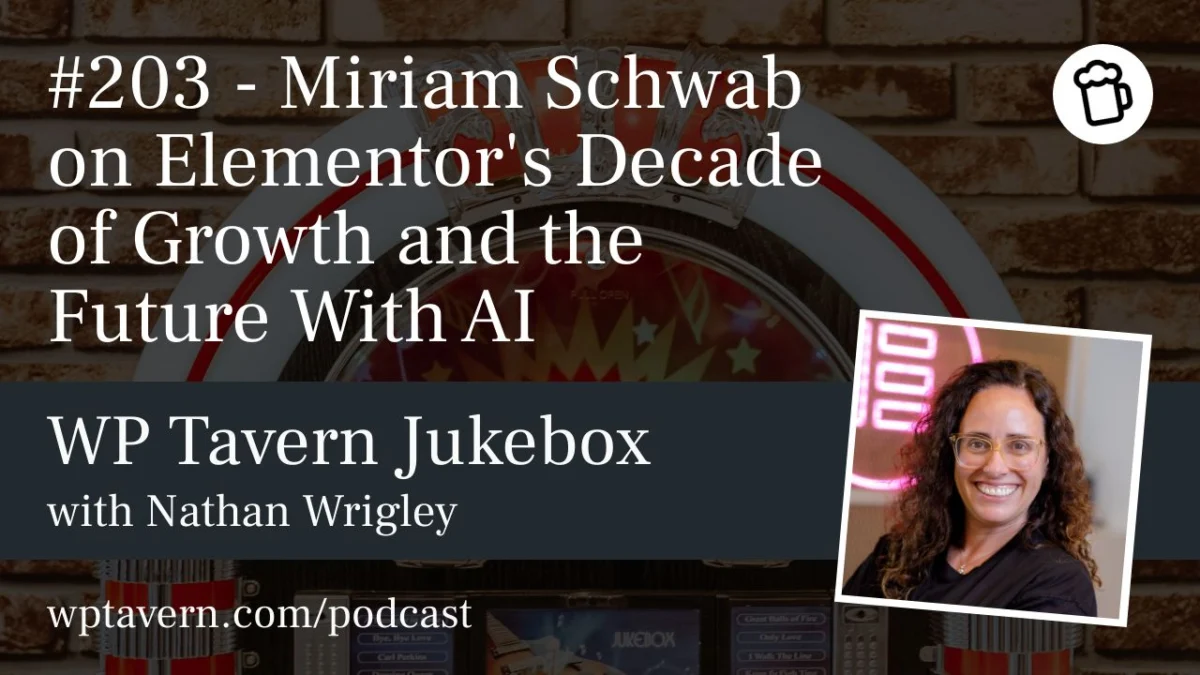
In a recent, in-depth discussion on the WP Tavern Jukebox podcast, Miriam Schwab—Head of WordPress at Elementor—offered a rare, high-level look at how the company is navigating the dual pressures of legacy maintenance and the rapid, often chaotic, evolution of Artificial Intelligence.
A Legacy of Growth: From Startup to Web Titan
To understand where Elementor is going, one must understand its roots. Founded in 2016, Elementor arrived when the WordPress market was already crowded with page builders. Its meteoric rise was fueled by a "freemium" model that provided professional-grade design tools to millions of users, effectively democratizing web development.
"It was the right product at the right time," says Schwab, who joined the Elementor fold in 2022 following the company’s acquisition of her own startup, Strattic. "It provided immense value to web builders, and that value proposition hasn’t changed. Today, we are seeing Elementor power over 13% of the entire web—not just the WordPress segment, but the web as a whole."
According to W3Techs data, Elementor has been ranked as the top Content Management System (CMS) for three consecutive years, outpacing proprietary giants like Wix and Shopify. This growth is not merely a result of existing users scaling their operations; Schwab notes that the platform added approximately 3.5 million new websites to its footprint in 2025 alone.
Chronology: The Evolution of the Elementor Ecosystem
- 2016: Elementor launches, quickly capturing the market with a robust, accessible free page builder.
- 2022: Elementor acquires Strattic, a static WordPress architecture startup, signaling a pivot toward higher-performance, secure, and scalable web solutions. Miriam Schwab transitions into the newly created role of Head of WordPress.
- 2024-2025: The company shifts focus toward "Agentic AI," moving beyond simple content generation toward the automation of complex administrative tasks within WordPress.
- 2026 and Beyond: Elementor prepares for the rollout of version 4.0, a major codebase overhaul designed to modernize the platform for the next decade of web standards.
The AI Revolution: From Content Generation to Agentic Workflow
If 2024 was the year AI entered the WordPress space, 2025 and 2026 are shaping up to be the years it became "agentic." Elementor’s strategy is three-pronged, moving from basic generative tools to deep, administrative integration.
1. Generative Basics
In the standard Elementor editor, users can now generate images, copy, and layout structures. These tools have moved from "wow factor" novelties to standard expectations for professional web creators.
2. Angie: The Agentic AI Plugin
Perhaps the most significant development is "Angie," a standalone plugin that acts as an AI assistant for the entire WordPress environment—not just Elementor. Angie leverages a library of roughly 200 tools, allowing it to perform tasks like managing user roles, updating WooCommerce products, and reconfiguring site settings.
"We built these tools before the core WordPress ‘Abilities API’ was fully realized," Schwab explains. "Our goal now is to sync with that core API to ensure that regardless of which LLM (Large Language Model) a user prefers, they have a standardized, secure way to interface with their WordPress site."
3. The Site Planner
The Site Planner tool represents a shift in how websites are conceptualized. Rather than asking a user to design from a blank canvas, the AI engages in a dialogue. It asks probing questions about the user’s goals, target audience, and content requirements, generating a site map and a "wireframe" version of the site that is roughly 80% complete. This, Schwab argues, eliminates the "blank page syndrome" that paralyzes many beginners and slows down professionals.
Supporting Data and Technical Realities
Managing a codebase used by 13% of the web is a monumental task. With a staff of approximately 350, Elementor’s primary challenge is the "snowflake" nature of WordPress: every site is a unique, fragile configuration of plugins, themes, and server environments.
"Backwards compatibility is the golden rule," says Schwab. "When you push an update to such a massive user base, you are essentially performing surgery on a living, breathing patient. Every update requires rigorous QA, and with version 4.0, we are managing a complex migration where old and new pages must live side-by-side until users are ready to fully transition."
Official Perspectives: The Role of the Human in the Loop
A recurring theme in the industry is the fear that AI will replace the web designer. Schwab offers a more nuanced, professional perspective: the designer’s role is shifting from "tinkerer" to "director."
"The value of the human in the loop is not diminished; it is redefined," she asserts. "AI is a tool that requires direction. The quality of the output depends on the skill of the person asking the questions. We aren’t just clicking buttons to change a background color anymore; we are producers. Our value lies in our strategy, our vision, and our ability to curate the results."
Furthermore, Schwab highlights that AI is solving the "forgotten" parts of development, such as accessibility. Elementor’s Ally plugin, which is compatible with any WordPress site, uses AI to analyze accessibility issues and, crucially, offers automated fixes that align with WCAG guidelines.
Implications for the Future
The implications of this shift are profound for the WordPress ecosystem. By embracing the Abilities API and investing in agentic AI, Elementor is ensuring that WordPress remains a modern, competitive platform.
The biggest challenge, according to Schwab, will be troubleshooting. When an AI agent, an Elementor page builder, and a third-party plugin are all interacting, the source of a technical error becomes increasingly difficult to isolate. "It’s a different level of support," she admits. "We are moving into an era where we need logs, guardrails, and a much more sophisticated approach to understanding what actually happened inside the machine."
As for 2026, the outlook is one of cautious optimism. The industry is no longer in a state of panic regarding the rise of AI; it is in a state of productive integration. "It’s a whole new world," Schwab concludes. "AI has reignited a spark for innovation in WordPress. It’s made the complex accessible, and it’s made the impossible, for many, a daily reality."
For developers and creators currently navigating this landscape, the message from the top of the WordPress mountain is clear: don’t fear the AI, but don’t assume it knows everything. The technology provides the power, but the human remains the architect. As the ecosystem continues to evolve, the winners will be those who view these new AI tools not as a replacement for their expertise, but as the most powerful leverage they have ever had.