In the modern digital landscape, ecommerce marketers are drowning in data yet starving for clarity. Despite the rise of sophisticated AI-driven attribution tools, advanced tracking pixels, and predictive modeling, the fundamental act of determining exactly how a marketing dollar translates into revenue remains stubbornly opaque.
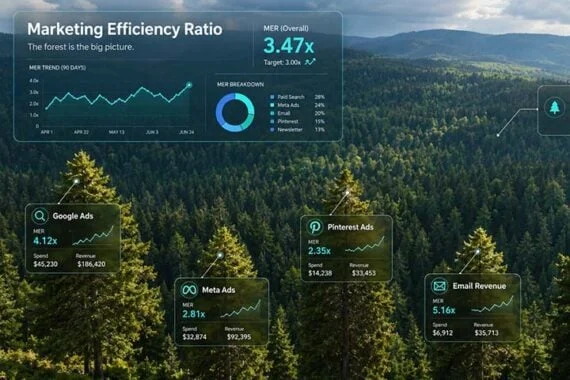
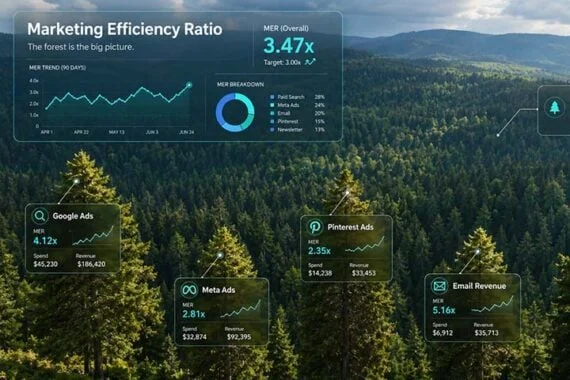
Google Ads reports a specific return on ad spend (ROAS). Meta’s dashboard tracks conversion values and cost-per-result across its ecosystem. Email marketing platforms calculate revenue per send, while affiliate networks log commissions and individual conversions. Each of these metrics acts as a "tree" in a vast, complex promotional forest. While individual tree health is essential, ecommerce leaders are increasingly realizing that focusing solely on the foliage causes them to lose sight of the forest—the overall growth and sustainability of the business.
As privacy regulations tighten and signal loss becomes the new industry standard, the industry is pivoting away from hyper-granular attribution toward a more holistic view: the Marketing Efficiency Ratio (MER).
What is MER? The Blended Reality
The Marketing Efficiency Ratio is a straightforward, macro-level indicator that compares total revenue against total marketing expenditure. It does not aim to replace channel-specific metrics like ROAS, Customer Acquisition Cost (CAC), or Lifetime Value (LTV); rather, it acts as a reality check for the entire business.
The formula is deceptively simple:
MER = Total Revenue ÷ Total Marketing Spend
For example, consider a direct-to-consumer brand that generated $500,000 in gross revenue last month while deploying a total marketing budget of $100,000—covering everything from social media ad spend and influencer fees to creative production costs and agency retainers. The brand’s MER is 5.0. This means for every dollar injected into the marketing machine, five dollars of revenue are returned.
Often referred to in industry circles as "Blended ROAS," this metric strips away the biases of platform-specific attribution models, which often inflate performance by double-counting conversions or failing to account for the "halo effect" of cross-channel interactions.
The Chronology of Attribution: From Click-Paths to Holistic Views
To understand the rise of MER, one must look at the evolution of digital advertising measurement.
- The Early Days (2000–2010): Attribution was largely "last-click." If a user clicked a Google search ad and bought a product, Google got 100% of the credit. It was simple, if inaccurate.
- The Proliferation Era (2011–2018): As social commerce and multi-channel funnels exploded, companies adopted multi-touch attribution (MTA). Tools attempted to assign fractional credit to every touchpoint in a customer journey. While mathematically elegant, these models were notoriously difficult to configure and prone to "data leakage."
- The Privacy Pivot (2019–Present): With the introduction of GDPR, Apple’s App Tracking Transparency (ATT), and the deprecation of third-party cookies, signal loss became rampant. Platform-provided data became less reliable.
- The MER Shift (2023–Forward): Facing a "black box" of data, marketers began reverting to the most reliable numbers available: total bank deposits (revenue) and total credit card charges (spend). MER emerged as the industry’s reaction to the limitations of digital tracking.
Supporting Data: When "Granular" Becomes "Misleading"
The primary argument for MER is the non-linear nature of the modern consumer journey. A typical high-value customer might follow a convoluted path:
- Monday: Discovery via a Meta ad.
- Wednesday: Engagement through an email newsletter.
- Friday: Brand awareness through an organic search query.
- Saturday: Final conversion via a direct URL visit.
In this scenario, Meta might claim a conversion, Email might claim a conversion, and Search might claim a conversion. If you aggregate the ROAS of these individual channels, you might believe you are generating $15 in revenue for every $1 spent, even if your bank account only shows $5 in revenue per $1 spent.

This discrepancy—known as "attribution stacking"—leads to dangerous budgeting decisions. If a manager relies solely on siloed ROAS, they may keep funding an underperforming channel because the dashboard tells them it is profitable, unaware that the channel is merely "stealing" credit from other sources. MER eliminates this by focusing on the total output of the entire ecosystem.
Industry Perspectives: The Experts Weigh In
Leading ecommerce consultants and financial officers have begun to standardize MER as a key performance indicator (KPI) for board-level reporting.
"ROAS is a tactic; MER is a strategy," says a prominent ecommerce growth strategist. "If you are optimizing toward a 5.0 ROAS on Facebook but your overall business MER is falling, you are essentially paying more to acquire customers who would have bought anyway. MER is the guardrail that keeps growth profitable."
However, some data scientists warn that MER is not a panacea. "The danger of MER is that it is a lagging indicator," notes a senior data analyst at a major retail consultancy. "If you turn off all your ads today, your MER will look fantastic tomorrow because you’re still getting organic traffic from previous efforts. But your revenue will eventually crater. MER must be viewed alongside volume metrics."
Implications: Building a Sustainable Budgeting Framework
Adopting MER requires a shift in how marketing teams are managed. It encourages a focus on incrementality rather than just attribution.
1. Setting the Guardrails
Companies should establish their MER thresholds based on their specific gross margins. An ecommerce brand with a 70% gross margin can afford a lower MER (e.g., 2.5) because they have more room to invest in customer acquisition. A retailer with a 25% margin must maintain a much higher MER to remain cash-flow positive.
2. Eliminating the "Blame Game"
By looking at the total picture, teams are forced to collaborate. Instead of the Meta team fighting the Email team for credit, the entire marketing department is held accountable for the collective MER. This shifts the conversation from "Which channel is best?" to "How can we increase the total efficiency of our collective spend?"
3. Identifying the Ceiling
One of the most valuable insights MER provides is the point of diminishing returns. When a company increases its spend and notices that the MER begins to drop, it is a clear signal that they have exhausted their high-intent audience. This is the "efficiency ceiling." By tracking this, marketers can avoid the trap of "buying" revenue at a loss just to hit top-line growth targets.
Conclusion: The Forest and the Trees
The Marketing Efficiency Ratio is not an admission of defeat against the complexities of modern tracking. It is a mature, pragmatic approach to business management. In an era where "perfect" attribution is a mathematical impossibility, MER provides a reliable, truthful, and actionable view of the bottom line.
By all means, keep monitoring the individual ROAS of your campaigns—the "trees" still need pruning. But when it comes time to plan budgets, determine profitability, and report to stakeholders, look up. The forest is what determines the long-term survival of the business. For the modern ecommerce operator, the path to sustained growth is not paved with better pixels, but with a clearer understanding of the big picture.