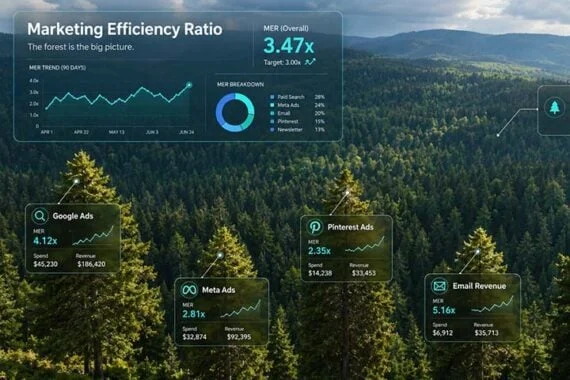
In the modern ecommerce ecosystem, data is abundant, yet clarity is increasingly elusive. Despite the proliferation of AI-fueled tracking tools, sophisticated attribution models, and granular analytics suites, many digital merchants find themselves paralyzed by the "attribution gap." Every platform—from Google Ads and Meta to email service providers and affiliate networks—claims credit for the same sale, leaving marketing teams to navigate a complex, often contradictory, landscape of metrics.
While ROAS (Return on Ad Spend) and CAC (Customer Acquisition Cost) remain standard industry benchmarks, they are effectively "trees" in a vast, dense forest. Focusing too intently on individual trees can obscure the health of the entire ecosystem. To truly understand the efficacy of an ecommerce business, leaders are increasingly turning to a holistic, top-line indicator: the Marketing Efficiency Ratio (MER).
The Attribution Dilemma: Why Granular Data Can Be Misleading
The fundamental issue with modern digital marketing is that the customer journey is no longer linear. A typical shopper might discover a brand through an influencer’s Instagram post, research the product via a Google search, receive a retargeting ad on Facebook, and finally convert after clicking a promotional email.
In this scenario, every individual platform will attempt to claim the conversion. Meta will report a purchase; Google will report a click-through conversion; the email platform will report a successful campaign. When summed together, these platform-reported conversions often exceed the actual number of orders the business received. This "double-counting" creates a false sense of security, often leading brands to over-allocate budget to channels that appear highly efficient in isolation but contribute little to net business growth.
The Rise of the "Blended" Mindset
As privacy regulations like Apple’s App Tracking Transparency (ATT) continue to erode the effectiveness of pixel-based tracking, the reliance on platform-specific attribution is becoming a liability. Marketers are shifting away from the "siloed" view—where every dollar is scrutinized for its immediate, direct impact—toward a "blended" mindset. This is where MER enters the equation, acting as a stabilizing force in an increasingly volatile measurement environment.
What Is the Marketing Efficiency Ratio (MER)?
At its core, the Marketing Efficiency Ratio is a straightforward, non-negotiable metric: it compares total revenue to total marketing spend. It does not attempt to untangle the messy web of individual channel performance. Instead, it asks the most important question a business owner can pose: For every dollar we pour into the engine of marketing, how much revenue are we extracting from the tailpipe?
The Calculation
The beauty of MER lies in its simplicity. The formula is:
MER = Total Revenue / Total Marketing Spend
Consider a scenario: An ecommerce brand generates $500,000 in gross revenue for the month of June. To achieve this, they spent $100,000 across the board—including Meta ads, Google Search, agency retainers, influencer fees, and affiliate commissions. The MER is 5.0.
This means for every $1 spent, the business generates $5 in top-line revenue. This "blended ROAS" provides an immediate temperature check on the business’s overall financial health.
Chronology of the Shift: From Platform-Centric to Business-Centric
To understand why MER has gained such traction, one must look at the evolution of ecommerce measurement over the last decade:
- The "Last-Click" Era (2010–2016): Marketing was dominated by simple attribution. If a user clicked a Google ad, the sale was attributed to Google. It was flawed but easy to understand.
- The "Omnichannel" Explosion (2017–2021): Brands began scaling across dozens of platforms. Attribution modeling (First-click, Linear, Time-decay) became the industry standard, attempting to give partial credit to each touchpoint.
- The "Privacy-First" Realignment (2022–Present): With the death of third-party cookies and the limitations placed on tracking pixels, attribution models began to break down. Advertisers realized that if they couldn’t track everything, they had to start measuring the one thing they could verify: the bottom line.
This evolution has forced a paradigm shift: from trying to track the "how" (the specific path a user took) to verifying the "what" (did the total revenue justify the total cost?).

Supporting Data: When to Use MER vs. ROAS
While MER is the North Star, it does not replace the need for ROAS. Instead, they serve two distinct purposes in the marketing hierarchy.
ROAS (The Tactical Tool)
- Purpose: Measures channel-specific performance.
- Application: Useful for day-to-day optimizations, such as pausing an underperforming ad creative, adjusting keyword bids in Google Ads, or identifying which audience segment is responding to a Facebook campaign.
- Limitation: Highly susceptible to attribution bias and platform inflation.
MER (The Strategic Tool)
- Purpose: Measures business-wide marketing sustainability.
- Application: Useful for budgeting, setting growth targets, and determining the "profitability threshold."
- Advantage: Immune to the "attribution wars" between platforms. It is the absolute source of truth for the CFO.
The Inputs: Building an Accurate MER
The effectiveness of MER is entirely dependent on the integrity of the data inputs. If a company excludes "hidden" costs, the ratio becomes a vanity metric that masks inefficiency. To calculate a true MER, the "Total Marketing Spend" must include:
- Paid Media Spend: All ad spend across social, search, display, and video platforms.
- Content & Creative: Costs associated with video production, graphic design, and copywriting.
- Agency & Contractor Fees: The cost of the human labor required to execute the strategy.
- Tech Stack Costs: The monthly fees for email platforms, SMS marketing tools, and attribution software.
- Affiliate & Influencer Commissions: All payouts to partners for driving sales.
Pro-Tip: Consistency is paramount. Once a business defines its cost categories for MER, it must stick to that definition month-over-month. Changing the inputs midway through a quarter will invalidate the ability to compare performance trends.
Implications for Budgeting and Scaling
Perhaps the most significant implication of adopting MER is how it changes the budgeting process. Rather than debating whether to cut 5% from Facebook to give to Google, marketing leaders can use MER as a guardrail for total spend.
Establishing the "Efficiency Guardrails"
Most ecommerce businesses will have a "Golden Range" for their MER:
- The Profitability Zone: If a company operates with a 70% gross margin, a 3.0 MER might be the break-even point. Anything above 3.0 is profit; anything below 3.0 is a loss.
- The Growth Zone: If the business has high lifetime value (LTV) and high repeat-purchase rates, leadership might intentionally aim for a lower MER (e.g., 2.5) to capture more market share, knowing that the long-term value of the customers acquired will compensate for the lower initial efficiency.
- The Danger Zone: If the MER falls below the business’s specific sustainability threshold, it is a flashing red light. It indicates that the company is "buying revenue" at a rate that is mathematically unsustainable.
Official Industry Perspectives
Marketing analysts and growth consultants have largely endorsed the "blended" approach as a necessary reaction to the changing digital landscape.
"We’ve moved into an era where we have to stop pretending we can track every single user journey with 100% precision," says Sarah Jenkins, a lead analyst in digital performance. "MER isn’t just a metric; it’s a philosophy. It’s an admission that the forest matters more than the individual trees. If the forest is dying, it doesn’t matter how healthy one individual tree is."
Conversely, some critics argue that relying only on MER can lead to "lazy marketing." They warn that if a team only looks at the blended total, they might continue to pour money into channels that are actually failing, while starving channels that are underperforming but have high potential. The consensus remains that MER should act as the master metric, while ROAS continues to function as the diagnostic tool for tactical adjustments.
Conclusion: Seeing the Forest
The Marketing Efficiency Ratio is the ultimate equalizer in the ecommerce world. It strips away the complexity, the vendor promises, and the algorithmic noise, leaving behind the stark reality of business performance.
By prioritizing MER, ecommerce teams can shift their focus from arguing over attribution credits to focusing on what truly drives the business: sustainable, profitable growth. While the "trees" of Google, Meta, and email will always require attention and maintenance, the MER ensures that the "forest" remains healthy, growing, and—most importantly—profitable.
In an industry defined by its constant state of flux, MER provides the one thing every merchant craves: a clear view of the big picture.