In the highly competitive landscape of digital advertising, maximizing return on ad spend (ROAS) while capturing every viable lead is a continuous balancing act. Search engine marketers (SEMs) must constantly assess whether their campaigns are underfunded or underbid, often relying on complex calculations of Impression Share to estimate what they might have left on the table.
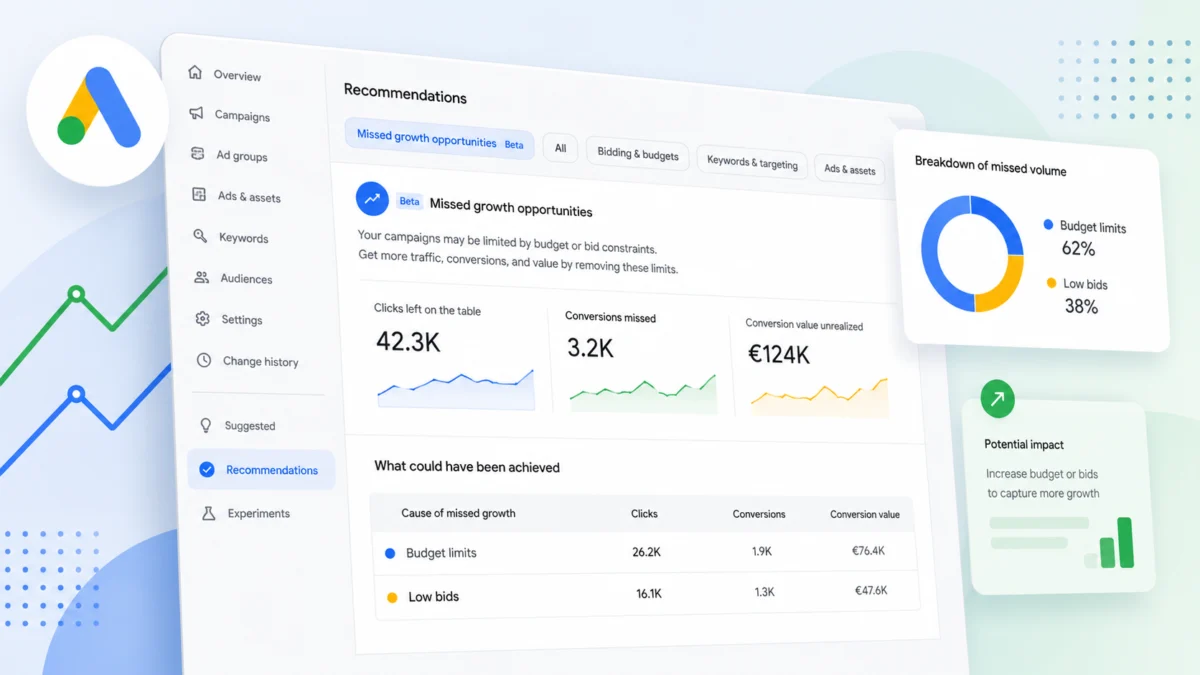
To streamline this diagnostic process, Google Ads has officially begun rolling out its "Missed Growth Opportunity" insights as a new beta feature directly integrated into the platform’s primary Recommendations tab. This update transitions the tool from an experimental sandbox into a mainstream optimization utility, providing advertisers with a clearer, more prominent view of the traffic, conversions, and revenue they may be forfeiting due to budget constraints or low bids.
This strategic migration signals Google’s ongoing commitment to making predictive performance metrics highly visible and actionable. However, as with all automated recommendations, the feature has sparked debate among pay-per-click (PPC) professionals regarding the accuracy of Google’s modeling and the strategic implications of acting on these insights.
1. Main Facts: The Integration of Missed Growth Insights
The new beta feature surfaces estimated missed performance metrics directly alongside Google’s existing suite of optimization recommendations. Previously, accessing these specific predictive datasets required navigating to "Google Ads Labs"—a testing ground for experimental features. By moving these insights into the core Recommendations tab, Google is making predictive growth modeling a standard part of the daily campaign management workflow.
+--------------------------------------------------------------------------+
|                        GOOGLE ADS RECOMMENDATIONS                        |
+--------------------------------------------------------------------------+
|  [Existing OptiScore Recommendations]                                    |
|                                                                          |
|  *NEW BETA RECOMMENDATION*                                               |
|  "Increase budget / Raise bids to capture Missed Growth Opportunities"   |
|                                                                          |
|  Estimated Unrealized Potential:                                         |
|  ├── Missed Conversions: +15%                                            |
|  ├── Missed Revenue: $4,500                                              |
|  └── Missed Traffic (Clicks): +1,200                                     |
|                                                                          |
|  Primary Bottleneck Identified:                                          |
|  [X] Insufficient Budget  [ ] Low Keyword Bids                           |
+--------------------------------------------------------------------------+
Key Elements of the Beta Feature:
- Quantified Missed Performance: The tool estimates the exact volume of traffic (clicks), conversions, and revenue that went uncaptured over a specified historical period.
- Granular Bottleneck Attribution: It explicitly categorizes whether the missed opportunities were caused by budget limitations (campaigns capped by daily limits) or bid limitations (bids too low to win competitive auctions).
- Direct Actionability: Advertisers can view simulated projections of how increasing their budgets or adjusting their target Cost Per Acquisition (CPA) or Return on Ad Spend (ROAS) targets would affect their bottom line.
Currently, this beta is being rolled out to eligible advertisers globally. Eligibility depends on campaign types, historical spend levels, and whether the account has accumulated sufficient conversion data to fuel Google’s machine learning projection models.
2. Chronology: From Experimental Labs to Core Infrastructure
To understand the significance of this update, it is necessary to trace how Google Ads has historically presented budget and bid recommendations to its users.
   [2020 - 2022]
   Google introduces Optimization Score (OptiScore) and basic "Limited by Budget" alerts.
         │
         ▼
   [Mid-2023]
   Google Ads Labs launches "Missed Growth Opportunity" as an opt-in, experimental tool.
         │
         ▼
   [July 2026]
   "Missed Growth Opportunity" graduates from Labs to the main Recommendations tab as a Beta.
The Era of "Limited by Budget" (Pre-2023)
For years, the primary indicator of missed opportunity in Google Ads was the red "Limited by Budget" status warning. While this alert notified advertisers that their campaigns were shutting off prematurely during the day, it offered relatively simplistic projections. Advertisers had to rely on the Search Impression Share Lost (Budget) metric and manually calculate potential returns, or use basic bid simulators that lacked deep integration with revenue and conversion modeling.

The Launch of Google Ads Labs (Mid-2023)
Recognizing the need for more sophisticated, forward-looking forecasting, Google introduced "Google Ads Labs." This section allowed power users to opt into experimental features before they were fully integrated into the platform’s main UI. Within this environment, Google debuted the "Missed Growth Opportunity" tool. It combined auction dynamics, historical performance, and predictive machine learning to give a more holistic view of unrealized revenue.
Transition to Core Recommendations (Present Day)
The transition of this tool from Google Ads Labs to the main Recommendations tab represents the final phase of its product development cycle. By embedding these insights into the main interface, Google has officially graduated the feature from an experimental curiosity to a primary optimization lever.
This move aligns with Google’s broader multi-year strategy to centralize account management under automated, AI-driven recommendations and the ubiquitous Optimization Score (OptiScore).
3. Technical Breakdown & Supporting Data: How the Estimates Work
To effectively utilize these recommendations, advertisers must understand the underlying mechanics of how Google calculates these "missed" metrics. The platform does not simply guess these numbers; instead, it runs continuous, real-time auction simulations.
The Simulation Engine
Google’s system analyzes the ad auctions in which an advertiser participated over the previous 7 to 14 days, alongside the auctions they could have participated in had their budget or bids been higher.
[Available Search Volume]
  ├── [Captured Impression Share]  --> Resulted in actual clicks & conversions
  └── [Lost Impression Share]
        ├── Lost due to Budget  --> Triggers "Increase Budget" recommendation
        └── Lost due to Rank    --> Triggers "Raise Bids/Targets" recommendation
The system evaluates:
- Search Impression Share Lost (Budget): The percentage of time an ad did not appear because the daily campaign budget was exhausted.
- Search Impression Share Lost (Rank): The percentage of time an ad did not appear due to low Ad Rank, which is heavily influenced by bid thresholds and Quality Score.
- Historical Conversion Rates: The campaign’s average conversion rate and average order value (AOV) are applied to the projected missed clicks to calculate "Missed Conversions" and "Missed Revenue."
Distinguishing Between Budget and Bid Bottlenecks
The tool’s primary value lies in its ability to isolate the specific constraint holding a campaign back:

| Constraint Type | Cause | Google’s Solution | Risk Factor |
|---|---|---|---|
| Insufficient Budget | Campaign budget is too low; ads stop showing midday. | Increase daily budget to match search demand. | May result in higher overall spend without a guaranteed increase in conversion efficiency. |
| Insufficient Bids | Smart Bidding targets (tCPA/tROAS) are too restrictive; ads lose auctions to competitors. | Loosen tCPA (increase) or tROAS (decrease) targets. | Can lead to a higher cost-per-acquisition (CPA) and lower overall profitability per sale. |
4. Industry Reaction and Expert Analysis
The PPC community has reacted to the update with a mixture of interest and characteristic skepticism. The rollout was first highlighted publicly by prominent PPC expert Thomas Eccel, who noted on LinkedIn that the feature is a direct, rebranded integration of the former Google Ads Labs tool.
The Consensus Among Search Marketers
While digital marketers appreciate having access to more granular forecasting data, many advise caution. The prevailing sentiment is that while these insights are highly useful for directional planning, they should not be treated as absolute guarantees.
Industry experts point out several critical caveats:
- The "More Spend" Bias: Google’s recommendations are naturally biased toward encouraging advertisers to increase their spend. An recommendation to increase budget will always result in higher revenue for Google, but it may not always align with the advertiser’s strict marginal profitability goals.
- Diminishing Returns: Google’s models often assume a linear, or near-linear, scaling of conversion rates. In reality, as budget and bids increase, campaigns often experience diminishing returns, where the cost of acquiring the next conversion (marginal CPA) rises significantly.
- Data Latency and Attribution: The modeled estimates rely heavily on historical conversion tracking. If an account has tracking discrepancies, or if it uses a first-click attribution model that over- or under-values certain touchpoints, the "Missed Revenue" projections will be fundamentally flawed.
5. Strategic Implications for Advertisers and Brands
The integration of "Missed Growth Opportunity" insights into the main Recommendations tab will undoubtedly influence how brands allocate their digital marketing budgets. To navigate this update successfully, marketing teams should establish a structured validation framework rather than blindly adopting Google’s suggestions.
          [Identify Recommended Opportunity]
                         │
                         ▼
          [Check Historical Impression Share]
           Is Lost IS (Budget) > 20%?
             ├── YES: Proceed to test
             └── NO: Re-evaluate bid/targeting strategy
                         │
                         ▼
          [Run Controlled Experiment (A/B Test)]
           Allocate 50% budget to trial campaign
                         │
                         ▼
          [Evaluate Marginal ROI, not just Volume]
           Did additional conversions justify the increased CPA?
Actionable Best Practices for SEM Managers
- Verify Before Scaling: Do not auto-apply these recommendations. Treat them as hypotheses. If Google claims a campaign missed out on $5,000 in revenue, set up a controlled Google Ads Experiment (A/B test) to allocate a higher budget to 50% of the traffic and measure the actual lift in a sandboxed environment.
- Analyze Marginal ROI: When evaluating the potential of increasing bids or budgets, focus on the marginal cost per conversion. If increasing your budget by 50% only yields a 10% increase in conversions, your marginal CPA for those new conversions is exceptionally high, which may erode your overall profitability.
- Optimize Quality Score First: Before raising bids to capture missed growth due to Ad Rank, focus on improving ad relevance, landing page experience, and expected click-through rate (CTR). Improving these Quality Score components can reclaim missed impression share without requiring an increase in monetary bids.
- Align with Inventory and Operations: Ensure that your business can actually support the projected growth. For e-commerce brands, a sudden influx of conversions is useless if the product is out of stock. For lead-generation businesses, ensure the sales team has the capacity to handle a higher volume of inbound leads without a drop in close rates.
The Bottom Line
Google’s integration of "Missed Growth Opportunity" into the core Recommendations tab is a double-edged sword. On one hand, it democratizes advanced performance forecasting, giving advertisers a highly visible tool to identify where budget bottlenecks are choking potential revenue. On the other hand, it intensifies the platform’s push toward automation and increased spending.
Ultimately, the advertisers who benefit most from this update will be those who treat Google’s modeled estimates as directional clues, validating every recommendation against their own first-party data and business unit economics before scaling their ad spend.