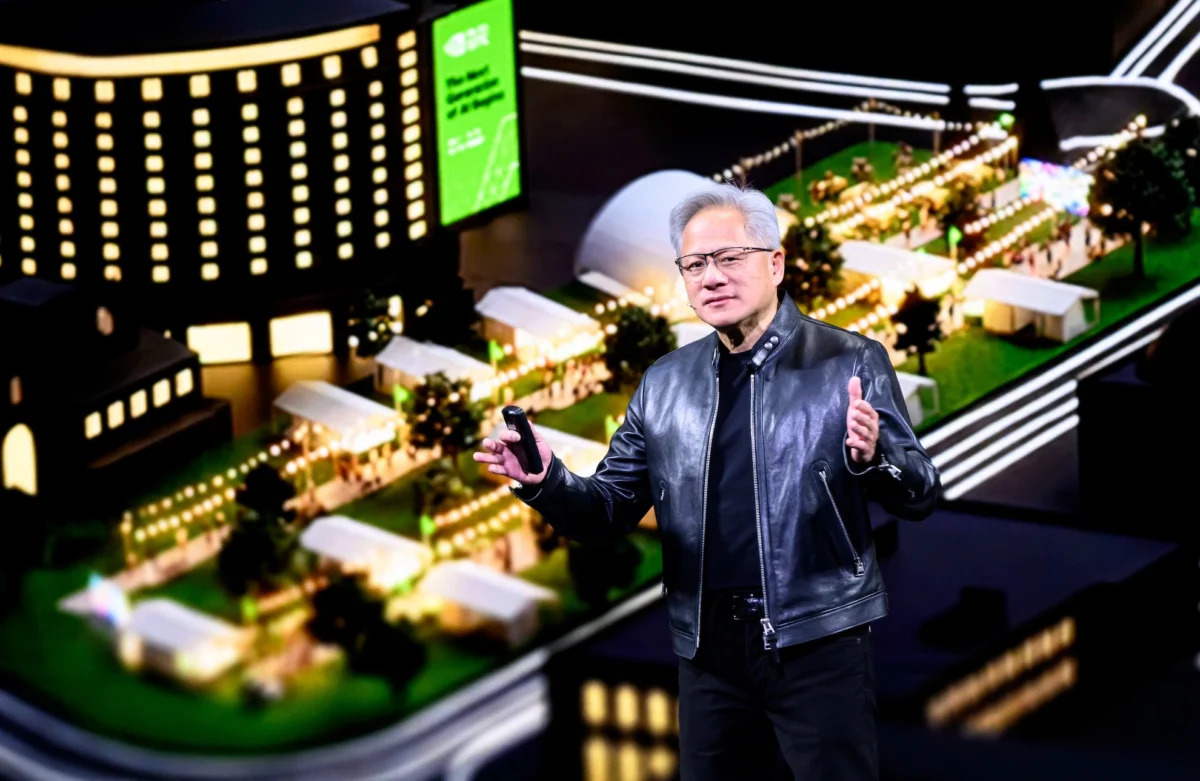
At the Goldman Sachs Communacopia + Technology conference this past Thursday, Nvidia CEO Jensen Huang stood before a room of investors and analysts, projecting a level of confidence that has become his hallmark. As the architect of the modern AI revolution, Huang did more than provide a financial update; he offered a masterclass in market dominance. Despite the growing chorus of skeptics questioning whether the Nvidia "party" is nearing its expiration date, Huang maintained that the company’s record-breaking growth is not a bubble, but the beginning of a sustained industrial transformation.
The Evolution of the "Chip": Redefining the Product
To understand the scale of Nvidia’s current operations, one must first discard the outdated notion that the company is simply a "chip maker." During his keynote, Huang addressed the persistent misconception that Nvidia’s output consists of individual units sold to PC hobbyists, as it did in the early 2000s.
"Most people think Nvidia builds a chip," Huang told the audience. "I mean, you need airplanes to ship what we build."
The modern Nvidia product is a monolith. Huang pointed to the company’s latest flagship systems—such as the GB200 NVL72—as the new standard for computing. This massive computer system, which integrates 36 Grace CPUs with 72 Blackwell GPUs, represents a fundamental shift in value proposition. "One GPU now is not $399," Huang remarked. "It’s $8.5 million. That’s one GPU, all connected with NVLink, 2 million parts, right? 250,000 kilowatts. That’s a GPU, and we ship thousands of them."
By pivoting from selling discrete components to selling complete data-center-scale infrastructure, Nvidia has effectively become the "general contractor" of the AI age. This transition allows the company to capture the lion’s share of the value chain, as clients are no longer just buying hardware; they are buying the foundational capacity required to train the world’s most advanced large language models.
Chronology of an Unprecedented Fiscal Run
Nvidia’s journey to its current valuation has been characterized by a series of logarithmic leaps.
- The Gaming Era: For years, Nvidia was synonymous with GeForce graphics cards, dominating the gaming market and establishing the CUDA software platform, which would later prove to be the company’s "moat."
- The AI Awakening: Around 2012, researchers began utilizing GPUs for deep learning. Nvidia recognized this pivot early, doubling down on the data center segment.
- The Generative AI Boom: With the release of ChatGPT in late 2022, the demand for high-end compute exploded. Nvidia’s H100 chips became the "gold" of the AI gold rush.
- The Current Phase (2024–2025): The company is currently executing the rollout of the Blackwell architecture. As noted in the company’s most recent earnings call, the demand for these systems is so high that the company is experiencing a 27% month-to-month sales growth on its flagship data center offerings.
- The 2026 Outlook: Looking ahead, Huang has set an ambitious target: 70% year-over-year revenue growth. Given that the company is projected to end the current fiscal year with approximately $400 billion in revenue, such growth would propel the company toward a staggering $680 billion revenue milestone next year.
Supporting Data: The Visibility Advantage
How can a CEO predict such precise, astronomical growth in a volatile tech market? According to Huang, it is a matter of visibility. Because Nvidia is deeply embedded in the supply chains of every major cloud provider, OEM, and AI-native startup, the company possesses a "panoptic" view of the global AI landscape.
"We’re tracking every single gigawatt of land, power, shell around the world," Huang explained. "Literally everything on the planet."
When he refers to "shells," he is talking about the physical infrastructure of data centers currently under construction. By monitoring the power capacity, cooling systems, and physical floor space being commissioned globally, Nvidia can predict exactly how many of its chips will be required to fill those spaces. This telemetry, provided by a network of partners ranging from hyperscalers like Amazon, Microsoft, and Google to emerging "neocloud" providers, gives Nvidia a structural advantage that competitors find difficult to emulate.
Official Responses and the "Circular Deal" Controversy
One of the most pressing questions facing Nvidia is the criticism surrounding "circular financing"—a practice where the company invests in AI startups, which then utilize that capital to purchase Nvidia hardware. Critics have drawn unfavorable comparisons to the collapse of telecom giant Lucent Technologies during the dot-com era, where inflated revenue cycles led to systemic failure.
Huang’s response to these allegations was characteristically blunt and dismissive of the "circular" label. "Well, it’s not circular because we put a little bit of money in, and a lot of money comes back," he joked, framing the investment strategy as a highly lucrative capital allocation exercise. "I look at the spreadsheet, we put in $1 and $100 comes back in. Is that circular? If that is, let’s do more of that."
Beyond the humor, Huang provided a structural defense: Nvidia conducts rigorous due diligence before any investment. He noted that the company has verified $100 billion in real, contracted revenue across its ecosystem. "I’m not taking any risks," Huang stated firmly. "I need a sure thing."
Implications: The Looming Shadow of Disruption
While Nvidia’s current position is one of unparalleled strength, the history of technology is littered with companies that fell because they assumed their status was permanent. The rise of competitors like Cerebras, which recently went public, and specialized startups like Etched, signals that the market is attempting to break the Nvidia monopoly.
The threat of "vertical integration" is the most significant long-term risk. Amazon, Microsoft, and Google are all actively developing their own proprietary AI chips (TPUs, Maia, Inferentia). If these hyperscalers succeed in building internal infrastructure that matches Nvidia’s performance-per-dollar, the demand for Nvidia’s general-purpose GPUs may soften.
Furthermore, the current AI market is heavily dependent on venture-backed startups that are burning through cash to secure compute resources. As the industry matures, the focus will shift from "growth at all costs" to "efficiency and ROI." When companies begin to optimize their models to run on fewer tokens and less compute, the insatiable demand for Nvidia’s high-power hardware could face a cooling period.
Conclusion: A Foundation, Not Just a Vendor
Despite these risks, Huang’s argument remains compelling. He describes Nvidia not as a component vendor, but as a "foundational platform" for the AI industry. Whether it is a research lab, a massive cloud provider, or a nimble startup, the current consensus is that there is no substitute for the Nvidia ecosystem.
As the tech industry moves into the latter half of the decade, the question is no longer whether Nvidia can maintain its current growth, but how it will manage the transition from a "growth-at-all-costs" startup phase to an industrial utility phase. For now, Jensen Huang’s view of the future is clear: the demand for compute is global, the power requirements are being met, and as long as AI remains the primary driver of technological progress, Nvidia plans to be the company that powers it all.
While all great things in tech eventually face disruption, Nvidia has effectively woven itself into the fabric of the digital economy. For the foreseeable future, it appears the "party" is only just entering its next phase of expansion.