Beyond Compliance: Why the Tech Industry Must Prioritize "Equivalent Experiences" in Digital Accessibility
In the fast-paced world of digital product development, the technology sector exhibits a persistent, structural bias: it prioritizes how things are built while largely ignoring why they are built, and crucially, who they are built for.
While multi-device ecosystems featuring smartphones, augmented reality, voice assistants, and Internet of Things (IoT) sensors dominate daily life, the industry-standard baseline for product testing remains overwhelmingly centered on desktop computers, pristine high-speed internet connections, and users without disabilities. This narrow focus reflects deeply ingrained design biases.
At the heart of the digital accessibility movement lies a guiding principle that challenges this status quo: the pursuit of the "equivalent experience." Conceived to push the industry beyond bare-minimum technical compliance, this philosophy dictates that digital spaces must be deliberately designed and engineered to be used with equal effectiveness by the widest possible range of people, regardless of ability or device.
Main Facts: Defining the Equivalent Experience
To understand the scope of the problem, digital accessibility practitioners emphasize that an accessible experience is not automatically an equivalent one.
An accessible experience might technically allow a user with a disability to accomplish a task, but only after forcing them through a digital equivalent of a Rube Goldberg machine. When poorly designed interfaces force users with motor control, visual, or cognitive disabilities to navigate a labyrinth of workarounds, the human toll is immense. The extra time, physical strain, and cognitive load required to operate a frustrating interface can exacerbate physical conditions (such as arthritis) or completely exhaust a user’s mental and physical energy.
Conversely, an equivalent experience preserves intent. It ensures that the core motivation behind a website, web application, or digital service—along with all its content and features—is understood and executed with equal ease by everyone.
Yet, industry practice frequently falls short. Common failures include:
Non-responsive web design: Websites designed strictly for desktops that force mobile smartphone users to endlessly pinch, pan, and zoom.
Locked screen zooming: Native mobile applications that prevent users from enlarging text, effectively locking out individuals with low vision.
Unregulated advertising: Autoupdating feeds and flashing animations that disrupt screen readers and trigger migraines, seizures, or severe distractions for users with ADHD.
Chronology: The Evolution of Digital Rights and Legal Precedents
The push for digital equality has transitioned rapidly from an ethical ideal into a strict legal reality, backed by landmark court rulings and mounting public advocacy:
1984–2019: For decades, assistive technology users—such as Kenny Hitt, who began using screen readers in 1984—have faced systemic digital barriers, often resorting to custom browser extensions (like Midnight Lizard for color contrast and ad blockers) as a form of consumer self-defense against inaccessible web design.
June 2017: In a historic first-of-its-kind trial (Winn-Dixie), a federal court ruled against a major retailer for maintaining an inaccessible website, affirming that websites heavily integrated with physical store locations violate the Americans with Disabilities Act (ADA).
September 2019: The United States Supreme Court declined to hear an appeal in the landmark Domino’s Pizza franchise case. The foundational ruling established that preventing individuals from using a website or app simply because they rely on screen-reading software is unconstitutional, cementing legal precedent for private companies facing civil rights lawsuits over digital barriers.
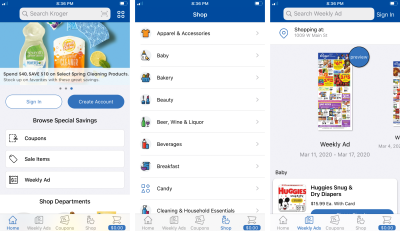
2019–2020: Major digital redesigns—such as a June 2019 update to the Kroger grocery app—inadvertently broke accessibility compliance, prompting sustained pushback from consumer advocates demanding accountability. Meanwhile, parallel regulations advanced across the European Union and parts of Asia to safeguard digital access as a protected human right.
Supporting Data: The Hidden Market and Billions in Lost Revenue
For organizations that remain unswayed by civil rights arguments or ethical obligations, market research offers an undeniable financial imperative: accessibility is a massive economic opportunity.
Data collected across major global studies underscores the immense purchasing power being actively alienated by poor digital design:
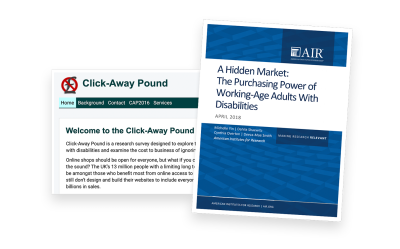
The Click Away Pound Survey: This comprehensive study tracking the online shopping habits of people with disabilities revealed that more than 4 million consumers abandoned retail websites due to insurmountable access barriers. This friction equates to an estimated £17.1 billion (~$21.1 billion USD) in lost annual revenue for UK businesses alone.
The American Institutes for Research (AIR): A landmark 2018 study titled The Purchasing Power of Working-Age Adults With Disabilities discovered that working-age adults with disabilities command an estimated $490 billion in disposable income.
Despite these figures, digital exclusion remains rampant. When e-commerce platforms, municipal water billing portals, and government job application systems feature broken workflows—such as utilizing clickable div elements instead of accessible buttons—they systematically bar qualified citizens from participating fully in society.
Official Responses and Industry Accountability
User testimony reveals a troubling disconnect between corporate developers and the individuals relying on their products.
When users encounter accessibility roadblocks and attempt to report them, the response is frequently disheartening. Feedback is routinely downplayed, ignored, or routed to marketing departments that lack both the technical understanding and the institutional power to implement fixes.
As software veteran Kenny Hitt notes, persistent encounters with dismissive corporate attitudes ultimately drive users away:
"When I run into accessibility issues nowadays, I’ll try reporting it… when I get the usual response from the feedback of the person not caring, I just give up and walk away. There’s no point in trying to teach these people about accessibility."
Industry advocates emphasize that handling accessibility feedback requires the same urgency and structured triage applied to any critical software bug. Best practices for organizational response include:
Acknowledging reports promptly and routing them directly to engineering and design teams rather than customer service brush-offs.
Treating accessibility regressions as critical functional defects that block core user flows.
Refusing to rely on manual workarounds (such as assigning a staff member to handle tasks via email on behalf of an assistive tech user), which strips users of their fundamental autonomy and privacy.
Implications: Moving Past Minimal Compliance
Complying with the ADA or local digital standards represents, by definition, the legally required minimum for accessibility. Compliance alone does not guarantee a good user experience, true usability, or genuine innovation.
When digital interfaces are built with a rigid adherence to personal developer biases—summarized by the digital equivalent of "it works on my machine"—they alienate vast segments of the population. Furthermore, the psychological toll of navigating inaccessible systems forces many users to abandon platforms entirely, internalizing the system’s failure as a personal shortcoming.
As digital systems continue to absorb essential public and private services—ranging from grocery delivery and banking to employment assessments—ensuring equivalent experiences is no longer optional. It is a fundamental professional obligation. By questioning default design assumptions, treating accessibility reports with institutional seriousness, and viewing inclusion as a driver of market innovation, the technology sector can finally build a digital landscape that works for everyone.