The rapid evolution of artificial intelligence has profoundly disrupted the software development landscape, challenging decades of established engineering paradigms. As large language models (LLMs) transition from novel curiosities to core components of everyday web development, developers are forced to grapple with a new reality: one defined by non-deterministic outputs, shifting workflows, and the delicate balance between creative acceleration and system integrity.
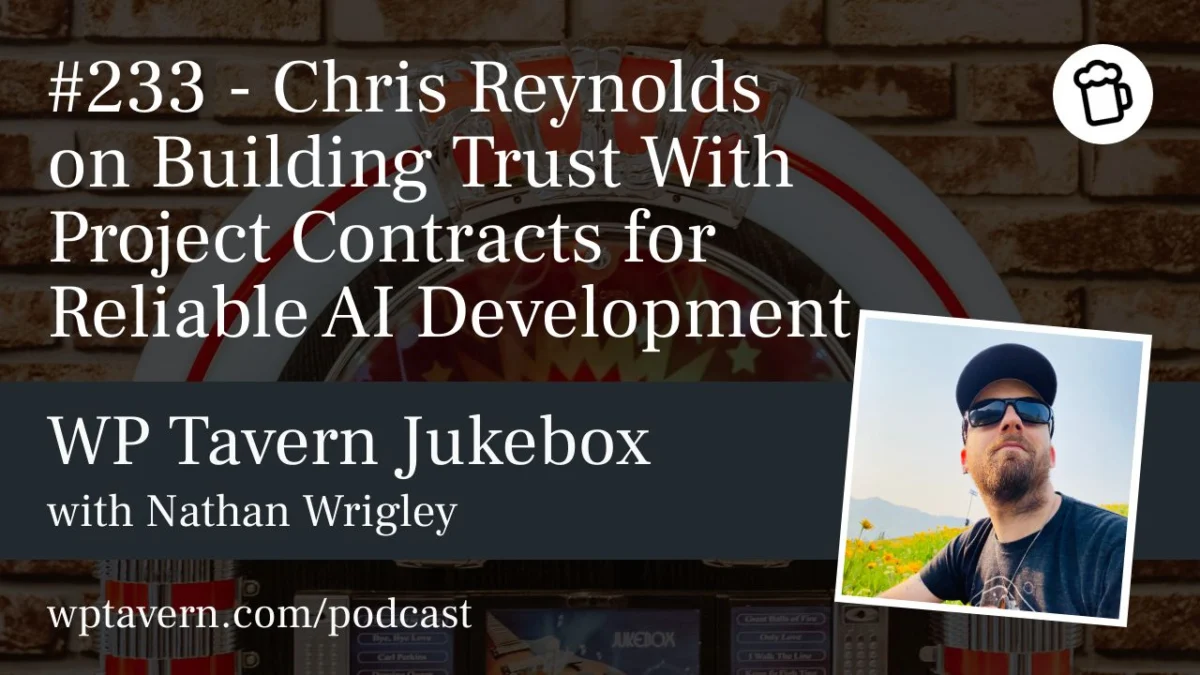
In a recent episode of the Jukebox Podcast by WP Tavern, host Nathan Wrigley sat down with Chris Reynolds, Senior Manager of Developer Relations at Pantheon. Drawing from his extensive two-decade background in the WordPress ecosystem and his recent WordCamp US presentation—titled "Parenting Claude: Guardrails for AI-Assisted Development"—Reynolds offered a candid look at how developers can harness the power of LLMs like Claude without losing control of their codebases.
Main Facts
- The Core Dilemma: LLMs are inherently non-deterministic and optimized to find the fastest computational path from point A to point B. Without strict boundaries, this efficiency can lead to shortcuts, ignored specifications, and compromised code quality.
- The Solution—Project Contracts: Reynolds introduced the concept of a "project contract"—a structured set of rules, documentation, and markdown files (
Claude.md,agents.md) embedded directly into a repository to dictate how an AI model must behave. - Automated Enforcement: To ensure compliance, Reynolds utilizes automated reviewer agents and pre-commit hooks that force AI-generated code to pass rigorous multi-point checklists before a commit can be executed.
- Democratization of Tech: AI tools have lowered the barriers to entry, enabling non-traditional developers ("vibe coders") to build functional web applications and experiment with complex technologies much faster than previously possible.
- The Developer Relations (DevRel) Perspective: Reynolds emphasizes that bridging the gap between complex emerging tech and the human developer community is crucial for establishing sustainable industry best practices.
Chronology: From Novelty to Necessary Workflow
The journey of AI in software development has moved at a staggering pace. To understand the current climate, it helps to examine how the relationship between developers and machine learning has evolved over recent years:
- 2021–2022 (The Early Era): AI-assisted text and code generation were in their infancy. Outputs were frequently erratic, reminiscent of early experimental text bots, and largely viewed as novelties rather than production-grade utilities.
- Late 2024–2025 (The Capability Leap): Major updates across foundational LLMs drastically improved their proficiency in coding languages. Tools like Claude Code transformed from simple chatbots into fully capable terminal assistants, allowing developers to generate functional scripts and user interfaces rapidly.
- August 2026 (The Current Frontier): As showcased at WordCamp US, the industry has shifted past the initial wonder of code generation. Developers are now focusing heavily on governance, workflow constraints, and automated oversight—moving from simply asking AI to write code to actively "parenting" the models through rigid programmatic contracts.
Supporting Data and Technical Architecture
The technical core of Reynolds’ workflow revolves around eliminating the unguided nature of LLMs. When deploying AI agents for tasks such as building a Next.js website on Pantheon, raw prompts alone are insufficient.
The Mechanics of a Project Contract
- Contextual Configuration: At the start of a session, Claude reads a designated
Claude.mdfile in the project directory, absorbing project-specific rules, architectural constraints, and styling guidelines. - Test-Driven Development (TDD) Mandate: Reynolds instructs the AI to utilize TDD, requiring the model to write automated unit tests before writing the implementation code. This ensures that any subsequent refactoring or automated corrections will immediately trip failing tests if regressions occur.
- The Reviewer Agent: Rather than relying solely on manual line-by-line human code review (which becomes impractical given the sheer volume of AI-generated output), a secondary reviewer agent is spawned automatically.
- The Pre-Commit Gate: A comprehensive checklist—spanning over 40 distinct criteria, including accessibility compliance, build validation, linting, and security audits—must be satisfied. Crucially, the system checks to ensure that no sensitive data or API keys are accidentally written to the file system. If the checklist passes, an approved timestamp file is generated; without it, pre-commit hooks block any code integration.
Official Perspectives and Industry Responses
The broader developer community remains sharply divided on the long-term implications of heavy AI integration.
- The Optimist View (Creativity and Play): Advocates like Reynolds argue that letting AI handle the tedious mechanics of writing syntax allows developers to refocus on high-level architecture and creative problem-solving. It revitalizes a sense of playfulness, granting individuals the ability to prototype complex applications in hours instead of weeks.
- The Skeptic View (The Black Box and the Junior Developer Crisis): Critics and traditional engineers voice deep-seated concerns regarding non-determinism. Because LLMs operate as a "black box" with hidden decision-making paths,完全 trusting generated code introduces unseen vulnerabilities.
Furthermore, a profound philosophical question looms over the industry: If AI agents absorb the entry-level tasks traditionally assigned to junior developers, how will the next generation of senior engineers acquire the foundational context and troubleshooting skills required to guide these systems?
Implications for the Future of Software Engineering
The widespread adoption of AI-assisted development carries far-reaching consequences for the tech sector, touching upon technical reliability, environmental concerns, and the philosophical definition of a software engineer.
1. The Shift from Determinism to Management
For decades, software development was rooted in strict determinism—predictable inputs reliably yielded exact outputs. Today’s engineers are transitioning from direct coders to systems managers and reviewers. The primary skill is no longer syntax memorization, but rather prompt architecture, agent orchestration, and the design of robust guardrails.
2. Infrastructure and Environmental Tolls
The relentless demand for ever-larger language models has fueled a massive expansion of data centers across the globe. While these facilities drive computational power, they spark valid debates over energy consumption and environmental sustainability—forcing the tech industry to weigh computational gains against ecological footprints.
3. The Changing Role of DevRel and Community
As technology evolves at breakneck speed, the role of Developer Relations has never been more critical. Translating complex, often opaque machine learning breakthroughs into accessible, actionable workflows is essential for keeping human developers empowered rather than obsolete.
Conclusion
As Chris Reynolds demonstrated in his WordCamp US discourse, the future of web development will not be determined by whether we use AI, but how we govern it. By instituting project contracts, automated testing mandates, and unyielding guardrails, developers can safely navigate the chaos of non-deterministic models. Yet, as the industry charges toward an automated horizon, the ultimate challenge will remain distinctly human: ensuring that in our rush to let the robot do the coding, we do not code away our own foundational expertise.