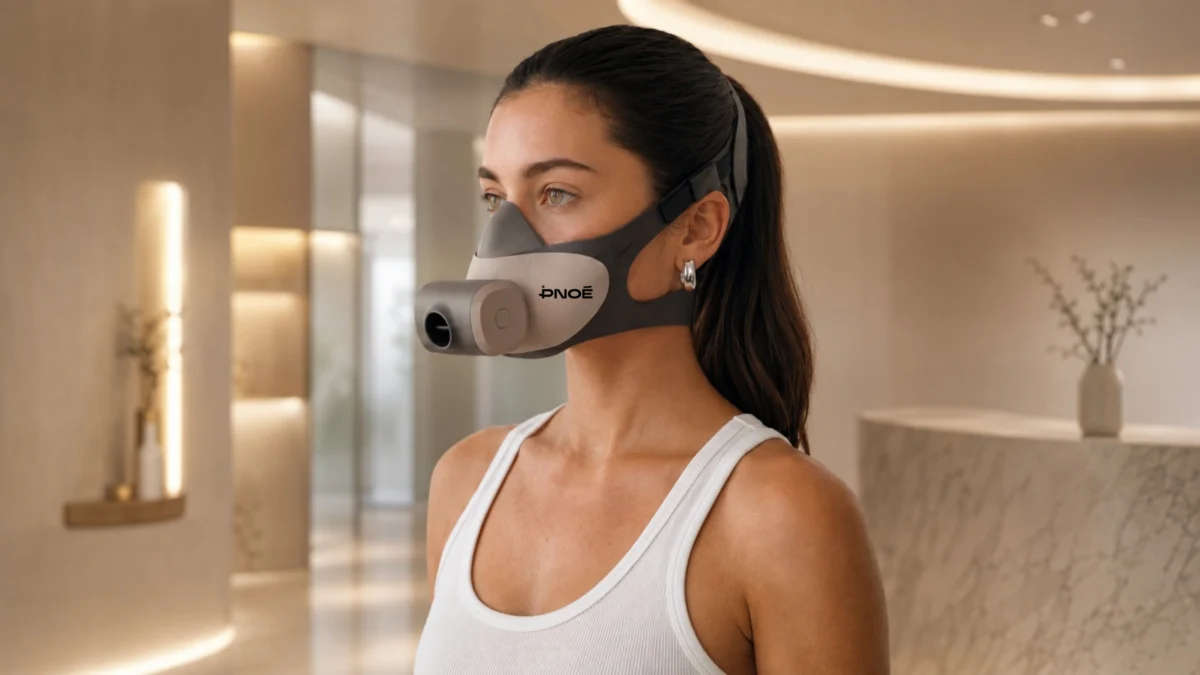
At first glance, the latest hardware from the Massachusetts-based health-tech startup PNOĒ looks like a relic from a dystopian sci-fi film. The device, a sleek mask covering the nose and mouth with straps securing it firmly behind the head, bears a striking, if unintended, resemblance to the mask worn by the iconic comic-book antagonist Bane. However, beneath this intimidating exterior lies a sophisticated, benign piece of medical-grade engineering designed to demystify the human metabolism.
By analyzing the gases in a user’s breath—specifically measuring oxygen consumption and carbon dioxide exhalation—the device translates complex physiological data into actionable insights for nutrition, athletic training, and, ultimately, longevity. As of October 1, the company is set to launch the PNOĒ 2.0, a significant iteration that pivots from professional-only clinical use to a user-friendly, self-administered model.
The Evolution of Metabolic Insight
Metabolic testing is far from a new scientific endeavor. For over a century, the analysis of breath to determine how the body produces energy has been the gold standard in sports medicine and clinical research. It is the definitive way to measure VO2 max—the maximum rate at which an individual’s body can utilize oxygen during intense exercise—and serves as a critical indicator of cardiorespiratory health.
Historically, however, these insights have been gated behind barriers of cost and geography. The necessary equipment—often bulky, expensive metabolic carts—was relegated to elite sports labs, high-end university research departments, and hospital settings. Consequently, precise metabolic data was the exclusive domain of professional athletes and the ultra-wealthy.
PNOĒ’s mission, spanning the last decade, has been to shrink this technology into a portable, accessible package. By pairing high-precision sensors with intuitive software, the company aims to move metabolic assessment out of the lab and into the everyday environments of health-conscious individuals.
Chronology: From Cambridge Labs to Global Scale
The roots of PNOĒ lie in the doctoral research of co-founder and CEO Apostolos Atsalakis. While studying sensing technologies at the University of Cambridge, Atsalakis became fascinated by the untapped potential of human breath as a diagnostic tool. Recognizing the burgeoning trend of wearables and personal health tracking, he teamed up with childhood friend Panos Papadiamantis, now the company’s Chief Product Officer, to turn his academic work into a commercial venture.
- 2014: Foundation of PNOĒ, with operations established in Malden, Massachusetts, and Athens, Greece.
- 2019: The company joins the prestigious Y Combinator Winter batch, positioning itself at the forefront of what would eventually become the modern "longevity industry."
- 2020–2023: PNOĒ scales its B2B operations, securing contracts with major fitness chains like Equinox, hospitality giants like Four Seasons, and athletic organizations such as the NBA.
- 2024: The company achieves profitability, recording over 100% year-over-year growth, and prepares for the global rollout of the PNOĒ 2.0.
The "Business in a Box" Model
PNOĒ’s growth strategy is predicated on a B2B subscription model. The company does not sell directly to the end user; rather, it provides businesses with a "business in a box" solution. For a monthly subscription fee ranging from $400 to over $1,000, fitness centers, med spas, and wellness clinics receive the hardware, specialized software, staff training, and marketing collateral.
This ecosystem allows a gym or a health club to seamlessly integrate high-level physiological testing into their member onboarding process. Because the electronics are modular and detachable from the silicone mask, the hardware remains a high-value asset for the gym, while the user maintains hygiene by keeping their own personal, inexpensive mask.
Currently, the company serves an impressive roster of clients, including the Mount Sinai Health System, Red Bull, and the med-spa chain Restore Hyper Wellness. With 85% of its revenue generated in the United States, PNOĒ views the American market as the most advanced in the world regarding longevity and proactive health, though it is now aggressively expanding its footprint into Europe, Latin America, and Asia.
Unpacking the Data: Why Metabolic Flexibility Matters
The PNOĒ 2.0 test is deceptively simple: a user walks into a facility, dons the mask, and breathes normally for eight minutes while sitting or performing light exercise. According to Atsalakis, this brief window provides a wealth of data that traditional blood tests simply cannot capture.
The device captures 23 distinct biomarkers. Among these, the most notable are:
- Resting Metabolic Rate (RMR): The precise number of calories an individual burns while at rest, moving beyond the generic estimates provided by standard calculators.
- Metabolic Flexibility: The body’s efficiency in switching between fuel sources—fat and carbohydrates. High metabolic flexibility is often correlated with improved energy levels, better weight management, and disease prevention.
- VO2 Max: The ultimate metric of aerobic fitness, which serves as one of the strongest predictors of long-term human survival and healthspan.
For the user, the result is a personalized roadmap. Instead of guessing how to adjust their caloric intake or intensity of training, they receive objective data that informs exactly how their body produces energy.
The Regulatory Landscape and Future Aspirations
Despite the clinical nature of the data, PNOĒ is careful to navigate the regulatory environment with caution. The device is not FDA-cleared, and the company explicitly states that it does not provide medical diagnoses or prescriptions. Atsalakis likens the tool to a sophisticated body-composition scale—a wellness instrument that provides data points, not clinical instructions.
However, the company’s long-term vision is far more ambitious. Scientists have long theorized that breath-based analysis could eventually identify chemical markers for diseases like cancer. While Atsalakis acknowledges that a diagnostic tool is likely "a couple of years away" due to the inevitable regulatory hurdles, the company is building a massive, growing repository of metabolic data that could one day form the backbone of a non-invasive screening platform.
Competitive Positioning and Market Impact
The market for health-monitoring technology is increasingly crowded. On one end, consumers have access to "good enough" estimates from wearables like Apple Watch, Garmin, and Whoop, which use heart-rate variability and other proxies to guess VO2 max. On the other end, professional labs offer the gold standard but remain inaccessible to the average person.
PNOĒ occupies the middle ground. It provides the precision of a lab-grade test with the accessibility of a gym membership. By designing the PNOĒ 2.0 with the help of Milan-based Design Group Italia, the company has prioritized reliability and compactness. The result of "a lot, a lot, a lot of iterations," the new device is engineered to be more robust than its predecessor, ensuring that even in a self-serve environment, the data remains accurate and reproducible.
Conclusion: The Road Ahead
As the "longevity" trend continues to transition from a niche interest to a massive global industry, the demand for measurable data is surging. PNOĒ is positioning itself as the scorecard for this industry. With a recently closed $11 million funding round and a total of $22 million raised to date, the company is well-capitalized to pursue its next phase of growth.
Plans for a Series B funding round are already on the horizon for the next six to 12 months. As PNOĒ scales, its goal remains consistent: to ensure that the secrets hidden in our breath are no longer reserved for the elite, but are available to anyone looking to optimize their health, training, and longevity. Despite the Bane comparisons, the company is betting that once people see their own metabolic data, they won’t be able to look at their health the same way again.