By Global Marketing Desk
Published in Digital Advertising Insights
In the high-stakes world of pay-per-click (PPC) advertising, conversion rate optimization (CRO) has long been governed by an unwritten scripture. Marketers across the globe routinely defer to a well-worn checklist of digital design tenets: match your keywords meticulously to your ad copy, align your landing page messaging directly with your ad extensions, leverage specific color psychology to build instant trust, ruthlessly eliminate visual distractions, and fiercely protect the digital real estate above the fold.
These conventions are not arbitrary. They are rooted in mountains of historical data, synthesized from global A/B tests that have reliably driven higher conversion rates across various digital ecosystems. Yet, as the digital marketing landscape grows increasingly complex, a provocative question is emerging among senior media buyers and CRO specialists: Have we crossed the line from treating landing page best practices as useful baselines to treating them as unquestionable dogma?
According to industry veterans and recent field tests, blindly adhering to industry standards without accounting for unique audience behaviors, traffic volumes, and industry nuances can actively suppress campaign performance. To maximize return on ad spend (ROAS), modern advertisers must learn a nuanced skill: knowing precisely when to trust the standard, and when to boldly question it.
The Genesis of Best Practices: A Foundation, Not a Forever Model
To understand the current debate, one must first understand where landing page best practices come from. Every published case study, widely shared framework, and conference presentation reflects a very specific set of initial conditions. A successful A/B test is born from a unique matrix: a specific audience demographic, a particular product or service, a distinct industry vertical, a localized budget, a specific traffic volume, a unique pricing structure, targeted competitors, and a specific buying cycle.
The fundamental flaw in modern PPC management occurs when marketers take a case study executed under hyper-specific conditions and apply it as a universal law to an entirely unrelated account.
Industry experts emphasize that best practices are exceptional tools when launching a campaign from scratch. For a brand-new PPC account devoid of historical data, landing page insights, or prior A/B testing, best practices serve as a vital safety net. They provide a defensible control and a realistic baseline against which future performance can be measured, sparing brands from unnecessary, costly guesswork.
However, once an account matures and accumulates sufficient historical data, these foundational models should no longer dictate long-term strategy. Relying on a generic blueprint indefinitely can cap a brand’s growth potential.
When to Question the Standard
Seasoned practitioners know that standard optimization rules must be challenged the moment a business model, audience demographic, or product offering directly contradicts or fails to align with traditional case studies.

PPC experts have long documented instances where textbook best practices fail under real-world scrutiny. For instance, rigid adherence to minimalism can backfire when a product requires deep educational context before a consumer feels secure making a financial commitment. Similarly, strict layout constraints can suffocate creative campaigns that rely on immersive storytelling or emotional resonance.
Recent real-world case studies from the front lines of paid search and paid social illustrate how challenging the conventional wisdom can unlock unexpected surges in conversion efficiency.
Case Studies from the Field: Two Accounts That Defied the Rules
To test the limits of conventional CRO wisdom, recent experiments conducted across distinct B2B and B2C accounts deliberately pitted traditional best practices against counter-intuitive variations. The results challenged foundational assumptions about visual design and information architecture.
Experiment 1: The Power of the Dark Side in B2B Logistics
In the first account, a niche B2B Software-as-a-Service (SaaS) company operating within the trucking and logistics sector tested a radical visual departure: a dark-themed landing page versus the traditional, brightly lit, whitespace-heavy standard.
Over a rigorous four-week testing period spanning both Google Search and Meta ads, the dark-themed landing page outperformed its conventional counterpart, generating a 32% higher conversion rate.
Qualitative customer feedback provided crucial context for the anomaly. Target buyers—logistics managers and fleet operators navigating high-stress, data-dense environments—described the black background as feeling significantly more "luxury" or "premium" compared to the blinding white screens typical of enterprise software. Furthermore, a bold red-outlined call-to-action (CTA) button did not deter conversions, as the stark contrast naturally harmonized with the brand’s established corporate identity.
Experiment 2: Broad Platform Pages vs. Hyper-Specific Messaging
The second account tackled a classic personalization dilemma. The campaign tested a broad, platform-specific landing page showcasing an entire suite of products against a hyper-personalized landing page designed to match exact search queries for one specific product.
Conventional wisdom dictates that hyper-personalization wins every time by providing a tighter message match. However, over a six-week period, the broad product landing page generated 71% more conversions and significantly higher overall sales volume than its personalized counterpart.
A deeper analysis revealed that traffic volume and consumer buying behavior were the driving forces behind the result. While search queries were often feature-specific, the actual buying decision was multi-faceted. Potential customers used specific search terms to enter the funnel, but they preferred exploring the comprehensive platform on a single, unified page before taking the final step to submit an inquiry.

Furthermore, traffic constraints played a pivotal role. Certain ad groups received fewer than 1,000 clicks per week. When limited traffic was artificially fractured across multiple hyper-personalized landing pages, individual pages became "underfed." This starved machine-learning algorithms on platforms like Google Ads and Microsoft Advertising, preventing the systems from gathering enough conversion data to optimize effectively.
The AI Factor: Navigating Generative Design and Human Nuance
As artificial intelligence permeates every corner of digital marketing, AI-generated landing pages have become a staple for agencies seeking to accelerate research, copy development, design, and deployment. AI tools can instantly generate polished, high-performing wireframes that religiously adhere to every established CRO standard.
Yet, experts issue a critical warning: more context and automation do not guarantee higher conversions.
AI-generated landing pages are bound by historical patterns and the specific prompts fed into them. While AI can efficiently format a page according to the rules, it frequently fails to comprehend human nuance. In digital advertising, nuance encompasses localized industry lingo, shifting cultural trends, macroeconomic pressures, and subtle socio-economic factors that subtly alter consumer preferences overnight.
An AI tool may design a mathematically flawless page based on global averages, but completely miss the localized psychological triggers required to convert a niche audience.
A Strategic Framework: Introducing the SIGNAL Methodology
To help modern marketers navigate the tension between established best practices and creative deviation, industry leaders have proposed structured evaluation models, such as the SIGNAL methodology:
- S – Scrutinize the Source: Understand the exact conditions under which a best practice was originally validated.
- I – Inspect the Audience: Evaluate whether your specific target demographic shares behavioral traits with the audience in the case study.
- G – Gauge Traffic Volume: Ensure your account generates enough volume to support multiple variant pages without starving optimization algorithms.
- N – Note Brand Alignment: Verify whether visual adjustments (such as dark themes or unconventional layouts) reinforce or detract from brand equity.
- A – Analyze Qualitative Data: Combine hard quantitative analytics with user feedback, session recordings, and customer surveys.
- L – Launch Controlled Tests: Never abandon a best practice on a hunch; always pit the conventional standard against your hypothesis in a controlled A/B test.
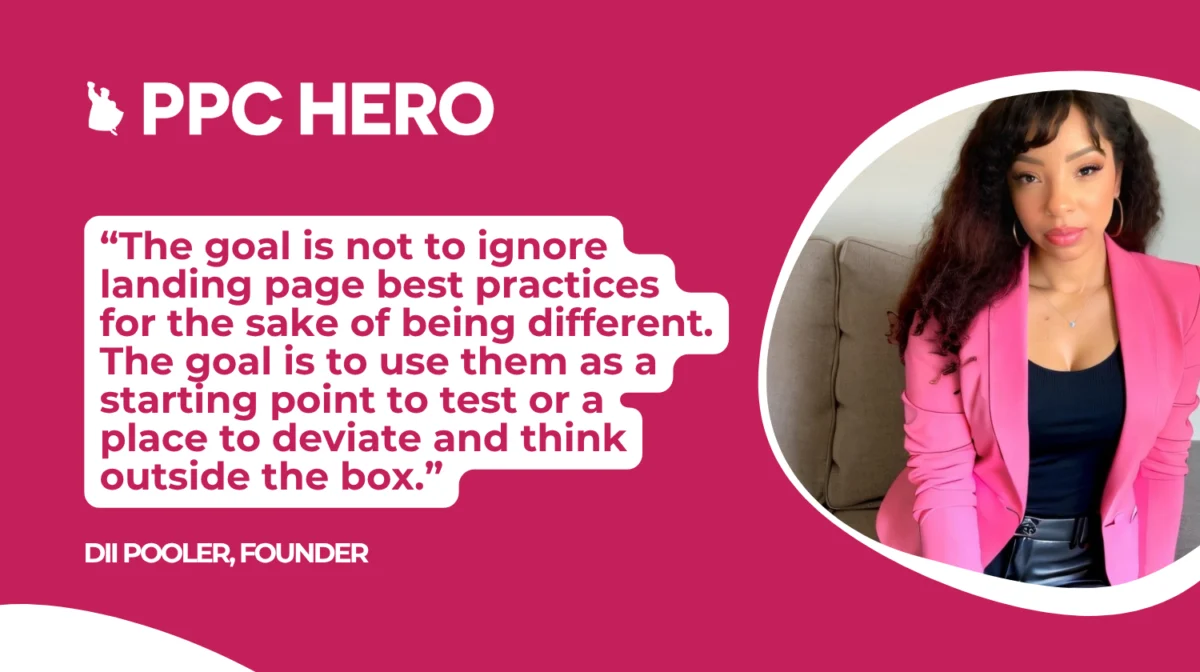
The ultimate objective is never to ignore landing page best practices simply for the sake of being contrarian. Rather, the goal is to utilize them as an intelligent starting point—a solid foundation from which marketers can test bold hypotheses, push boundaries, and discover what genuinely resonates with their unique audience.