By the Editorial Desk
Published: January 2026
Main Facts
For the past three years, corporate marketing departments have lived on the front lines of a generative artificial intelligence gold rush. The era has been defined by rapid experimentation, endless software trials, and a constant stream of predictions claiming that algorithms would completely automate the content creation pipeline.
Yet, as marketing organizations take stock of their operations, the reality on the ground looks remarkably different. While a subset of agile teams has successfully extracted genuine efficiency gains from these technologies, a far larger group has simply accumulated a costly stack of redundant software subscriptions while team frustration reaches an all-time high.
This disconnect highlights a persistent chasm between AI’s theoretical promise and its practical, day-to-day value. Countless "AI best practices" circulate online, yet few can be traced back to measurable business outcomes or improved return on investment. Meanwhile, macro-level industry metrics are flashing warning signs: organic search clicks and web traffic are in freefall across major sectors.
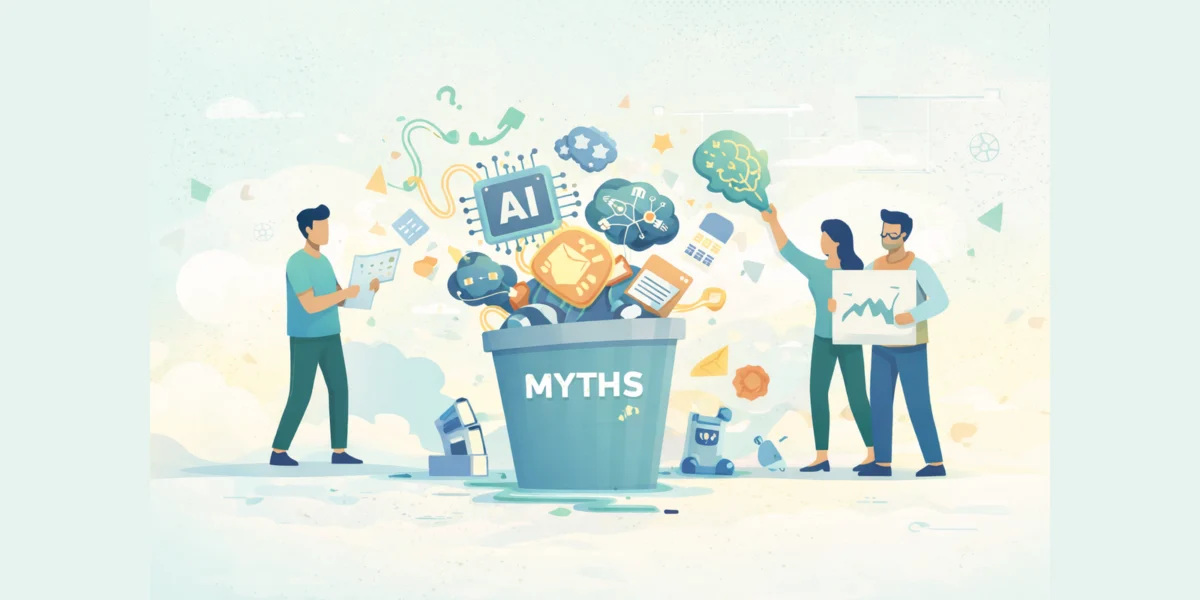
In response, industry leaders are shifting their focus away from unbridled experimentation and toward operational discipline. The consensus among top strategists is clear: generative AI works best not as a replacement for human creativity, but as a force multiplier for talented teams. When implemented thoughtfully, it streamlines research, tightens workflows, and helps companies ship high-quality material faster. However, unlocking this potential requires dismantling several persistent "marketing myths" that continue to plague corporate content programs.
Chronology: The Three-Year Evolution of AI in Content Marketing
To understand where corporate marketing stands today, it is necessary to retrace the rapid evolution of generative AI over the past thirty-six months:
- Phase 1: The Wild West of Experimentation (2023)
Immediately following the widespread public release of advanced large language models, marketing teams rushed to adopt generative tools. The primary objective was volume. Organizations experimented with fully automated blog posts, social media blasts, and programmatic copywriting, largely driven by the fear of missing out (FOMO) rather than cohesive strategic planning. - Phase 2: The Tool Accumulation and Burnout Era (2024)
As the novelty wore off, organizations realized that generating raw text was only a small part of the publishing lifecycle. Teams began layering multiple specialized tools on top of one another—one for SEO optimization, another for tone matching, a third for image generation. Instead of simplifying workflows, this created administrative bloat, tool fatigue, and widespread frustration among creative staff who found themselves managing software rather than crafting strategy. - Phase 3: The Traffic Crunch and the Call for Discipline (2025–2026)
The widespread saturation of AI-generated content coincided with a fundamental shift in search engine mechanics. Search engines and AI-driven answer engines began penalizing generic, derivative text. Organic traffic plummeted, forcing marketing directors to abandon the "publish more, faster" playbook. The current landscape is defined by a demand for operational rigor, human editorial oversight, and verifiable ROI.
Supporting Data and Industry Insights
The challenges facing modern content marketers are heavily documented by recent empirical research across the search and digital marketing landscapes:
- The AI Overview Impact on Traffic: According to prominent search industry research published in 2025 (including insights highlighted by Ahrefs), the rollout of AI Overviews and automated search summaries has drastically altered user behavior. Studies indicate that AI Overviews reduce outbound clicks to top-ranking traditional web pages by 34.5%.
- The Visibility Shift: Traditional search engine optimization (SEO) relied heavily on site architecture and keyword density to secure page-one rankings. Today, ranking well no longer guarantees visibility. Content that lacks structured schema markup, clear entity definitions, and authoritative human context is routinely bypassed by language models that synthesize information from multiple sources directly on the results page.
- The Efficiency Paradox: Internal enterprise data shows that teams attempting to bypass human editing and publish unedited AI copy often experience a paradoxical drop in conversion rates. While output volume increases exponentially, audience engagement stalls because the output defaults to the "safest," most generic version of an idea—failing to build the trust required to drive a buyer through the marketing funnel.
Official Responses and Industry Perspectives
Thought leaders and enterprise platforms are increasingly vocal about the need for a paradigm shift in how organizations approach generative technology.
Industry veterans emphasize that tools must be integrated into existing ecosystems rather than treated as standalone magic bullets. "Before adding anything new to your tech stack, map your current process end to end," advises enterprise content platform Contently in its latest operational guidelines. "Look for bottlenecks AI can realistically remove, consolidate where possible, and invest in helping your team use the tools they already have with confidence."
Experts also emphasize that AI cannot substitute for core human brand identity. When left to its own devices, automated text tends to strip away the lived experiences, nuanced arguments, and unique perspectives that make content persuasive. The organizations successfully navigating the current climate are those treating AI as a collaborative partner—using algorithms for structural outlines and preliminary research while relying on subject-matter experts for final execution, fact-checking, and narrative differentiation.
Implications for Marketers: Five Myths to Leave Behind
To survive and thrive in the current environment, marketing directors must systematically dismantle the operational fallacies that continue to drain budgets. Industry analysts have outlined five critical myths that must be abandoned:
Myth 1: More AI Tools Automatically Mean More Efficiency
On paper, adding specialized tools sounds logical. In practice, it creates software bloat and fragmented workflows. True efficiency emerges only when AI is integrated directly into the platforms where work already happens—such as editorial calendars, content management systems, and project briefs. Good training and clear internal guardrails yield far greater productivity than chasing the newest feature release.
Myth 2: AI Content Performs Just as Well on Its Own
Grammatically correct copy is not the same thing as a compelling narrative. Unedited AI output tends to default to safe, predictable phrasing that fails to resonate with sophisticated audiences. High-performing teams use AI for early-stage heavy lifting—like research and first drafts—while relying on rigorous human editing to inject brand voice, factual accuracy, and real-world customer insights.
Myth 3: AI Will Solve Bad Strategy
Artificial intelligence is an optimization engine; it cannot fix flawed positioning or unclear business objectives. Scaling a broken strategy simply accelerates failure, resulting in higher traffic metrics that fail to translate into pipeline conversions. Messaging and conversion paths must be crystal clear before production is scaled.
Myth 4: Everyone Needs to Adopt AI for Everything Immediately
FOMO-driven technology adoption breeds organizational cynicism. Successful teams do not move the fastest; they move deliberately. They isolate a single, high-impact friction point, run a contained pilot project, measure the results against defined benchmarks, and only then scale the solution across the wider department.
Myth 5: AI Search Is Basically the Same as SEO
Traditional SEO metrics are foundational, but AI-powered search operates entirely differently. Because language models compress and rewrite information from across the web, visibility now depends on structured data markup, clear entity definitions, and direct, question-driven formatting that makes it easy for algorithms to cite your brand.
Frequently Asked Questions (FAQs)
How do I know if my team is ready for AI adoption?
Assess your current content operations first. If your team has documented workflows, clear brand guidelines, and consistent publishing processes, you are ready to pilot AI tools. If basic operations still feel chaotic, strengthen those foundations before adding technological complexity.
What is the minimum investment needed to see results from AI?
Most teams can start with existing tools. Many modern content platforms include generative AI features at no additional cost. The real investment is time: expect to spend two to four weeks training your staff on effective prompting, fact-checking, and editorial oversight workflows before seeing consistent productivity gains.
How should I balance traditional SEO with AI Search optimization?
Treat them as complementary pillars. Continue building topical authority, improving site performance, and earning quality backlinks. Simultaneously, layer AI-specific optimization practices on top—such as structured schema markup, clear entity definitions, and content formats that answer user questions directly and concisely.
Ready to build AI workflows that actually help your team accomplish real work? Contently’s AI-assisted content platform combines generative efficiency with rigorous editorial oversight, ensuring your enterprise accelerates output without ever sacrificing quality or brand safety. Book a Content Strategy Call today to learn more.