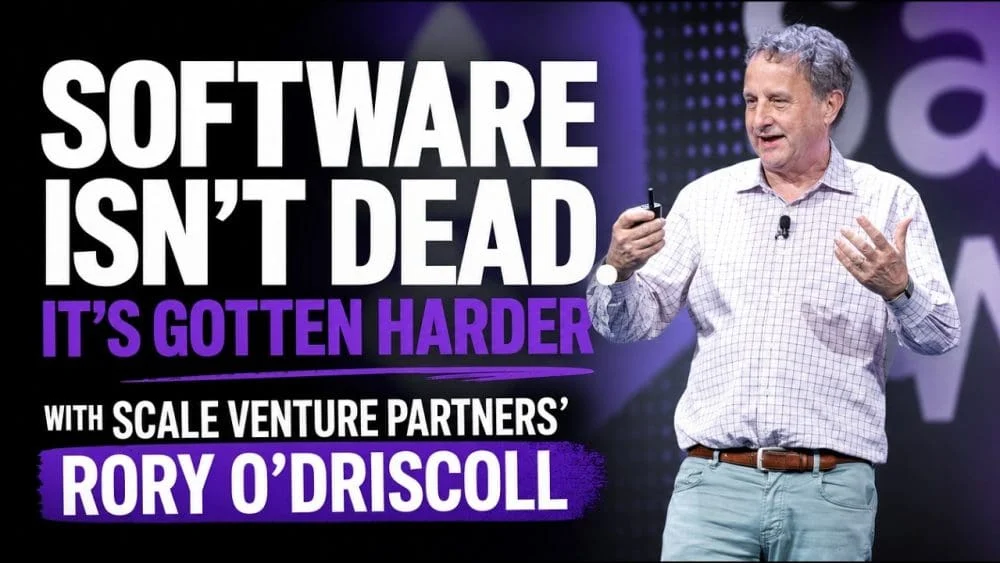
For over thirty years, veteran software investor Rory O’Driscoll has navigated the shifting tides of the technology sector. From the rise of the internet to the cloud-native revolution, he has seen cycles come and go. Yet, few periods have been as polarizing as the current "AI Summer." With the industry rife with speculation about the survival of the software business model, O’Driscoll—a familiar voice from the 20VC x SaaStr podcast circuit—has decided to strip away the hype to answer the question: Is software dead?
His conclusion is nuanced: Software is not dead, but the era of easy wins has evaporated. To survive in the age of Large Language Models (LLMs), founders must navigate a landscape defined by gargantuan capital expenditure, shifted economic incentives, and a fundamental restructuring of what constitutes a "moat."
Main Facts: The "Invest Mode" Reality
The central tension in the current market is a staggering imbalance between capital input and revenue output. In 2026, hyperscalers (the giants powering the AI infrastructure) are projected to spend approximately $688 billion on AI capital expenditure (capex). Conversely, the revenue generated by the industry is expected to be a fraction of that figure—roughly $110 billion, with $89 billion of that concentrated within the two leading foundation model providers.
This creates a half-trillion-dollar annual deficit. O’Driscoll argues that we are currently in an "Invest Mode" that will persist for several years. While this sounds alarming, he views it as a necessary phase of industrial maturation. Much like the massive infrastructure build-outs of the early internet era, the industry is currently betting on future returns that are years away from realization.
Chronology: The Road to the 2032 Crossover
The industry’s current trajectory suggests that the "crossover point"—the moment when revenue finally catches up to cumulative capital expenditure—will not occur until approximately 2031 or 2032. By that time, the AI industry is expected to be a $1 trillion revenue engine.
The Five-Year Runway
For founders, this timeline carries two critical implications:
- Extended Capital Cycles: We are likely five to six years away from the end of the current "Invest Mode." This provides a long runway for entrepreneurs to leverage increasingly powerful, cheaper, and more accessible foundation models to build their products.
- The Looming Market Correction: The current burn rate is unsustainable in a vacuum. O’Driscoll warns that the market will eventually demand efficiency. Founders should anticipate a "hard breath"—a period of volatility—before 2032, where investors will pivot from valuing growth at any cost to demanding absolute capital discipline.
Supporting Data: Targeting the Knowledge Worker Wage Bill
Where will this $1 trillion in revenue come from? O’Driscoll points to the largest pool of capital available in the global economy: the knowledge worker wage bill.
For AI to justify its current valuation, it must capture an appreciable percentage of global human labor costs. If the $1 trillion spend were concentrated entirely in the United States, it would represent 15% to 17% of total knowledge worker expenditures. In the context of software engineering, the target is even higher—north of 25%. Effectively, for every $200,000 developer, the market is betting that $50,000 can be redirected toward AI tokens and automated systems.
This is the central bet of modern American capitalism: that scaling laws (where more money equals better models) combined with high user demand for ChatGPT-like interfaces will fundamentally disrupt the cost of human expertise.
The Stack: "Making AI" vs. "Using AI"
To understand where value lies, one must segment the AI stack into two distinct categories: Making AI and Using AI.
- Making AI: This involves energy, chips, and foundational infrastructure. It is characterized by massive, non-venture-backable capital requirements. The vast majority of this capital is currently flowing toward a single dominant player (Nvidia). For most startups, this is a "no-go" zone; it is a game of scale that few can win.
- Using AI: This is the domain of the software application. The critical question for the next decade is how enterprises will consume AI. Will they purchase directly from foundation model providers, or will there be a robust layer of "application companies" that buy raw AI and add specialized, economically differentiated value on top?
O’Driscoll maintains that there is ample room for the latter. The "harness"—the software layer that manages context, actions, outputs, and logging—will become the new equivalent of the LAMP stack. Just as thousands of unique SaaS companies were built on the same LAMP architecture, the next generation of AI-native applications will share an architectural DNA while solving vastly different business problems.
Implications: Building Moats in an AI-First World
The most pressing question for any founder is: What can the foundation models roll over, and what can they not? O’Driscoll identifies several moats that remain defensible:
- Workflow Integration: If your product is deeply embedded in a customer’s daily operations, the cost of switching—even if a better model exists—is high.
- Proprietary Data Flywheels: Models are commodities; unique, non-public data that improves your specific product over time is not.
- Domain-Specific UI/UX: The way a lawyer interacts with AI is fundamentally different from a chemical engineer. Applications that provide a frictionless interface for specific high-value workflows will survive.
- Regulatory and Compliance Barriers: In highly regulated industries, the "human in the loop" or the specific verification processes built into the software represent a moat that a general-purpose LLM cannot easily breach.
The Multiples Reset and the "Growth" Myth
The investment climate has undergone a significant correction. Public software multiples have crashed because the underlying growth rates of many SaaS companies have plummeted from 30% to 10% or lower. Wall Street is not being irrational; they are reacting to a shift in growth velocity.
This impacts fundraising directly. "Triple-triple-double-double" growth (10x YoY) is no longer the default expectation. Instead, investors are seeking:
- Capital Efficiency: If you cannot reach hypergrowth, you must be lean.
- Differentiated Category Leadership: If your product blends into the "undifferentiated mass" of low-growth software, you are effectively a dead company walking.
- Compute-Adjusted P&L: A new standard deviation has emerged in startup costs. Some companies spend 10% of revenue on compute, others 60%. If you are spending 60%, your product must be so good that it "sells itself," effectively eliminating the need for a bloated sales and marketing organization. You cannot afford to pay for both an expensive compute bill and an army of sales reps.
Final Insights: The Path Forward
Software is not dead, but the "business as usual" approach is. The era of the "wrapper" startup—a company that adds no value beyond a thin layer over an API—is likely nearing its end.
Founders today face a higher barrier to entry. They must have a clear theory of the case:
- Are they on the "Making" or "Using" side of the stack?
- Is their growth driven by real customer value, or by "token-burning" mandates from corporate leadership?
- Is their product architecturally defensible, or is it vulnerable to the next incremental model update from OpenAI or Anthropic?
As O’Driscoll concludes, the job of the founder has become significantly harder. It requires deeper technical conviction, more rigorous financial discipline, and a clear understanding of the new economic reality. The winners will be those who stop trying to build "AI companies" and start building software companies that happen to use AI to deliver a level of value that was previously impossible. The era of easy growth is over; the era of building real, sustainable utility has only just begun.