By Contently Editorial Insights
Published: Early 2026
Main Facts: The Generative AI Reality Check
For the past three years, corporate marketing departments have been locked in a relentless cycle of generative AI experimentation. Armed with venture capital, executive pressure, and a bottomless pit of vendor pitches, teams rushed to integrate AI into every corner of their operations. The results, however, have been decidedly mixed.
While some organizations have unlocked genuine efficiency gains—automating routine research, streamlining rough drafts, and accelerating publishing cadences—far too many others have simply accumulated a costly graveyard of unused tool subscriptions. Frustration among creative and strategic teams is mounting as they realize that the promised return on investment (ROI) remains stubbornly out of reach.
The core issue stems from a persistent gap between AI’s theoretical potential and its practical, day-to-day value. Marketing leaders have been force-fed a diet of "AI best practices" that often evaporate when confronted with real-world execution. Meanwhile, the digital landscape has shifted beneath their feet: organic traffic and traditional click-through rates are in freefall, disrupted by algorithmic changes and the rapid rise of AI-driven search engines.
As organizations enter a new operational phase, industry leaders like Contently argue that AI must be treated as a force multiplier for talented human teams rather than a magical replacement for strategy and execution. To survive and thrive in this shifting landscape, marketing directors must shed lingering industry myths and embrace a disciplined, outcome-focused approach to artificial intelligence.
Chronology: Three Years of Experimentation to Post-Click Disillusionment
To understand how marketing teams reached this critical juncture, it is necessary to examine the rapid evolution of generative AI over the last three years:
- Phase 1: The Gold Rush (2023): Following the widespread public release of advanced large language models (LLMs), marketing departments experienced an unprecedented surge of FOMO (Fear of Missing Out). Budgets were hurriedly allocated for standalone AI writing assistants, image generators, and automation scripts. The primary directive was speed: publish more, faster.
- Phase 2: The Tool Pile-Up (2024): As the novelty wore off, teams realized that stacking multiple disconnected AI applications did not automatically translate to productivity. Instead, employees found themselves juggling disparate platforms, managing conflicting brand voices, and spending more time editing robotic copy than it would have taken to write it from scratch.
- Phase 3: The Traffic Cliff and the Search Revolution (2025): The introduction and widespread adoption of AI Overviews and conversational search engines fundamentally altered content consumption. According to landmark research by Ahrefs, AI-generated search summaries reduced clicks to top-ranking organic search results by over 34%. Volume-based SEO strategies collapsed, forcing a reckoning.
- Phase 4: The Discipline Pivot (2026 and Beyond): Marketers are now stepping back from breathless predictions. The current era is defined by operational consolidation, workflow integration, and a rigorous demand for verifiable, metrics-driven outcomes over empty promises.
Supporting Data: The Metrics That Define the New Marketing Reality
The push for AI adoption has collided with stark empirical data regarding how audiences consume content and how search engines distribute visibility:
- The Click Deficit: Research highlights that AI-powered search features (such as Google’s AI Overviews) siphon away up to 34.5% of traditional clicks that previously went to top-ranking organic pages. High rankings no longer guarantee traffic.
- The Content Saturation Paradox: Generative AI has made it frictionless to produce massive volumes of text. However, internal corporate studies reveal that generic, unedited AI output fails to build audience trust, often resulting in stagnant conversion rates despite inflated publishing metrics.
- The Cost of Disconnection: Teams that adopt tools without mapping their end-to-end workflows report increased employee burnout. Rather than eliminating manual steps, unintegrated AI tools frequently introduce new bottlenecks in legal, compliance, and editorial review stages.
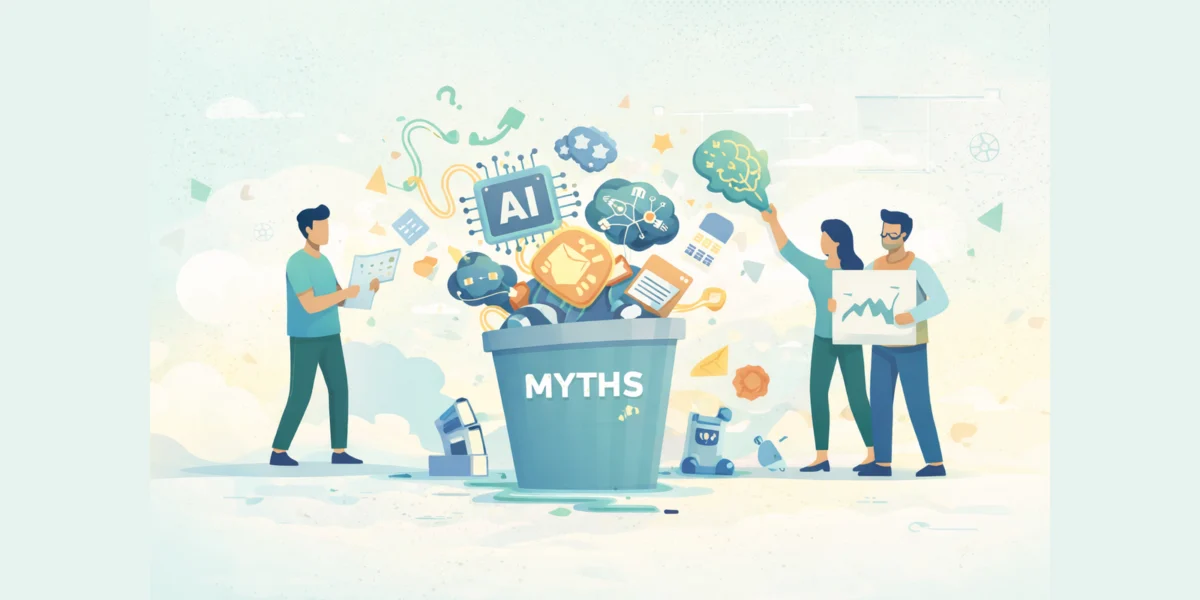
Official Responses and Industry Perspectives: Dispelling the Five Great Marketing Myths
To help marketing directors navigate the noise, industry experts have systematically dismantled the most pervasive misconceptions surrounding AI in content marketing.
Myth 1: More AI Tools Automatically Mean More Efficiency
The Fallacy: The assumption that layering multiple specialized AI applications on top of one another will exponentially accelerate output.
The Reality: In practice, disconnected tools create administrative bloat and cognitive friction. True efficiency is born from integration, not accumulation. When AI capabilities are embedded natively within existing workflows—such as content management systems (CMS), editorial calendars, and structured brief templates—productivity naturally follows.
- What works: Map out current processes end to end before purchasing new software. Identify genuine bottlenecks, consolidate redundant subscriptions, and invest in robust team training on the tools already deployed.
Myth 2: AI Content Performs Just as Well on Its Own
The Fallacy: Relying entirely on raw, unedited AI-generated copy to fill content calendars and drive customer acquisition.
The Reality: Raw AI output defaults to the safest, most generic version of an idea. It lacks lived experience, nuanced brand voice, and genuine subject-matter expertise. Search engines and modern consumers actively filter out homogeneous, synthesized text in favor of authentic perspectives.
- What works: Treat AI as a collaborative partner for preliminary tasks like research, outlining, and initial drafting. Human oversight is non-negotiable for injecting original insights, verifying facts, sharpening arguments, and aligning copy with brand voice.
Myth 3: AI Will Solve Bad Strategy
The Fallacy: Believing that artificial intelligence can compensate for fuzzy product positioning, poorly defined target audiences, or weak conversion funnels.
The Reality: AI is an execution engine, not a strategic compass. Accelerating output without a sound strategic direction simply magnifies existing flaws. Traffic may rise temporarily, but if the messaging fails to address real buyer pain points, conversion metrics will stall.
- What works: Solidify core messaging, value propositions, and conversion paths before scaling content production. Let AI execute a strategy that is already pointed toward a clearly defined destination.
Myth 4: Everyone Need to Adopt AI for Everything Immediately
The Fallacy: Yielding to industry pressure to deploy AI across all operational departments overnight.
The Reality: Hasty, unfocused adoption breeds organizational cynicism, security risks, and compliance nightmares. Sustainable transformation happens through targeted experimentation rather than sweeping mandates.
- What works: Isolate a single, high-impact use case where AI can measurably reduce friction. Run a contained pilot project, track empirical improvements, establish clear governance guardrails, and expand incrementally.
Myth 5: AI Search Is Basically the Same as SEO
The Fallacy: Treating AI-driven answers as a minor variation of traditional search engine optimization (SEO).
The Reality: Traditional SEO focuses on keyword rankings and page structures. AI search engines, by contrast, compress, synthesize, and rewrite information drawn from multiple sources simultaneously. Ranking #1 on a search engine results page (SERP) no longer guarantees visibility if an AI summary answers the user’s query directly without citing the source.
- What works: Maintain foundational SEO practices while proactively optimizing for AI discoverability. This includes implementing rigorous schema markup, defining clear semantic entities, and publishing direct, question-driven content formats that language models can easily parse and cite.
Implications: Building a Resilient Content Program for the Future
The implications of this market correction are profound. Marketing organizations that cling to volume-driven, unedited AI content strategies will continue to watch their organic visibility and customer trust erode. Conversely, teams that embrace discipline, operational integration, and rigorous editorial oversight will position themselves to dominate the post-click landscape.
Furthermore, as regulatory and compliance demands tighten, the need for verified expertise becomes paramount. Automated content programs that lack human validation expose brands to legal liabilities, factual inaccuracies, and brand safety failures. The future belongs to hybrid models—those that harness the computational speed of generative AI while anchoring every piece of content in deep human expertise, strict compliance reviews, and uncompromising editorial standards.
Frequently Asked Questions (FAQs)
How do I know if my team is ready for advanced AI adoption?
Assess your operational baseline. If your team maintains documented workflows, crystal-clear brand guidelines, and consistent publishing cadences, you are ready to pilot AI tools. If basic operations are chaotic or ad hoc, strengthen those fundamental processes before introducing AI complexity.
What is the minimum investment required to see measurable results from AI?
Most organizations can begin experimenting with capabilities already bundled into their existing software stack at no additional cost. The true investment is measured in time: expect to dedicate two to four weeks to team training on prompt engineering, editing workflows, and governance before realizing consistent productivity gains.
How should marketers balance traditional SEO with AI Search optimization?
Treat them as two sides of the same coin. Continue investing in foundational SEO—such as topical authority, site speed, and quality backlinks—while simultaneously layering on AI-specific optimizations like structured data (schema markup), explicit entity definitions, and concise, authoritative answers to user queries.
Ready to build AI workflows that genuinely accelerate your team without sacrificing quality, originality, or brand safety? Contently’s AI-assisted content platform combines cutting-edge generative efficiency with rigorous editorial oversight.
Contently writers hold the professional credentials your compliance teams demand—including CFAs, MDs, JDs, and FINRA-registered reviewers, with an expert managing editor assigned to every single piece of content. Book a Content Strategy Call today to see what a compliance-ready, high-performance content program looks like for your industry vertical.