In the high-stakes world of digital marketing, where billions of dollars in advertising budgets are allocated based on data-driven insights, a subtle but dangerous shift in terminology has taken root. The industry is increasingly relying on what is described as "directional results"—a nebulous term used to justify campaign performance despite a lack of rigorous statistical backing.
At the center of this debate is Google, the world’s largest advertising engine. Through its suite of measurement tools—Brand Lift, Search Lift, and Conversion Lift studies—Google provides advertisers with "certainty" scores to justify continued spending. However, a closer look at the statistical guidance provided by the tech giant reveals a fundamental misalignment between the interests of the platform and the interests of the advertiser. While Google frames its findings as "good chances" for success, a deeper statistical analysis suggests that for the Chief Financial Officer (CFO) and the marketing budget holder, these results may be effectively indistinguishable from noise.
The Semantic Trap: Defining "Directional" Results
The term "directional" is designed to sound sophisticated and nuanced. In professional marketing discourse, it is often used as a diplomatic way of saying, "We aren’t sure, but it looks like something happened." However, as experts in data science argue, when stripped of its corporate varnish, "directional" means whatever the user wants it to mean to justify an investment.
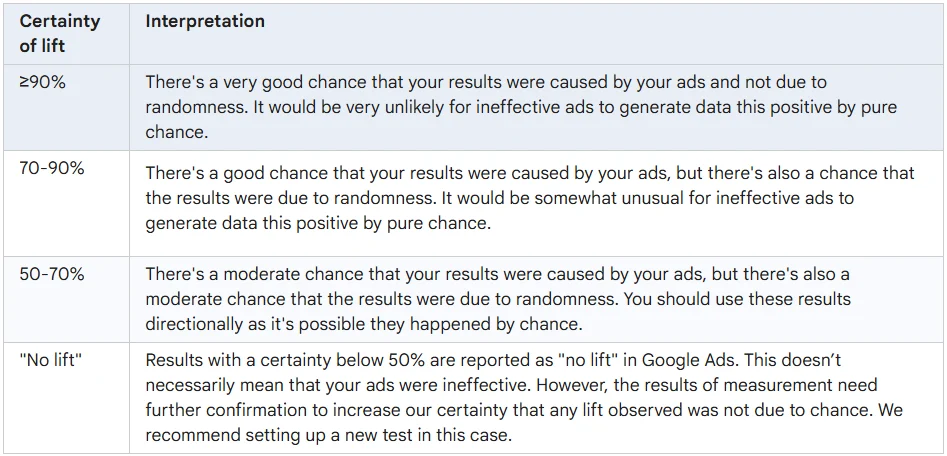
Google’s official documentation on interpreting lift studies creates a tiered system of confidence: 90% is labeled a "very good chance," 70%–90% is a "good chance," and 50%–70% is a "moderate chance." At 50%, the platform suggests there is "no lift."
The crux of the issue is the implication of these categories. By classifying 70% certainty as a "good chance," Google is essentially nudging advertisers toward a favorable interpretation of ambiguous data. For a platform that profits from increased ad spend, there is no incentive to demand higher statistical rigor. The message to the advertiser is: "Your ads probably did something good; spend more to see if it holds up."
The Divergence of Incentives
To understand why this gap exists, one must look at the two parties involved.
Party One: The Advertising Platform. Google’s business model relies on the continuous flow of capital into its ecosystem. If a study provides even a glimmer of positive evidence, Google has a vested interest in encouraging the advertiser to maintain or increase their budget. The platform’s definition of "useful information" is broad because it is designed to facilitate growth, not to provide a rigorous audit of causal impact.
Party Two: The Advertiser. The marketing director or CMO is tasked with a fundamentally different objective: risk management. They are not looking for "interesting" trends; they are looking for evidence strong enough to justify a multi-million dollar capital expenditure. When a marketer reports to a CFO, "There is a 70% chance this worked," they are effectively admitting that there is a 30% chance the investment was a total waste. In the world of corporate finance, that is not a "good chance"—it is a gamble.
The Mathematics of Replication Risk
The danger of relying on low-certainty metrics is best illustrated through the concept of "Replication Risk." When a marketer asks, "If I spend another $5 million, will I see the same results?", they are asking a question about the future stability of the data.
Using Bayesian replication models—a method championed by biostatisticians like Steven Goodman—we can translate Google’s "certainty" scores into practical business outcomes. If an initial study reports a 70% "good chance" of lift, the math is sobering. When you factor in the uncertainty of the initial measurement and the probability of replicating that result under identical conditions, the "good chance" evaporates.
In many scenarios where a platform reports 70% certainty, the probability of achieving any positive lift in a second, identical campaign is often as low as 65%. Even worse, the probability of that second campaign achieving the same high-certainty result required to justify the spend is often a measly 30%.
For the budget holder, this means that for every ten times they follow "directional" advice, they are likely to be disappointed seven times. This is the "Heads Google wins, tails you lose" dynamic: the platform gets the ad spend regardless of the outcome, while the advertiser bears the full weight of the wasted capital.
A Higher Standard for Decision Making
Given the inherent risks, many senior media directors have adopted a 90% or 95% certainty floor for decision-making. This is not because 90% is a magical number, but because it represents the minimum threshold of evidence required to defend a multi-million dollar budget to a skeptical board or CFO.
When an organization pushes for 95% certainty, they are effectively demanding that the platform provide higher-quality, more stable data. While this may result in fewer "green lights" for campaigns, it significantly reduces the likelihood of "Type S" (sign) and "Type M" (magnitude) errors, where the apparent impact of a campaign is either completely wrong or wildly overstated.
The Industry-Wide Implications
This problem is not unique to Google. Whether it is Meta, TikTok, or a boutique agency providing reports, the incentive structure remains the same: those who sell the advertising are incentivized to provide reports that encourage more spending.
Advertisers must stop outsourcing their risk tolerance to the companies receiving their money. The guidance provided by ad platforms is often self-serving by design, using language that obscures evidence rather than illuminating it. By focusing on "moderate" and "good" chances, platforms lead advertisers into a cycle of perpetual testing where the ultimate cost of "learning" is borne entirely by the company funding the ads.
Conclusion: Taking Control of the Data
The path forward for marketing and analytics professionals is to standardize their own internal reporting. If an agency or a platform sends over a report with a 70% certainty score, the response should not be to blindly increase the budget. It should be to demand a higher level of statistical confidence or to treat the result as a hypothesis that requires further, more rigorous testing—not as a green light for major investment.
Marketing is an investment, not a game of chance. By moving away from "directional" interpretations and toward rigorous, evidence-based decision-making, companies can reclaim their budgets from the platforms that are all too happy to see them spent on uncertainty. It is time for advertisers to stop asking, "What does this data say?" and start asking, "Is this evidence strong enough to risk my company’s money?"
The answer, more often than not, is to wait for better data. Carpe diem: seize the day, but do not sacrifice the budget for the sake of a "good chance."