In the modern digital landscape, the success of a product is rarely determined by the aesthetic quality of its interface alone. Instead, it is increasingly defined by the "UX maturity" of the organization behind it—the systemic integration of user-centric philosophies, processes, and tools into the core of business operations. As UX practitioners, our responsibility extends far beyond crafting wireframes or conducting user interviews; we must act as strategic advocates, guiding our organizations toward a more sophisticated understanding of design’s role in driving business value.
The Essence of UX Maturity: A Strategic Imperative
UX maturity is not a measure of an individual’s design prowess; it is an organizational characteristic. As noted by Chapman and Plewes (2014), "Achieving great UX design is not just a function or talent of individuals, it is an organizational characteristic."
When an organization operates at a low level of UX maturity, design is often treated as a late-stage "beautification" step rather than a foundational requirement. This leads to fragmented user experiences, wasted development cycles, and a reactive posture toward customer feedback. Conversely, high-maturity organizations treat UX as a strategic asset. In these environments, leadership understands the value of UX, resources are allocated consistently, and the organizational culture actively promotes empathy for the end-user.
Simply being excellent at our own jobs is no longer sufficient. To truly impact the trajectory of our products, we must become educators and advocates, pushing our organizations along the maturity continuum.
Defining the Stages: Where Do We Stand?
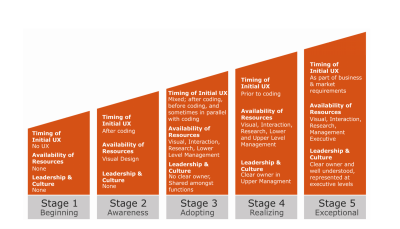
While there is no single, universally accepted model for UX maturity, most frameworks—including those explored by Natalie Hanson and the foundational work of Chapman and Plewes—categorize organizational growth into distinct stages.
These stages typically range from "Beginning" (Stage 1), where UX is non-existent, to "Exceptional" (Stage 5), where UX is fully integrated into the business DNA, with robust research pipelines, cross-functional collaboration, and proactive executive support.
Most practitioners find themselves in the middle of this spectrum. However, even in organizations with some UX presence, there is often a significant disparity between products. A team might have a high-performing app in one department while another business unit remains trapped in a legacy, development-first cycle. Identifying where your specific project or department sits on this spectrum is the essential first step in creating a roadmap for progress.
Tactic 1: The Power of UX Champions
One of the most effective ways to break through the inertia of a low-maturity environment is to identify and cultivate "UX Champions." These individuals are not necessarily designers or researchers, but they are influential stakeholders who possess the political capital and enthusiasm to advocate for user-centered change.
The Anatomy of a Champion
Research into product innovation consistently shows that champions are critical for overcoming the social and bureaucratic barriers that often stifle design initiatives. A true champion doesn’t need to be an expert in UX; they need to be an expert in the organization’s power structure.
To identify a potential champion, look for individuals who:
- Show high receptivity: Who has been vocal about the frustrations of current development processes?
- Possess internal networks: Who has the ability to influence peers and leadership across different departments?
- Have a "pain point" that UX can solve: Who would see an immediate, tangible benefit from a more efficient or user-friendly product?
- Believe in the vision: Who is consistently pushing for the organization to improve?
Case Study: Mobilizing Change in Logistics
In a recent engagement with a major international logistics company, the organization was struggling to transition its disparate entities onto a unified technology platform. Despite a stated goal of being "customer-first," UX processes were absent, and developers were building solely based on technical requirements.
By interviewing stakeholders, we identified a product owner who was frustrated by the disconnect between the product roadmap and user needs. This individual became our champion. While they were not an executive, they were highly respected and managed a product central to the company’s success. By working closely with them, we were able to embed user research into their workflow. The results were immediate: the champion used their influence to secure a seat for UX in executive meetings, which eventually led to the establishment of a dedicated UX budget, the hiring of permanent staff, and a cultural shift toward evidence-based design.

Tactic 2: Quantifying the ROI of UX
In organizations where decisions are scrutinized through the lens of profit and loss, justifying UX as a "feel-good" activity will ultimately fail. We must learn to speak the language of business by demonstrating the Return on Investment (ROI) of our work.
Debunking the ROI Myths
Many practitioners fear that attempting to measure ROI will reduce human experience to a cold calculation. However, the Nielsen Norman Group identifies three common myths that hinder this process:
- "UX cannot be measured": In reality, metrics such as conversion rates, task completion time, and support ticket volume are all direct indicators of UX health.
- "ROI calculations are too complex": There are numerous frameworks, such as those provided by Human Factors International, that simplify the process.
- "It’s only about money": While revenue is the ultimate goal, proxy metrics—like user satisfaction scores or reduced onboarding time—are just as compelling to leadership.
Demonstrating Value: A Medical Insurance Example
Consider a large medical insurance provider that attempted to roll out a new platform for agents. The initial launch failed because the system was unintuitive, causing a surge in support calls and a decline in usage.
When our team was brought in, we didn’t just focus on "improving the look." We worked with project leaders to establish a "dashboard of value." We tracked call center volume, quote completion rates, and agent satisfaction. By showing executives that every hour spent on usability testing resulted in a quantifiable reduction in support costs, we transformed the perception of UX from a cost center to a cost-saving necessity. The result was a sustained, long-term commitment to UX funding.

Chronology of Organizational Growth
Building maturity is a marathon, not a sprint. The process generally follows a predictable cadence:
- Phase 1: Observation & Listening. Before pushing for change, spend time mapping the current landscape. Understand who the decision-makers are and what keeps them up at night.
- Phase 2: Identification of Champions. Build alliances with stakeholders who are equally frustrated by the status quo.
- Phase 3: The "Pilot" Project. Select a high-visibility project where UX can have a clear, measurable impact. This is your "proof of concept."
- Phase 4: Data Collection & Advocacy. Use the results from your pilot to build a business case. Present these findings to leadership in a way that aligns with their financial goals.
- Phase 5: Institutionalization. Once you have established success, move toward formalizing processes, hiring permanent staff, and integrating UX into the standard operating procedure.
Supporting Data and Strategic Implications
The implications of failing to improve UX maturity are significant. Organizations that ignore user experience face "experience debt," which manifests as higher churn, lower employee productivity, and increased technical debt.
Data-driven advocacy is the most potent tool in a practitioner’s arsenal. When presenting to stakeholders, avoid jargon. Instead, frame your requests around business objectives:
- Risk Mitigation: "Investing in user testing now prevents the cost of re-engineering post-launch."
- Efficiency: "Reducing the cognitive load of this interface will save our agents 15 minutes per transaction."
- Competitive Advantage: "Competitor X is winning market share because their checkout flow is 30% faster than ours."
Official Perspectives on Cultural Integration
Leadership’s role in this transition cannot be overstated. According to organizational change theory, top-down mandates are rarely enough; the change must be supported by the grassroots level. A successful maturity transformation requires a two-pronged approach: the "Champion" who pushes from within the product teams, and the "Executive Sponsor" who provides the cover and resources from the top.

When you align your UX goals with the broader corporate strategy—whether that is digital transformation, customer retention, or operational efficiency—you cease to be a "design advocate" and start being a "business partner."
Conclusion: The Path Forward
Increasing UX maturity is a vital responsibility for any practitioner who wishes to see their craft have a lasting impact. By identifying champions who can navigate the political landscape and using data to prove the tangible ROI of our work, we can move our organizations from the periphery of design-thinking to the center of it.
This article represents the first in a three-part series. Having established the foundation of maturity through champions and ROI, our next focus will be on the internal processes required to document and share our work, as well as the mentorship structures necessary to foster a culture of continuous improvement. As we work to mature our organizations, we ultimately ensure that the products we build are not only functional but are truly, deeply, and effectively useful for the people who rely on them every day.