In the fast-paced world of digital marketing, the narrative surrounding Artificial Intelligence has largely been one of speed. Teams are told to draft faster, publish in higher volumes, and automate the "busywork" that consumes their daily calendars. However, a growing chorus of industry experts is suggesting that we are missing the forest for the trees. The real competitive advantage of AI is not in using it to complete tasks more rapidly, but in transforming professional expertise into autonomous, scalable tools that perform the work on our behalf.
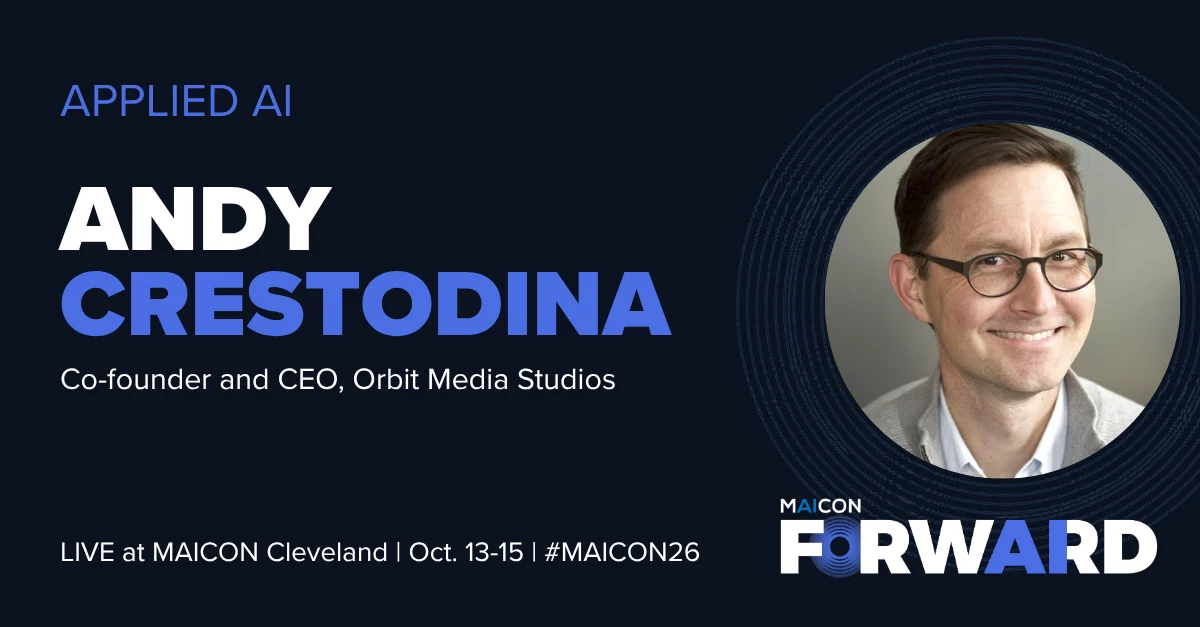
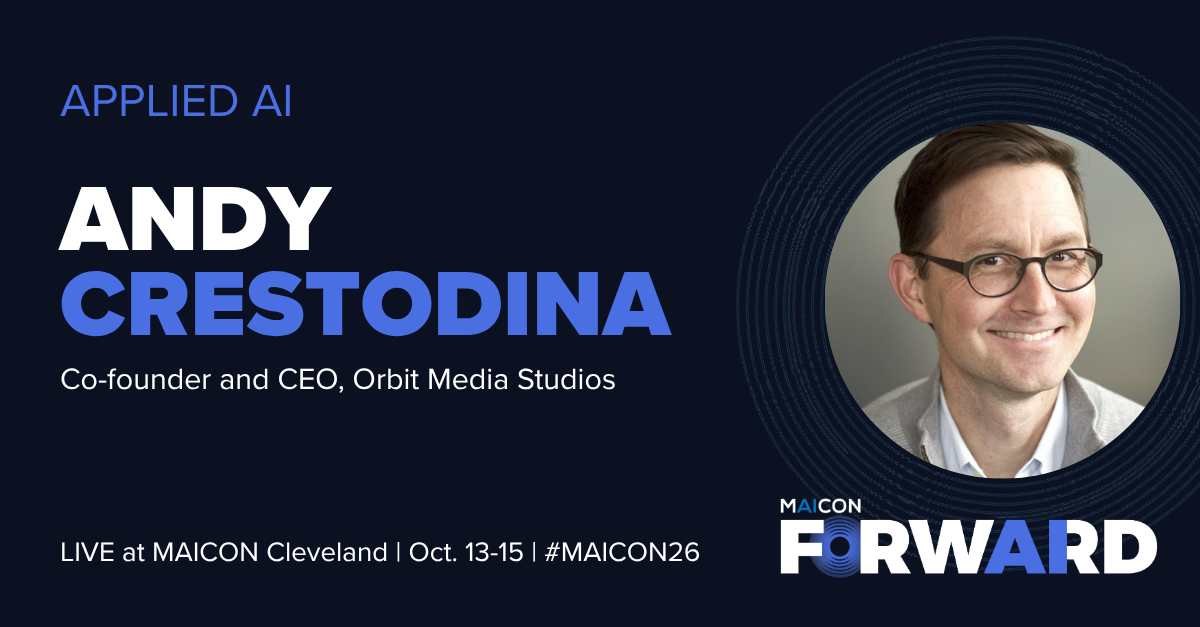
This paradigm shift will be the focal point of a keynote presentation at MAICON 2026, delivered by Andy Crestodina, the Co-founder and CMO of Orbit Media. His session, titled "From Process to Prompt to Automation: How a Marketing Job Becomes a Marketing Tool," challenges marketers to stop viewing AI as a simple productivity hack and start treating it as a foundational infrastructure for their business processes.
The Evolution of Marketing Workflows
For years, marketing workflows were binary: they were either done manually by a human or not done at all. According to Crestodina, we are currently witnessing a dramatic evolution in this sequence.
"The work of marketing has changed," Crestodina notes. "Modern marketing workflows evolve in a specific sequence from 100% done-by-human-hands to 100% done by assistants—and then reviewed by humans."
This progression is not an overnight transition. It requires a disciplined, iterative approach. Crestodina emphasizes that "my most powerful assistants evolved gradually. I don’t think you can one-shot a great AI worker bee." This evolution implies that for a machine to effectively replicate human output, it must first be fed with the institutional knowledge, nuanced brand voice, and strategic logic that only an experienced marketer possesses.
Experts: The Architects of the AI Future
Perhaps the most provocative stance taken by Crestodina is his view on who should be building these AI systems. There is a common misconception that AI implementation is a technical task better left to IT departments or prompt engineering specialists. Crestodina disagrees entirely.
"The best assistants are built by people who already do that job well," he argues. "The expert at the job is the best suited to evaluate AI’s output, judge it, and make improvements."
By framing AI as the "world’s most powerful skill-transfer tool," Crestodina highlights a critical opportunity for organizations: senior-level experts can effectively clone their high-level decision-making processes. When an expert takes the time to refine a prompt into a repeatable system, they aren’t just completing a task; they are creating a scalable asset that can elevate the performance of less-skilled team members. This democratizes excellence across an entire department, allowing junior staff to operate at a higher standard by leveraging the "codified" expertise of their more experienced colleagues.
The New Literacy: Why Prompts Are Code
The barrier to entry for AI development has collapsed. No longer does one need to learn Python or SQL to create software-like functions. As Andrej Karpathy, co-founder of OpenAI, famously observed, "The hot new programming language is English."
Crestodina echoes this sentiment, urging marketers to stop "shopping" for the latest shiny tool and start building their own. "In other words, your prompts are code," he says. "They are functions. They are tools. Work hard on them. Look for novel new inputs to combine with them. Look carefully at the outputs. Test them. Iterate and improve them."
This shift in mindset—from consumer to creator—is essential. When a team treats their prompt library as a code repository, the output quality stabilizes. These prompts should not exist in isolation on an individual’s desktop; they should be documented, shared, and combined. When teams build full workflows around these "prompt-functions," they create a proprietary system that is unique to their brand, providing a distinct competitive moat that off-the-shelf software cannot replicate.
Implications for Marketing Strategy
The implications of this shift are profound, particularly for leadership teams looking to optimize ROI. If marketers spend their time merely "using" tools, they remain beholden to the feature sets of third-party vendors. If they spend their time "building" tools, they own their intellectual property and their operational efficiency.
1. The Death of the "One-Off" Mindset
Marketing teams often fall into the trap of treating AI as a disposable resource—generate a caption, discard the chat history, move on. Crestodina’s philosophy demands a systemic approach: document the process, refine the prompt, and save the result as a reusable tool. This creates a cumulative benefit, where every week the team becomes slightly more automated than the week before.
2. Bridging the Skill Gap
By turning senior-level expertise into reusable prompts, organizations solve one of the perennial problems in agency and in-house marketing: the onboarding and training of new hires. When an expert’s judgment is baked into a prompt, a junior employee can produce "expert-level" work in a fraction of the time, provided they are trained to review the output with a critical eye.
3. Scalable Creativity
Creativity is often viewed as the "last mile" of human endeavor, but even creative processes can be supported by robust AI tools. By automating the technical and analytical aspects of a campaign—data synthesis, SEO optimization, and structural drafting—marketers can reclaim the time necessary for the high-level strategic thinking that AI is not yet equipped to handle.
What to Expect at MAICON 2026
Crestodina’s upcoming session at MAICON 2026 is designed to be a practical workshop for those who have moved past the initial "AI curiosity" phase and are ready to operationalize their efforts. Drawing on his 25 years of experience in the digital space, his session will provide a roadmap for moving from manual work to prompt-driven prototypes, and finally to repeatable, scalable AI assistants.
Attendees can expect:
- A Framework for Evaluation: How to identify which workflows within your team are actually ready for automation, and which ones should remain strictly human-driven.
- The Anatomy of a "Tool": Practical guidance on how to turn individual, siloed expertise into shared, reusable prompts that act as mini-applications.
- Cultural Implementation: How to foster a culture where marketers are encouraged to build and refine their own tools rather than constantly seeking external solutions.
The Road Ahead
Crestodina’s career, highlighted by his seminal work Content Chemistry, has always been focused on the intersection of data, performance, and clear, actionable strategy. His core conviction—that most websites fail because they do not consistently drive qualified leads—remains the driving force behind his current focus on AI. He views AI not as a replacement for strategy, but as the engine that allows that strategy to be executed at scale.
"Don’t look for new tools. Make your own tools," Crestodina concludes. "The only gap is our own imaginations."
As the industry converges at MAICON 2026, the message is clear: the future of marketing belongs to those who view themselves not as users of the technology, but as the architects of it. By moving from process to prompt to automation, marketers can ensure that their efforts are not just faster, but fundamentally smarter, more consistent, and infinitely more scalable.
Join the Conversation at MAICON 2026
Andy Crestodina will be joining a roster of over 50 leading AI and business experts at the upcoming Marketing Artificial Intelligence Conference. This event is specifically designed to move beyond the hype and provide real-world, actionable strategy for leaders at all levels.
To learn more about how you can transition your team from manual labor to automated excellence, register for MAICON 2026 today. The landscape of marketing is changing; ensure your team is building the tools that will define the next decade of success.