By WP Tavern News Desk
The landscape of website localization has undergone a seismic shift. Once a laborious, financially prohibitive enterprise reserved for enterprise-tier corporations with deep pockets, translating a WordPress website into multiple languages has transformed into a streamlined, nearly frictionless process.
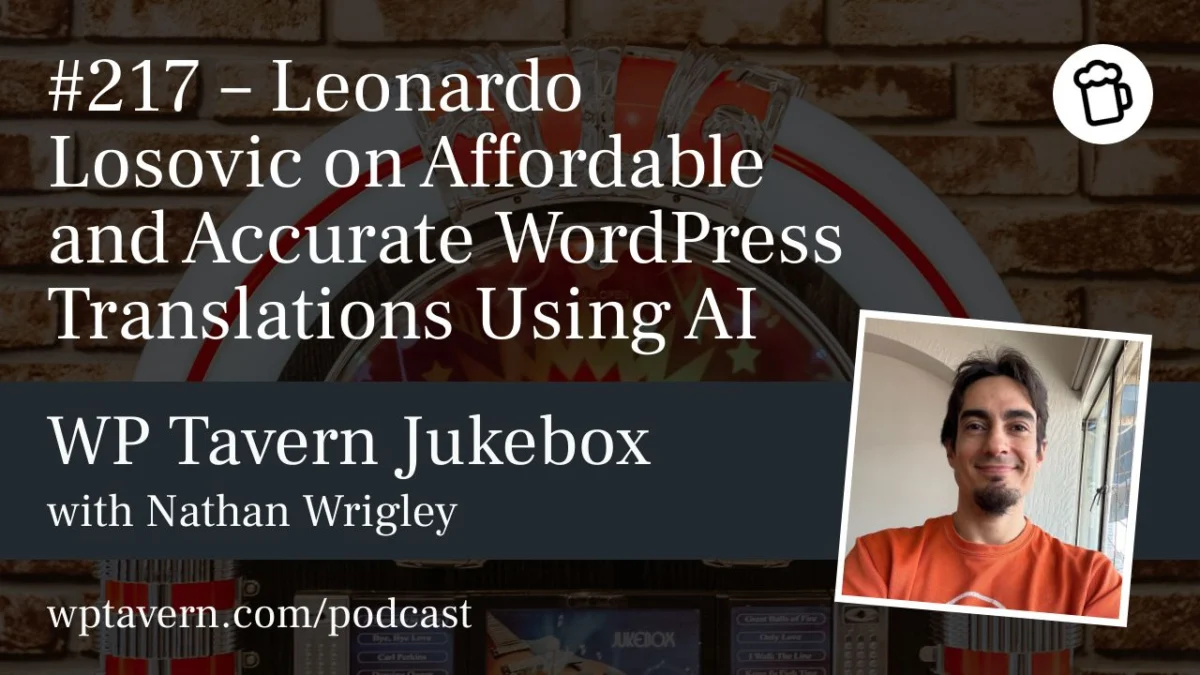
This evolution—driven by advancements in artificial intelligence and the changing expectations of global digital consumers—was the central focus of a recent episode of the WP Tavern Jukebox podcast. Host Nathan Wrigley sat down with Leonardo Losoviz, a veteran WordPress developer and creator of Gato GraphQL and Gato AI Translations for Polylang, to discuss the intersection of AI and multilingual content management.
Drawing from his recent presentation at WordCamp Asia, Losoviz unpacked the "invisible gotchas" of WordPress translation, the steep drop in economic barriers, and how upcoming platform architectures are poised to redefine the human-AI collaborative workflow.
Main Facts: The New Economics and Capabilities of AI Translation
For over a decade, translating a WordPress site meant navigating a complex matrix of professional human translators, protracted timelines, and high hourly rates. A business wanting to expand its reach from English to German, French, or Japanese faced hundreds—if not thousands—of dollars in operational overhead.
Today, those financial metrics have been effectively upended.
- Cost Reduction: Modern AI translation relies on token consumption via providers such as OpenAI, Anthropic, and Google’s Gemini. Translating comprehensive volumes of content now costs mere cents on the dollar, a stark contrast to traditional human translation services charging $50 to $100 per hour.
- Accuracy and Limitations: Modern Large Language Models (LLMs) boast an estimated 99% accuracy rate for standard prose. While technical jargon, industry-specific terminology, and niche academic concepts still require professional oversight, the scope of human intervention has shifted from comprehensive translation to targeted polishing.
- Architecture and Integration: Plugins like Losoviz’s Gato AI Translations for Polylang leverage the robust infrastructure of tools like Polylang to duplicate posts natively across languages, linking them via proper taxonomies and generating essential
href_langmeta tags automatically for search engine optimization (SEO).
Chronology: From Manual Friction to Instantaneous Global Reach
The Pre-AI Era: A Fragmented Workflow
Historically, setting up a multilingual WordPress site required meticulous planning. Site administrators had to audit every string on their platform, source independent human translators, negotiate rates, and manually copy-paste translated texts back into custom meta boxes or secondary post entities. The user interface (UI) within the WordPress dashboard often became cluttered, making multi-language management cumbersome for solo bloggers and marketing teams alike.
The Rise of Machine Translation and DeepL
Mid-era solutions introduced machine translation engines like DeepL and Google Translate. While faster, these earlier algorithms frequently struggled with contextual nuances, syntax, and natural phrasing. They served as a bridge, but the quality gap often necessitated heavy manual editing.
The AI Inflection Point (2024–2026)
The integration of generative AI transformed machine translation from a mechanical string-replacement exercise into a context-aware linguistic process. By wrapping API-driven LLMs directly into WordPress plugins, developers like Losoviz enabled site owners to execute bulk translations across dozens of languages with a single click directly from the WordPress post list table.
Supporting Data & Technical Realities
Despite the apparent magic of AI translation, experts emphasize that technical preparedness is critical to avoiding wasted resources.
Avoiding Token Waste
Running an AI translation prematurely—before a post is fully finalized—leads to wasted compute tokens and inflated API costs. Losoviz outlines a strict pre-translation checklist that site owners must complete to ensure efficient workflows:
- Content Finalization: Ensure zero typos, final structural hierarchies (correct usage of H2 and H3 tags), and finalized copy.
- Media Audit: Verify that images possess correct alternative text and titles. Furthermore, avoid embedding images with hardcoded English text, as these cannot be dynamically translated by standard text workflows.
- Embedded Media Review: Assess whether region-specific embeds (such as a YouTube video in Spanish) remain contextually relevant when translated into French or German.
Database Efficiency: Files vs. Metadata
A common concern among developers is whether translating content into multiple languages bloats server storage. Solutions built on Polylang handle this efficiently: while separate post entries are created in the database for each language to ensure maximum speed and compatibility with caching and static site exporters, the actual underlying physical files (such as JPEGs or PNGs) are not duplicated. Instead, media metadata and attachments are referenced globally, preserving server hard drive space while delivering distinct localized captions and titles.
Official Responses and Strategic Perspectives
When questioned about the moral versus business imperatives of making a site multilingual, Losoviz suggests that legal compliance (such as language mandates in regions like Canada or parts of Europe) forces the hand of certain enterprises. However, for those with a choice, the rationale is straightforward: if you can reach new audiences, you should.
"The key question is, as long as you can do it, do it. Why wouldn’t you want to show your content to a new user base?" Losoviz noted during the podcast.
Yet, this democratization of translation introduces a paradox akin to an arms race. When translation becomes effortless and inexpensive, it ceases to be a competitive differentiator.
"When it’s so easy, everyone will do it," Losoviz warned. "And when everybody does it, you’re not moving forward. You’re just running to be in the same spot… In a way, unfortunately, it becomes a situation in which you need to do it just to not fall behind."
Implications: The Horizon of WordPress 7.0 and Collaborative AI
Looking forward, the integration of AI translation within WordPress is poised to leap forward with upcoming core releases.
Collaborative Editing Meets Artificial Intelligence
WordPress Phase 3 focuses heavily on collaborative editing, bringing Google Docs-style communication features—such as inline commenting and real-time multi-user interaction—directly into the Gutenberg editor. While initially conceptualized for human-to-human collaboration, this infrastructure opens the door for human-to-AI workflows.
Losoviz envisions a future where WordPress 7.0 and its accompanying AI connectors enable continuous, interactive refinement:
- Confidence Scoring: An AI could analyze a generated translation, flag ambiguous technical terms where it lacks 100% confidence, and deploy a sticky note or comment directly in the Gutenberg editor margin.
- Contextual Dialogues: Rather than a black-box generation process, editors could chat directly with the AI inside the post interface to debate alternative phrasing or industry-specific terminology.
The SEO and Discoverability Impact
For search engines, proper localization infrastructure remains paramount. Automated plugins ensure that search crawlers correctly interpret the relationship between pages through href_lang tags, directing French-speaking users to French URLs and Spanish-speaking users to Spanish variants. This ensures that global visibility scales cleanly without triggering duplicate content penalties.
Conclusion
The evolution of WordPress translation highlights a broader trend across the tech industry: capabilities that once demanded heavy capital investment are rapidly becoming commoditized by AI.
While the ease of automated translation means that going global is no longer a unique competitive advantage—but rather a baseline requirement for modern digital survival—the underlying technology continues to mature. As WordPress edges closer to Phase 3 and deeper AI integration, the friction of multilingual publishing is disappearing, empowering creators and developers to connect with global audiences seamlessly, efficiently, and at a fraction of the historical cost.
For more details, including a full transcript and links to Leonardo Losoviz’s projects and WordCamp Asia presentation, visit the WP Tavern Podcast archive.