SAN FRANCISCO — In the modern landscape of digital product development, few organizational rituals are as universally championed—and as frequently frustrating—as the creation and maintenance of a design system. Touted as the holy grail of efficiency, design systems promise seamless alignment between engineering and design, faster time-to-market, and a unified brand experience.
Yet, ask any cross-functional team about their day-to-day reality, and you are likely to hear a very different story. Months of tedious component auditing, endless alignment meetings, developers waiting endlessly for polished Figma files, and designers watching their meticulous tokens get mangled in translation are the common pitfalls of a broken process.

According to industry experts, the root of the dysfunction lies in a fundamental misallocation of focus: teams build isolated design elements (buttons, chips, cards) rather than cohesive, product-specific patterns. By flipping the script and building design patterns first, cross-functional teams can unblock parallel workflows, ensure rock-solid alignment, and generate reusable modules that genuinely accelerate future projects.
The Anatomy of Collaboration Breakdown
True collaboration is the bedrock of superb product design, but working across disciplines remains notoriously tricky. In theory, a design system is the physical manifestation of a close partnership between developers and designers. In practice, it often triggers classic organizational friction.

Designers craft intricate states that are prohibitively complex to code; developers build components with rigid data structures that break visual continuity; and product managers watch timelines slip as teams argue over whether to reuse an existing asset or build a new one from scratch.
These challenges do not dissolve simply because teams increase their meeting cadence. In fact, many cross-functional teams find themselves deep into a project before realizing that designers, developers, and product owners harbor entirely divergent mental models of what they are actually building.
For sole designers or small design squads embedded within cross-functional product teams—surrounded by front-end engineers and led by product owners—relying on top-down organizational mandates or rigid corporate processes rarely works. Instead, teams need a grassroots approach to nurturing their design system, treating it less as an administrative chore and more as a product with active users.
A New Twist on an Old Idea: Design Patterns
The solution to these persistent collaboration bottlenecks may lie in a concept borrowed not from modern UI frameworks, but from classical architecture, urban planning, and software engineering: design patterns.
As defined by Christopher Alexander in The Timeless Way of Building, “Even the most complicated, sophisticated things are defined by a small number of composable patterns.” In software and design, patterns act as a toolkit of reusable solutions to recurring problems—templates for how to solve specific experience challenges in multiple contexts.
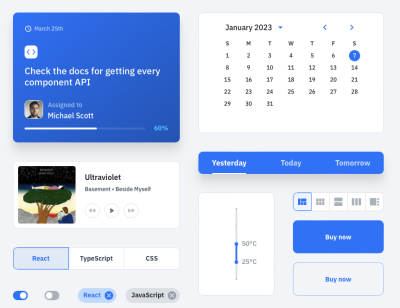
While most organizations focus heavily on atomic elements—individual components like buttons or inputs—industry veterans argue that elements alone do not deliver the value promised by a design system.

┌────────────────────────────────────────────────────────┐
│                      ELEMENTS                          │
│         (Buttons, Chips, Cards, Inputs, etc.)          │
└───────────────────────────┬────────────────────────────┘
                            │
                            ▼  (Too granular to solve features)
┌────────────────────────────────────────────────────────┐
│                      PATTERNS                          │
│     (Reusable combinations of elements for a purpose)  │
└────────────────────────────────────────────────────────┘
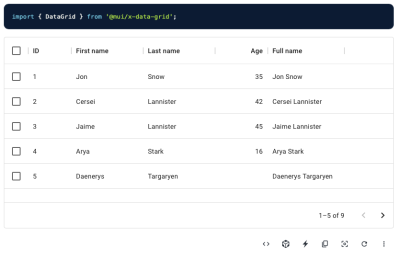
Having a pristine library of elements does not save time or guarantee alignment because elements are simply too granular to implement a complex feature on their own. Conversely, heavily pre-built component libraries from third-party ecosystems (such as Material-UI’s Data Grid or Salesforce Lightning’s List Builder) often come with too much baggage, requiring extensive rework to fit a unique product’s needs.
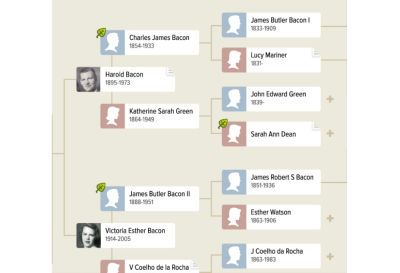
True utility emerges when teams identify product-specific design patterns—the recurring structural combinations of elements that solve specific problems within their unique product experience. Whether it is a media tile in a streaming TV service, a node in a family tree research tool, or a voting module in a travel app, these patterns form the true heart of an effective design system.
Chronology of a Collaborative Workflow: The “WeTrip” Case Study
To understand how pattern-first development transforms team dynamics, consider a hypothetical cross-functional team building a group-travel coordination app called WeTrip.
Phase 1: Seed Funding and Early Alignment
Faced with early-stage funding pressure and an urgent need to ship a Minimum Viable Product (MVP), the WeTrip team—comprising designers, engineers, and product managers—refuses to fall into the trap of waiting for pixel-perfect designs before writing code.

Instead, they convene to map out core domain objects on a whiteboard. They identify three foundational concepts:
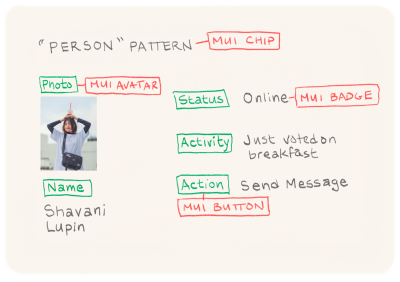
- Person: A trip participant who can vote and interact.
- Place: A geographical location or venue proposed for a visit.
- Occasion: A scheduled time block for group activities.
Rather than arguing over hex codes or typography, the team focuses strictly on structure, establishing shared nomenclature and rough conceptual outlines.
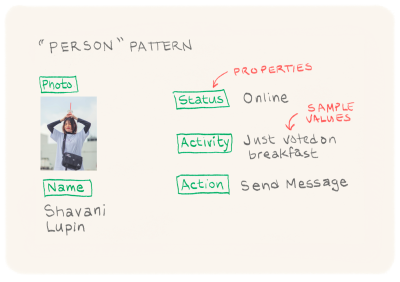
Phase 2: Integrating Standard Elements
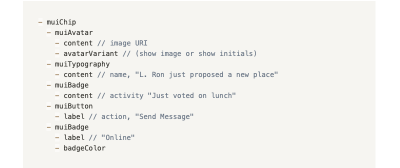
Once the core patterns are sketched, the team pulls in a foundational library of restyled elements from an existing ecosystem (such as MUI) to serve as a shortcut. They map these elements to shared documentation pages (using tools like Notion) where every team member can view, edit, and update component properties in real time.
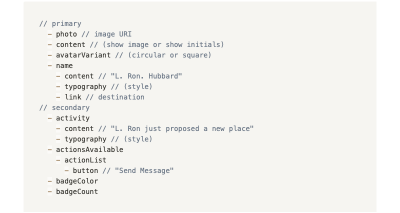
Critically, adding properties to a pattern documentation page does not commit the team to a final visual design; rather, it opens a low-stakes dialogue about what could be included in the experience.
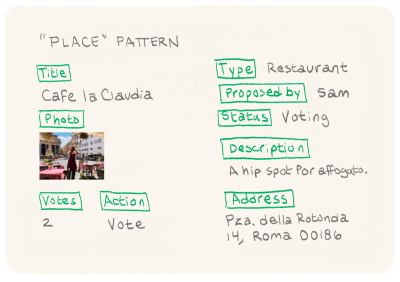
Phase 3: Unblocked, Parallel Execution
With the patterns clearly defined in a shared format, designers and developers decouple their workflows:
- Engineering: Developers begin stubbing out TypeScript components and setting up data structures based directly on the pattern specifications.
- Design: Designers flesh out visual variants in Figma without keeping engineers waiting for final handoffs.
When engineers realize they missed a critical detail—such as a presence property to track whether a user is actively online—they simply update the shared documentation and notify the team. Designers immediately incorporate a corresponding presence indicator into their Figma components. Because the pattern definition acts as a living source of truth, there are no bottlenecks or costly miscommunications.
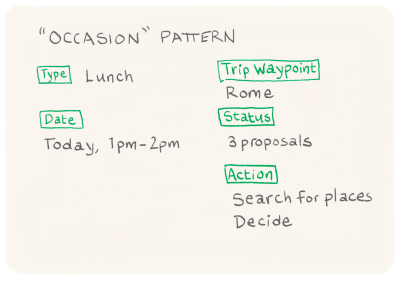
Phase 4: High-Level View Synthesis
As the product matures, the team convenes for subsequent planning sessions to establish primary views—such as a People List, a Schedule View, and a Proposals View.
Because these views are simply nested combinations of pre-established patterns (Person, Place, Occasion), the final visual design phase executes rapidly. Visual design becomes the natural culmination of collaborative groundwork rather than an upstream roadblock.
Supporting Data and Scaling Implications
As organizations scale their use of design patterns, the operational benefits multiply:
- Reduced Time-to-Market: By shifting alignment upstream to the pattern level, teams eliminate rework and handoff friction.
- Measurable Reuse: Pattern adoption can be tracked as a core metric, quantifying how much reusable code and design work is generated over time (akin to test coverage metrics in software engineering).
- Module Federation: In mature organizations, individual patterns can be spun out into independent repositories, managed by dedicated owners, and integrated into modern build toolchains like WebPack 5 module federation.
Furthermore, structuring design systems around patterns transforms them from static style guides into dynamic product accelerators. When a pattern has matured and its properties are codified into a stable API, it can be seamlessly redeployed across entirely new features—such as recycling a location-card pattern from a trip-planning view into a newly developed search results page.
Industry Implications and Cultural Shifts
The implications of adopting a pattern-first philosophy extend far beyond immediate project efficiency. For organizations struggling to justify the heavy resource investment required to build and maintain a design system, the pattern-first approach offers a compelling ROI: it ties system maintenance directly to feature delivery.
When design systems are built around patterns rather than atomic elements, they cease to be "extra work" pushed off to a dedicated systems team. Instead, they become an integrated, natural byproduct of how cross-functional product teams build software together.
For teams weary of the traditional handoff wall, embracing design patterns offers a viable roadmap toward seamless collaboration, faster delivery, and ultimately, happier humans building better products.