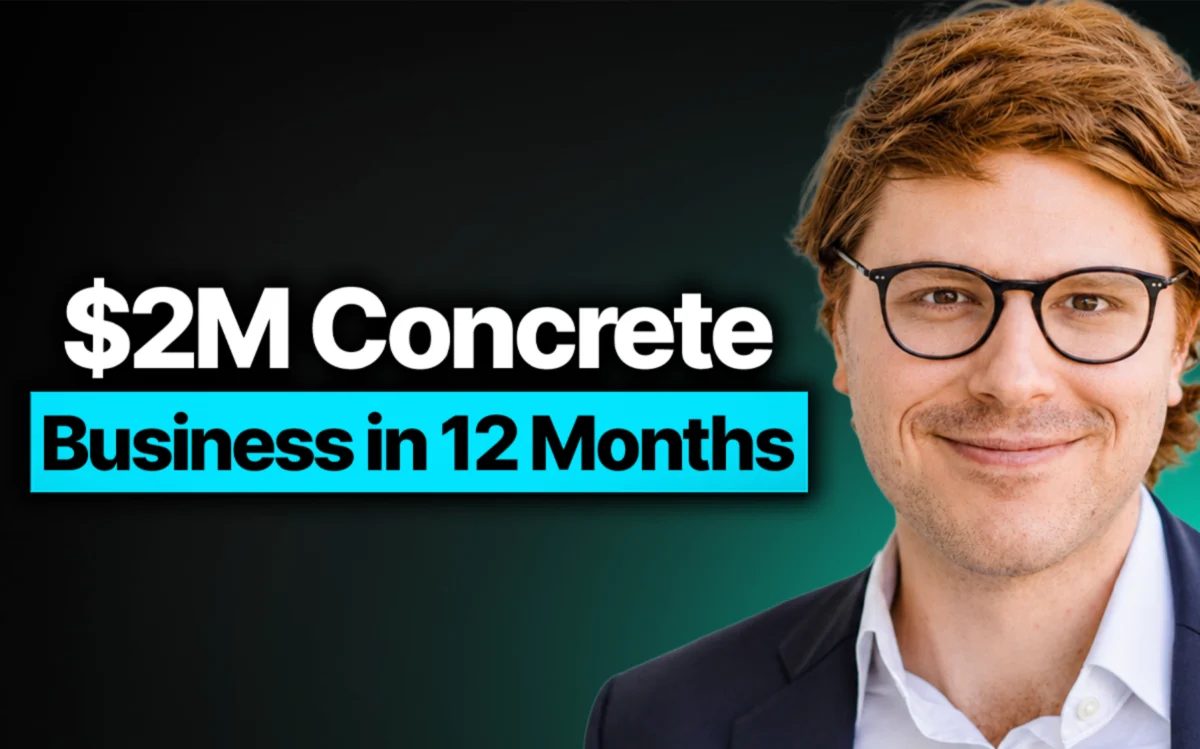
HOUSTON — In an era dominated by high-tech startups, venture capital burn rates, and endless software-as-a-service (SaaS) iterations, the blueprint for modern entrepreneurial success is undergoing a radical reevaluation. Increasingly, founders are trading Silicon Valley boardrooms for "boring" blue-collar industries.
No story illustrates this shift more vividly than that of Jeff Price. A veteran of the corporate strategy, finance, and fintech sectors, Price walked away from the high-stakes startup ecosystem to build Texas Slab Guys, a Houston-based concrete installation company. In just 12 months, Price has scaled the enterprise to a staggering $2 million annual revenue run rate.
His journey, recently featured on the Niche Pursuits podcast, offers a masterclass in combining elite corporate problem-solving with the foundational reliability of traditional trades, supercharged by pragmatic artificial intelligence.
Main Facts: The Anatomy of a Rapid Scale
The trajectory of Texas Slab Guys challenges conventional wisdom about where high-growth opportunities lie. While digital-first businesses often spend years fighting for market share in crowded, borderless digital landscapes, Price targeted a hyper-local, physical market in one of the most structurally demanding regions in the United States.
- The Founder: Jeff Price, an MBA graduate from Rice University with a background in corporate finance, fintech startup founding, and Series B scaling.
- The Business: Texas Slab Guys, a residential and commercial concrete contractor operating in the greater Houston area.
- The Growth Metric: Achieved a $2 million annual revenue run rate within 12 months of operations, rebounding from a slow start that saw less than $200,000 in revenue at the close of its initial phase.
- The Operational Edge: The integration of custom-built AI micro-tools and voice agents designed to eliminate administrative friction, paired with premium material positioning (such as high-PSI concrete pours).
Houston, notably, boasts more concrete per capita than any other metropolitan area in the Americas, creating an immense, perpetual demand for flatwork, foundations, and structural slabs.
Chronology: From Venture Capital to Hard Hats
The Corporate Exit
Long before he was pouring foundations, Price’s life was deeply entrenched in the digital economy. He worked in corporate strategy and finance, successfully founded a fintech company that raised $2 million in capital, earned his MBA, and subsequently managed operations at a Series B startup that had secured over $30 million in funding.
However, despite the allure of high-growth tech, the financial outcomes and cultural realities of his initial ventures left him searching for a more tangible, direct line of sight between effort and reward. Rather than launching immediately back into the software grind, Price spent months rigorously researching blue-collar business models.
The Acquisition Pivot
Price’s original strategy was not to build a company from scratch, but rather to acquire an existing blue-collar business. He reviewed thousands of enterprise profiles, narrowed his focus to a handful of viable acquisition targets, and prepared to close a deal. When that acquisition ultimately fell apart at the eleventh hour, Price found himself at a crossroads.
Through the due diligence process, however, he had developed a deep appreciation for the economics of the concrete industry. Recognizing the massive market size in Houston, he chose to pivot, establishing Texas Slab Guys as a de novo startup.
The Stumbling Blocks
The first several months of operation were defined by steep learning curves and near-constant operational friction. Price candidly admits to making nearly every mistake possible during his initial phase, capping off his early operational period with under $200,000 in revenue.
The primary bottleneck was not technical expertise—learning how to manage concrete pours was relatively straightforward compared to corporate finance—but rather human resources. Finding dependable subcontractors who could maintain schedules, show up on time, and execute consistent quality proved immensely difficult.
The Breakthrough
The turning point arrived in the first half of the year as Price refined his subcontractor vetting process and cemented a reliable core team. With execution stabilized, word-of-mouth momentum took over, propelling the business past the $2 million run rate milestone and bridging the gap between local residential jobs and lucrative commercial contracts.
Supporting Data and Operational Strategies
Price’s rapid scaling was not driven by massive advertising budgets or venture capital injections. Instead, it was engineered through a combination of superior customer service, premium product positioning, and hyper-targeted operational automation.
Beating the Competition on Responsiveness
In the local service sector, complacency is rampant. Price quickly identified that many of his competitors suffered from severe administrative bottlenecks—failing to answer incoming calls, missing scheduled estimates, and lagging behind on customer communication.

Texas Slab Guys weaponized basic reliability as a competitive differentiator:
- Guaranteed Contact: Ensuring every incoming inquiry is acknowledged immediately.
- Punctual Estimates: Respecting prospective clients’ time by showing up precisely when promised.
- Digital Social Proof: Documenting finished projects and consistently pushing visual testimonials to Instagram, TikTok, and Facebook.
This transparent, highly responsive workflow transformed residential clients into powerful referral engines. In one notable instance, a residential driveway customer was so impressed by the execution that they subsequently awarded Price’s team the concrete contract for a commercial dental practice.
Premium Positioning Over Race-to-the-Bottom Pricing
Rather than competing on the lowest bid—a trap that often compromises margins and quality—Texas Slab Guys positioned itself at the premium end of the market. The company utilizes high-grade 5,000 PSI concrete, which allows homeowners to drive vehicles onto their new surfaces significantly faster than standard pours allow.
Homeowners willingly pay a premium because the minimization of project inconvenience and downtime outweighs marginal cost savings.
The Technology Integration: AI as a Force Multiplier
Perhaps the most innovative aspect of Price’s business model is how he integrated artificial intelligence into a traditional, blue-collar trade. Rather than attempting to replace physical labor with automated systems, Price used AI to strip away administrative friction.
Custom-Built Quoting Tools
Using natural language programming prompts via platforms like Replit, Price built a custom quoting and lead-qualification system. This tool prevents him from wasting hours driving across the sprawling expanse of Houston to meet with unqualified prospects. Instead, the software systematically gathers vital pre-qualification metrics, ensuring that in-person estimates are reserved for high-probability clients.
While the AI tool didn’t eliminate entire workdays, it created compounding, incremental time savings:
- Eliminating unnecessary windshield time.
- Automating initial client vetting.
- Streamlining communication logs.
The $100-per-Month AI Voice Agent
One of Price’s most lucrative investments is an AI-powered voice agent that answers inbound calls whenever he is unavailable. For roughly $100 a month, the system fields missed calls, interacts naturally with callers, collects project details, and immediately texts Price a comprehensive summary.
The efficacy of this tool was proven dramatically when a customer named Dwayne called after failing to reach five separate concrete competitors. The AI voice agent handled the initial intake, gathered the exact scope of the project, and secured a lead that converted into a $15,000 commercial project with direct costs of only about $3,000. Without the AI receptionist, that call—and the substantial profit attached to it—would have been lost to competitors.
Implications for the Future of Local Service Businesses
The success of Texas Slab Guys carries profound implications for both aspiring entrepreneurs and established blue-collar industries.
1. The Death of the "Tech-Only" Monoculture
For over a decade, the prevailing narrative dictated that high-growth entrepreneurship belonged exclusively to software and tech platforms. Price’s transition from elite fintech ecosystems to concrete foundations proves that traditional, physical service industries can achieve venture-like revenue velocity when approached with strategic rigor.
2. Practical AI in the Trades
The discourse surrounding artificial intelligence is frequently dominated by fears of widespread labor replacement. Price’s business model demonstrates the inverse: AI functions best as an administrative force multiplier for traditional workers. By deploying inexpensive voice agents and automated intake systems, local service businesses—from plumbers and electricians to roofers and landscapers—can capture lost revenue without bloated corporate overhead.
3. Redefining Entrepreneurial Success
Beyond the financial metrics—a $2 million run rate, high-margin project execution, and robust commercial pipelines—Price’s journey highlights a fundamental shift in entrepreneurial motivation. While financial freedom was the initial driver of his corporate career, he now measures success by lifestyle autonomy: the flexibility to coach his children’s sports teams, control his daily schedule, and prioritize family.
In a rapidly changing economic landscape, Jeff Price’s pivot to concrete demonstrates that tremendous opportunity still exists in the physical world—provided it is met with modern operational discipline, unwavering reliability, and smart technological leverage.