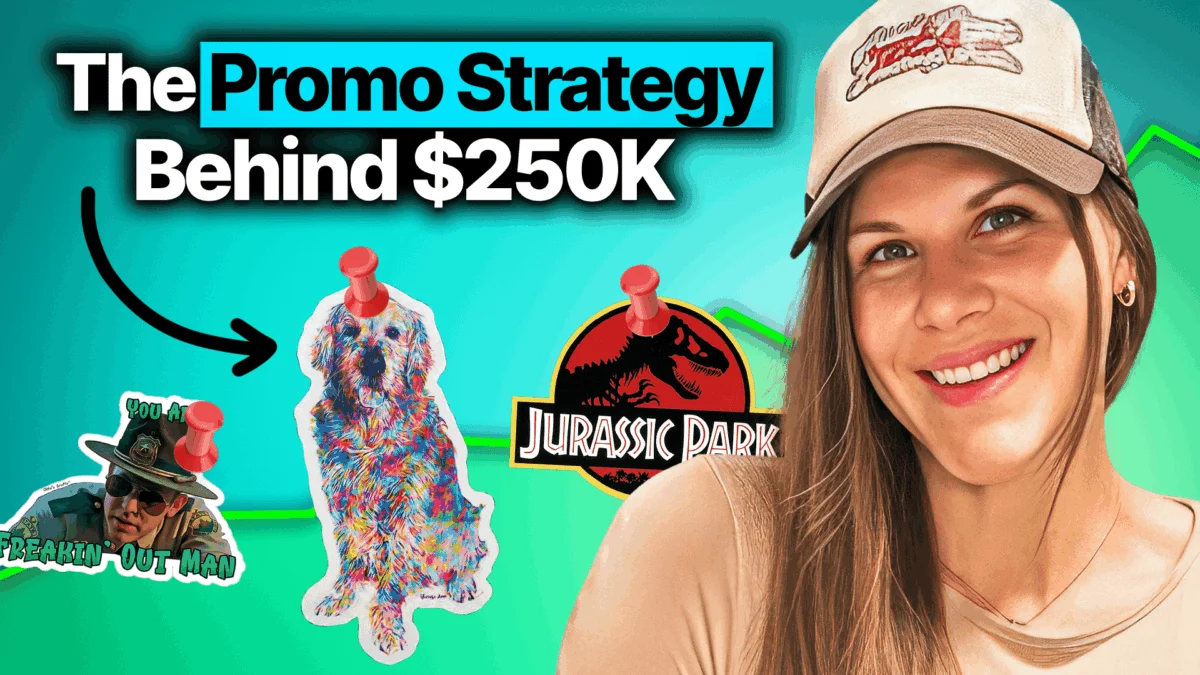
In the competitive world of e-commerce, few products seem as modest as a sticker. Yet, for entrepreneur Therese Waechter, founder of Otto’s Grotto, these adhesive designs have become the bedrock of a $250,000-per-year business. Her journey from accidental creator to a multi-platform powerhouse offers a masterclass in adaptation, technical scaling, and the art of leveraging digital ecosystems.
In a recent episode of the Niche Pursuits Podcast, Waechter sat down to deconstruct the operational architecture of her business, revealing how a pivot from t-shirt design to sticker production created a scalable, four-platform machine.
The Genesis: Accidental Beginnings and the Pivot
Waechter did not start with a grand vision of becoming a "sticker mogul." Her entry into e-commerce was marked by the trial-and-error common to many digital entrepreneurs. She began by dabbling in Amazon FBA (Fulfillment by Amazon) flips and various merchandise experiments.
The breakthrough occurred almost by happenstance: she created a single, high-performing design that resonated with a specific audience. When she tested the design as a sticker bundled with t-shirts, the market response was immediate. However, her early growth was not without turbulence.
Like many independent sellers, Waechter relied on social media platforms for traffic. When Facebook abruptly shut down her account without warning or explanation, she faced a "sink or swim" moment. This crisis served as a critical inflection point, forcing her to abandon reliance on volatile social media traffic in favor of building a resilient foundation on established, search-driven marketplaces like Etsy and Amazon.
Scaling Operations: The "In-House" Era
As demand grew, Waechter faced the classic entrepreneur’s dilemma: outsource production and sacrifice margins, or keep production in-house and manage the chaos. She chose the latter, investing in high-quality printing, laminating, and cutting equipment.
The Benefits of Vertical Integration
Bringing production in-house was a transformative decision. By managing her own manufacturing, Waechter gained three distinct advantages:
- Margin Control: Eliminating the "middleman" manufacturing fee allowed her to maximize profit per unit.
- Quality Assurance: She could personally vet the durability and aesthetic finish of every batch.
- Agility: The ability to pivot quickly to new trends meant she could capitalize on viral designs within hours, rather than waiting weeks for third-party fulfillment.
This operational maturity allowed her to handle wholesale orders with ease, providing her with a significant competitive edge regarding shipping speed—a metric that is heavily weighted by the algorithms of platforms like Amazon and Etsy.
The Four-Pillar Strategy: Diversifying Revenue Streams
Waechter’s business today is defined by a sophisticated, multi-platform approach. Each channel serves a specific function within her sales funnel:
- Etsy: Her primary hub for discovery and customer acquisition. The platform’s search-heavy interface is perfect for organic growth.
- Amazon: Leveraged for volume and "prime" status. She utilizes Amazon’s logistics network to capture customers looking for reliability and speed.
- Faire: The go-to platform for B2B wholesale. This allows Otto’s Grotto to reach brick-and-mortar retailers without the need for a dedicated sales team.
- Shopify: Her direct-to-consumer (DTC) storefront. By driving traffic here, she avoids the commission fees associated with third-party marketplaces, allowing for higher profit margins and total control over branding.
Furthermore, she strategically funnels wholesale leads to her direct website whenever possible, effectively bypassing the 15% commission fees typically charged by wholesale aggregators like Faire.
Mastering the Algorithm: Platform-Specific Tactics
One of the most valuable insights shared in the podcast is Waechter’s "Platform-Specific Scaling" methodology. She rejects the "one-size-fits-all" approach to SEO and content.
Amazon Strategies
For Amazon, she focuses on high-intent keywords. Because Amazon is a search engine disguised as a store, she optimizes her listings for conversion rather than just vanity metrics. This includes aggressive use of internal advertising and ensuring that product titles and backend search terms align perfectly with high-volume buyer intent.
Etsy Strategies
Etsy is a different beast entirely. Waechter treats it as a community-driven platform. Her success here hinges on high-quality photography and seasonal updates. By constantly cycling designs and utilizing "Etsy Ads" during peak shopping windows, she keeps her products in front of buyers who are already predisposed to supporting small, independent creators.
The Faire Approach
On the B2B side, Waechter focuses on "ease of stocking." Retailers want products that move quickly. Her strategy involves creating "bundle deals" that lower the barrier to entry for shop owners. By keeping her wholesale catalog streamlined and her communication transparent, she ensures that once a retailer buys from her once, they are likely to reorder.
Technological Evolution: AI and "Vibe Coding"
Waechter has gained a reputation for what she calls "vibe coding"—a term that has caught the attention of mainstream media outlets like Business Insider. In the context of her business, this refers to the use of Large Language Models (LLMs) like ChatGPT to "code" website features and marketing assets without having a formal background in computer science.
By using AI as a force multiplier, she has been able to:
- Automate repetitive customer service responses.
- Draft SEO-optimized product descriptions in seconds.
- "Debug" her website’s liquid code to implement minor design tweaks.
While she acknowledges that AI can lead to "side quests"—time-consuming tasks that do not necessarily contribute to the bottom line—her disciplined use of these tools has allowed her to scale the output of her business while keeping her input (time spent) remarkably low.
The Pivot to Passive: Trade Printing
Currently, Waechter is undergoing another evolution: shifting from in-house production to a vetted trade printer. By outsourcing the physical manufacturing, she is transitioning her business from an active "maker" model to a more passive "brand owner" model.
This shift allows her to focus on high-level strategy, marketing, and design, rather than the manual labor of printing and cutting. This transition is essential for any business owner looking to scale beyond the constraints of their own physical time.
Implications for Future Entrepreneurs
The trajectory of Otto’s Grotto is not just a story about stickers; it is a blueprint for modern e-commerce. The core takeaways for any aspiring entrepreneur are clear:
- Diversify or Die: Never rely on a single platform. If Facebook can shut down a business overnight, so can Amazon or Etsy. Build your own website (Shopify) as a safety net.
- Optimize for the Algorithm: Learn the nuances of each platform. What works on Amazon will fail on Etsy. Tailor your marketing and SEO strategies to the specific user behavior of each channel.
- Embrace "Earned Media": Waechter uses platforms like Qwoted to secure press features. This not only builds brand authority but provides powerful backlinks that improve her SEO ranking.
- Automate Early: Use tools like AI to bridge the gap between your ambition and your technical skill set.
Final Thoughts
Therese Waechter’s journey proves that the "side hustle" is not dead; it has simply become more professionalized. By treating a sticker business with the same rigor and strategic planning as a tech startup, she has created a sustainable, six-figure income stream. Her success is a testament to the power of constant iteration, the courage to pivot when things break, and the wisdom to know when to stop doing the work yourself and start managing the business.
For those looking to replicate her success, the path is open. It starts with a single, compelling design, a willingness to learn, and the strategic foresight to scale across multiple digital borders.