In the high-stakes world of performance marketing, predictability is the ultimate currency. On August 17, Google Ads will implement a fundamental change to its bidding architecture that promises to standardize performance across its automated suite. While Google positions this update as a move toward greater consistency and alignment with advertiser goals, the industry is bracing for a period of potential volatility.
For many, the update marks a shift from a “best-effort” optimization model to a “target-strict” model. For others, it represents a potential constraint on the runaway success of high-performing campaigns. As the deadline approaches, advertisers are scrambling to audit their account structures, evaluate their Return on Ad Spend (ROAS) targets, and decide whether to lean into Google’s new automated guardrails or pivot their strategies entirely.
The Core Change: Redefining Target-Based Bidding
At the heart of the August 17 update is a refinement of how Google’s machine learning interprets Target Cost Per Acquisition (tCPA) and Target Return on Ad Spend (tROAS) bidding strategies.
Historically, Google’s algorithms have operated with a degree of elasticity. If an advertiser set a tROAS goal of 300%, but the campaign’s actual performance—driven by favorable market conditions or high-intent traffic—hit 500%, the system generally allowed that over-performance to continue. The logic was simple: if the algorithm could achieve higher efficiency, it should.
Under the new directive, Google is prioritizing the target above all else. If your target is 300%, Google will now aggressively steer the algorithm to hit that 300% mark, even if the campaign is currently trending at 500%. The system will effectively “optimize downward” to force the campaign back into the target’s parameters. While Google claims this will create more predictable, goal-oriented outcomes, critics argue that this effectively punishes high-performing campaigns by capping their potential reach and revenue efficiency.
Chronology of the Update
The path to this update has been marked by a series of quiet shifts in Google’s automation philosophy over the past eighteen months.
- Q1 2026: Google began signaling to premium partners that the disparity between “Target” and “Actual” performance was causing confusion, particularly for small-to-medium-sized businesses (SMBs) who struggled to forecast budgets when campaigns exceeded their ROAS targets.
- June 2026: Official announcements were circulated via the Google Ads support hub, detailing the transition. Google introduced the “Bid Target Adjustment Tool,” a diagnostic interface designed to show advertisers the delta between their current targets and their recent performance averages.
- July 2026: Advertisers entered a “prep window,” during which they were encouraged to use the adjustment tool to audit their portfolio. During this time, early-adopter agencies reported varying results, with some noting that the tool identified hundreds of campaigns where “downward optimization” would be triggered on August 17.
- August 17, 2026: The global rollout date. Starting on this day, the bidding architecture will switch to the new strict-adherence model for all target-based campaigns.
The Bid Target Adjustment Tool: A Necessary Diagnostic
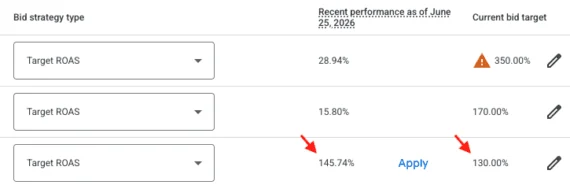
To mitigate the shock of this transition, Google has provided a diagnostic tool that highlights exactly where a campaign’s current performance deviates from its stated goal.
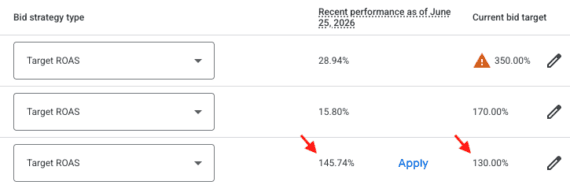
When an advertiser opens the tool, they are presented with a table showing active campaigns, their target ROAS, and their actual ROAS over a recent lookback period. If a campaign is currently over-performing, the tool flags it with a warning icon. This is the “danger zone.” If an advertiser does nothing, the algorithm will, as of August 17, begin systematically reducing bids to bring that performance down to the target.
The implication is clear: Google is forcing advertisers to acknowledge that their historical goals may be obsolete. If your campaign is hitting 150% ROAS despite a 100% target, Google is essentially telling you: "You are no longer allowed to be that efficient. We are going to prioritize hitting the 100% target."
Implications for Advertisers: Strategic Choices
Advertisers are now faced with four distinct paths forward, each with its own set of trade-offs regarding budget, scale, and profitability.
1. Maintaining the Status Quo
The simplest approach is to do nothing. For campaigns that are currently performing exactly where the advertiser wants them, or for those where efficiency is secondary to volume, the update may have little to no impact. However, for campaigns that have been “riding the wave” of organic over-performance, this choice will likely lead to a contraction in total revenue as the system suppresses high-value auctions to keep the ROAS within the target window.
2. Gradually Increasing Targets
For advertisers who want to maintain their current high performance, the recommendation is to increase the target ROAS to match actual performance. However, Google warns against radical, overnight changes. A recommended best practice is an iterative approach: increase the target by no more than 20% every two weeks. This allows the machine learning model to stabilize while gradually raising the ceiling of the campaign’s goal.
3. Adjusting Custom Targets
In cases where performance is significantly higher than the target—for example, a 500% actual ROAS versus a 300% target—a gradual increase may take months to normalize. In these scenarios, advertisers should perform a one-time adjustment to a more realistic goal. This requires a deep analysis of market conditions: is the current 500% ROAS sustainable, or is it a seasonal anomaly? Setting a target that is too high can lead to the algorithm “starving” the campaign of traffic, resulting in a sudden drop-off in conversion volume.
4. Switching to “Maximize” Strategies
If the goal of the campaign is primarily growth, the switch to “Maximize Conversions” or “Maximize Conversion Value” may be the most prudent move. These strategies do not rely on a fixed ROAS percentage. Instead, they focus on spending the available budget to generate the highest possible return. The trade-off is a potential decrease in efficiency (lower ROAS), but a significant increase in total conversion volume. This is often the preferred route for scaling brands that have moved past the initial efficiency-gathering phase.
Supporting Data and Risk Assessment
The primary risk identified by industry analysts is the “Account-Level Drag.” Even if a single campaign’s move to a lower ROAS seems negligible, the cumulative effect across an entire account can be catastrophic.
Consider an account with ten campaigns, all with varying ROAS targets. If five of those campaigns are currently exceeding their targets by 50% or more, they are providing a significant buffer to the overall account ROAS. Once the August 17 update forces these campaigns down to their target levels, the overall account efficiency could drop sharply. Advertisers must therefore model the impact not just at the campaign level, but at the portfolio level.
Furthermore, budget-limited campaigns are expected to be the most volatile. Because these campaigns are already fighting for space, any adjustment in the bidding logic—especially one that prioritizes a strict ROAS target over volume—could lead to a sudden, unexpected decline in daily spend, as the system refuses to enter auctions that don’t meet the exact, newly enforced efficiency threshold.
Official Responses and Industry Outlook
Google has maintained a consistent narrative throughout the rollout: the update is about “predictability.” In their documentation, they emphasize that advertisers often find it difficult to manage budget pacing when their campaigns fluctuate wildly above their targets. By forcing a strict target, Google claims it can better manage the auction environment, ensuring that the budget is spent steadily throughout the day rather than being front-loaded on high-efficiency, high-intent searches.
However, the sentiment from the digital marketing community is one of skepticism. Many veteran media buyers view this as a way for Google to ensure that budget is spread more evenly across their entire network, potentially pushing spend into lower-intent inventory that wouldn’t have been profitable under the old, looser guidelines.
"The keyword here is ‘predictability,’" says one senior search consultant. "But for a performance marketer, predictability is often the enemy of growth. We want the algorithm to seize every opportunity it can find. If it finds a way to get a 500% return, we don’t want it to ‘correct’ that back to 300%. We want it to double down."
Final Preparation Checklist
As August 17 looms, advertisers should complete the following steps to ensure their accounts remain resilient:
- Audit the Adjustment Tool: Log into your Google Ads account and check the status of all campaigns currently utilizing tCPA or tROAS.
- Model the Impact: Calculate what the change in ROAS will look like for your total account revenue. Will a drop in ROAS efficiency significantly impact your bottom-line profitability?
- Define Strategy per Campaign: Categorize campaigns into “Growth” (should switch to Maximize Conversion Value) and “Efficiency” (should have their targets updated to match actuals).
- Monitor the Transition: For the 48 hours following August 17, increase the frequency of account monitoring. Watch for unexpected dips in spend or volume, which would indicate that the algorithm is over-correcting.
- Re-evaluate Creative and Landing Pages: If you are forced to lower your ROAS target to maintain volume, ensure your landing pages are optimized for a higher volume of traffic. If you are forced to keep your target high and lose volume, optimize your conversion rate to maximize the limited traffic you are receiving.
The August 17 update is a clear signal that the era of “set it and forget it” automation is coming to an end. While Google’s algorithms have become more powerful, they have also become more rigid. Success in this new environment will require a proactive approach, constant vigilance, and a willingness to move away from legacy strategies that no longer align with Google’s new, stricter definition of performance.