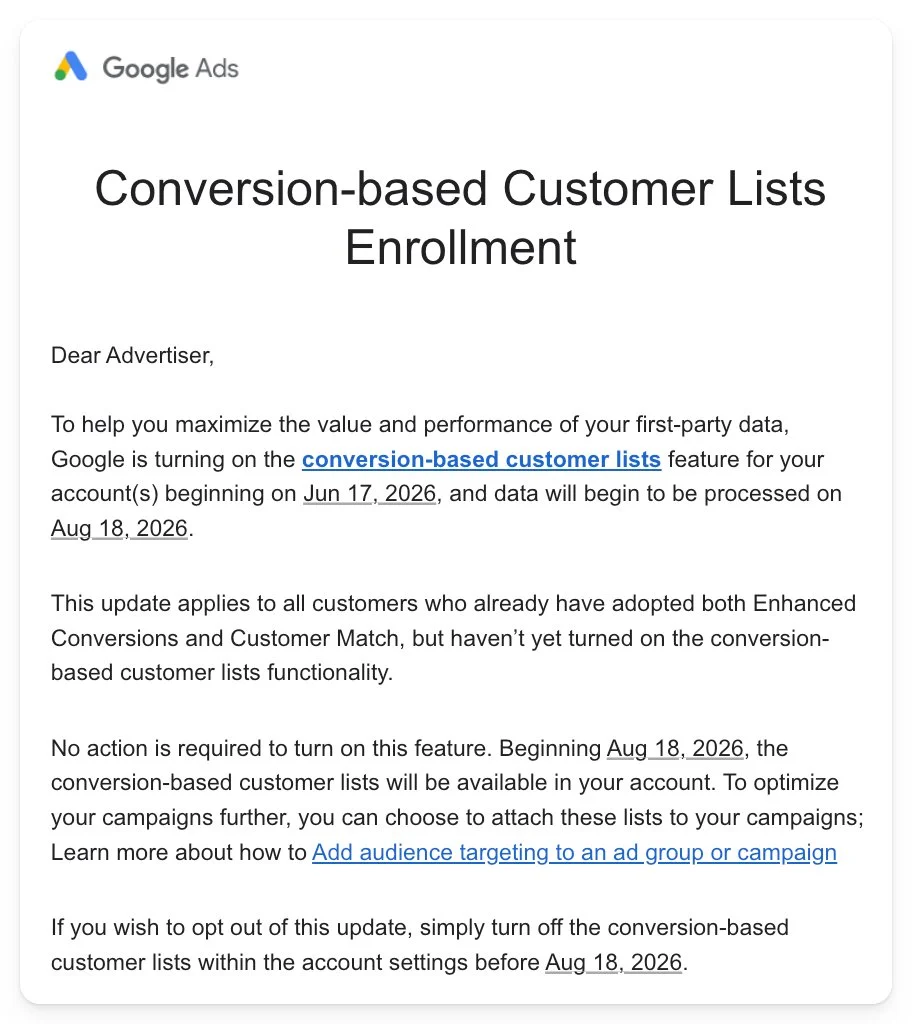
In an ongoing effort to streamline audience targeting and leverage first-party data in a privacy-conscious advertising landscape, Google has announced a significant update to its Google Ads platform. Starting August 18, Google will automatically enable conversion-based customer lists for all eligible advertiser accounts.
This update represents another major step in Google’s automation-first roadmap. It is designed to bridge the gap between conversion tracking and audience building by automatically converting transaction data into targeting assets. However, because this change operates on an "opt-out" rather than an "opt-in" basis, it has sparked widespread discussion across the digital marketing community regarding data privacy, user consent, and account control.
Below is a comprehensive breakdown of the update, its technical background, the broader industry context, and the strategic implications for advertisers.
1. Main Facts: The Core of the Update
The upcoming automation directly impacts a specific subset of advertisers: those who are already utilizing both Enhanced Conversions and Customer Match but have not yet manually activated conversion-based customer lists.
Key Details of the Rollout:
- Effective Date: Data processing and list generation are scheduled to begin automatically on August 18.
- Eligible Accounts: Advertisers who currently have both Enhanced Conversions and Customer Match active in their Google Ads accounts.
- Mechanism: Google will automatically extract hashed, first-party customer data captured during user conversions and compile it into dynamic Customer Match lists.
- Advertiser Action Required: None, if the advertiser wishes to use the feature. The lists will automatically populate within the Audience Manager section of the Google Ads dashboard.
- Opt-Out Deadline: Advertisers who do not wish to have these lists automatically generated must manually opt out within their account settings prior to August 18.
Once these lists are generated, they will not automatically be applied to active campaigns. Instead, advertisers will have the discretion to attach these automatically generated audiences to campaigns and ad groups as targeting criteria, observation segments, or exclusion lists.
2. Chronology: The Evolution of Google’s First-Party Data Ecosystem
To understand why Google is implementing this change now, it is essential to trace the chronological development of its core data-matching and privacy-centric tracking tools over the last decade.
[2015] Customer Match Launched (Manual CSV uploads of first-party data)
   │
[2021] Enhanced Conversions Introduced (Privacy-safe hashing of conversion data)
   │
[2022-2023] API-Based Integrations & Customer Match Expansions (Automating list updates)
   │
[August 18] Automated Conversion-Based Customer Lists (Bridging tracking and targeting automatically)
The Genesis of Customer Match (2015)
Google introduced Customer Match in 2015 as a response to the growing importance of first-party data. Initially, the feature required advertisers to manually format and upload CSV files containing customer contact details (such as email addresses, phone numbers, and physical addresses). Google would then match this data against its logged-in user database to create targetable audience segments.
The Launch of Enhanced Conversions (2021)
As third-party cookies began to face technical restrictions from web browsers (like Apple’s Safari and Mozilla’s Firefox) and regulatory pressure from global authorities, conversion attribution became less reliable. In response, Google introduced Enhanced Conversions in 2021. This feature allowed advertisers to send hashed, self-reported customer data from their website conversion tags directly to Google in a secure, privacy-safe manner (using the SHA256 algorithm). This drastically improved attribution accuracy by matching conversion events back to Google ad clicks.
Bridging the Gap (The Present Update)
Historically, Customer Match and Enhanced Conversions operated in separate silos. Enhanced Conversions was used purely for measurement and attribution, while Customer Match was used for audience targeting and bid optimization.
The August 18 update officially merges these two workflows. By automatically enabling conversion-based customer lists, Google is removing the manual step of exporting conversion data and re-uploading it as a Customer Match list. The data collected via Enhanced Conversions will now flow directly into Customer Match audience lists in real-time.
3. Supporting Data: The Macro Shift to First-Party Data and Automation
Google’s decision to automate conversion-based customer lists is not occurring in a vacuum. It is a direct response to macroeconomic, regulatory, and technical shifts reshaping the global advertising industry.
The Privacy and Regulatory Landscape
Global privacy regulations such as the European Union’s General Data Protection Regulation (GDPR), the California Consumer Privacy Act (CCPA/CPRA), and the EU Digital Markets Act (DMA) have placed stringent limits on how consumer data can be tracked, shared, and targeted.
Furthermore, although Google recently adjusted its timeline for deprecating third-party cookies in Chrome—opting instead to introduce a user-choice prompt—the overall trajectory of the industry remains clear: third-party data is depreciating in value and availability.
| Metric / Trend | Impact on Advertisers | Google’s Automated Solution |
|---|---|---|
| Browser Cookie Blocking | Loss of standard remarketing pools. | Hashed first-party matching via Enhanced Conversions. |
| Regulatory Compliance | Strict consent requirements for targeting. | Conversion-based lists leverage direct first-party consent. |
| Data Decay | Manual lists quickly become outdated. | Real-time, dynamic list updates as conversions occur. |
According to industry benchmarks, brands that successfully integrate first-party data into their digital marketing programs realize up to a 2.9x increase in revenue lift and a 1.5x increase in cost savings compared to those that do not. Despite this, many mid-sized and small advertisers struggle with the technical hurdles of setting up continuous API feeds or manually managing customer databases. By automating the pipeline from conversion tracking to audience creation, Google is aiming to democratize high-level first-party data strategies.
4. Industry Reactions and Official Responses
The news of this automatic enablement was first spotted and shared publicly by digital marketing expert Menachem Ani, Founder of JXT Group, who posted a screenshot of the official notification on the social media platform X (formerly Twitter).
The reaction from the Pay-Per-Click (PPC) and search engine marketing (SEM) community has been mixed, highlighting a familiar tension between Google’s automation goals and advertisers’ desire for control.

The Pro-Automation Perspective
Supporters of the update argue that it eliminates friction. For lean marketing teams and small business owners who lack dedicated data engineering resources, setting up automated Customer Match pipelines via Google Ads API or third-party tools (like Zapier) can be cost-prohibitive or technically daunting.
By automating the creation of these lists, Google ensures that even smaller advertisers can benefit from advanced audience signals, which are critical for feeding modern machine learning campaigns like Performance Max (PMax) and Smart Bidding.
The Skeptical / Control-First Perspective
Conversely, many agency professionals and enterprise-level advertisers have expressed concern over Google’s "auto-opt-in" approach. A common criticism of the modern Google Ads ecosystem is the platform’s tendency to automatically apply settings and recommendations that can sometimes lead to unintended ad spend or compliance issues.
Critics point out several potential operational bottlenecks:
- Consent Discrepancies: An individual who consents to have their data used for transaction tracking (Enhanced Conversions) may not have consented to have their data used for targeted advertising or remarketing (Customer Match), particularly under strict interpretations of the GDPR and the DMA.
- Data Quality Control: Automatically generated lists do not allow advertisers to filter out low-value converters, spam leads, or one-time purchasers before they are fed back into the targeting engine.
- Lack of Transparency: Some marketers prefer to maintain clear boundaries between measurement data and targeting data to ensure clean A/B testing and accurate attribution modeling.
5. Strategic Implications for Digital Marketers
The integration of Enhanced Conversions and Customer Match into a unified, automated pipeline carries deep strategic implications for how campaigns are managed, structured, and optimized.
A. Enhancing Smart Bidding and Performance Max
Google’s Smart Bidding algorithms and Performance Max campaigns rely heavily on audience signals to find high-converting users. By feeding real-time, conversion-based customer lists back into the Google Ads algorithm, advertisers provide the system with a continuous stream of high-intent user profiles.
This feedback loop allows Google’s AI to:
- Identify common characteristics among recent converters.
- Optimize bidding strategies to target prospective customers who share those exact traits (Lookalike targeting).
- Exclude recent buyers from awareness campaigns to prevent wasted ad spend on existing customers.
B. Navigating Compliance and Consent Mode
The automation of conversion-based customer lists places a premium on correct Consent Mode implementation. If your website operates in regions governed by GDPR or CCPA, you must ensure that your consent banners are technically aligned with Google Ads.
If a user rejects advertising cookies but accepts analytical cookies, or rejects personalization entirely, your tracking tags must accurately reflect this status. Failing to align your consent management platform (CMP) with Google’s automated list generation could result in policy violations, account suspensions, or regulatory fines.
User visits site ➔ Consent Banner ➔ If "Ad Personalization" accepted ➔ Data added to Conversion-Based List
                                  ➔ If "Ad Personalization" denied  ➔ Data excluded from targeting list
C. The Operational Trade-Off: Efficiency vs. Granularity
While automation increases operational efficiency, it reduces granularity. Advertisers who require precise segmentation—such as separating customers based on high lifetime value (LTV), product category interest, or purchase frequency—will still need to manage their Customer Match lists manually or via API. The automatically generated lists are broad by nature, capturing all converting users indiscriminately.
6. Actionable Guide: How to Prepare, Manage, or Opt Out
With the August 18 deadline approaching, advertisers should take immediate steps to audit their accounts and decide on their preferred course of action.
Step-by-Step: How to Opt Out
If you decide that automated conversion-based customer lists are not appropriate for your business model, privacy policy, or targeting strategy, you can opt out by following these steps within your Google Ads account:
- Log into your Google Ads account.
- In the left-hand navigation menu, click on the Tools and Settings icon (represented by the wrench).
- Under the Shared Library column, select Audience Manager.
- From the left-side menu within Audience Manager, click on Settings.
- Locate the section labeled Conversion-based customer lists.
- Uncheck the box or toggle the setting to Disable the automatic generation of these lists.
- Click Save.
Checklist for Advertisers Choosing to Opt In
If you choose to embrace this automated update, use the following checklist to ensure a seamless transition:
- [ ] Audit Consent Banner: Verify that your site’s Consent Management Platform (CMP) correctly maps user consent to Google’s Consent Mode API, specifically for
ad_user_dataandad_personalization. - [ ] Review Account Settings: Confirm that both Enhanced Conversions and Customer Match are active and correctly configured.
- [ ] Plan Exclusion Strategies: Prepare to use the new automatically generated lists as exclusions in your acquisition campaigns to prevent showing retention ads to recent converters.
- [ ] Monitor List Sizes: Post-August 18, check your Audience Manager periodically to monitor the growth and match rates of the newly created conversion-based lists.
Conclusion
Google’s shift toward automatically enabling conversion-based customer lists highlights the platform’s focus on automation and first-party data. By linking measurement directly with audience creation, Google is helping advertisers build more effective targeting loops with minimal manual setup.
However, because this feature relies on an opt-out rollout, it requires immediate attention. Marketers must evaluate their data compliance, consent frameworks, and campaign strategies before the August 18 data processing deadline to ensure their accounts remain both compliant and performant.