By TechCrunch Reporting Staff
July 16, 2026
In the rapidly shifting landscape of generative artificial intelligence, the narrative surrounding AI video production has hit a significant inflection point. Following the high-profile shutdown of OpenAI’s Sora earlier this year—a move that left a vacuum in the creative tech space—Google has signaled that it is doubling down on its own vision for the medium. On Thursday, the tech giant announced a major suite of updates to Google Vids, transforming the platform from a simple presentation tool into a comprehensive, multi-modal video creation powerhouse.
The update centers on the integration of Gemini Omni, Google’s advanced multi-modal model, and the introduction of highly realistic, user-generated "Personal Avatars." This strategic pivot places Google in direct competition with established industry players like HeyGen, Synthesia, and Captions, while simultaneously attempting to set a new standard for ethical AI deployment in the workplace.
Main Facts: The New Capabilities of Google Vids
The latest iteration of Google Vids is designed to bridge the gap between amateur video production and professional-grade content. By leveraging Gemini Omni, the platform can now interpret complex, multi-modal inputs to generate, edit, and refine video content with unprecedented speed.
The Personal Avatar Initiative
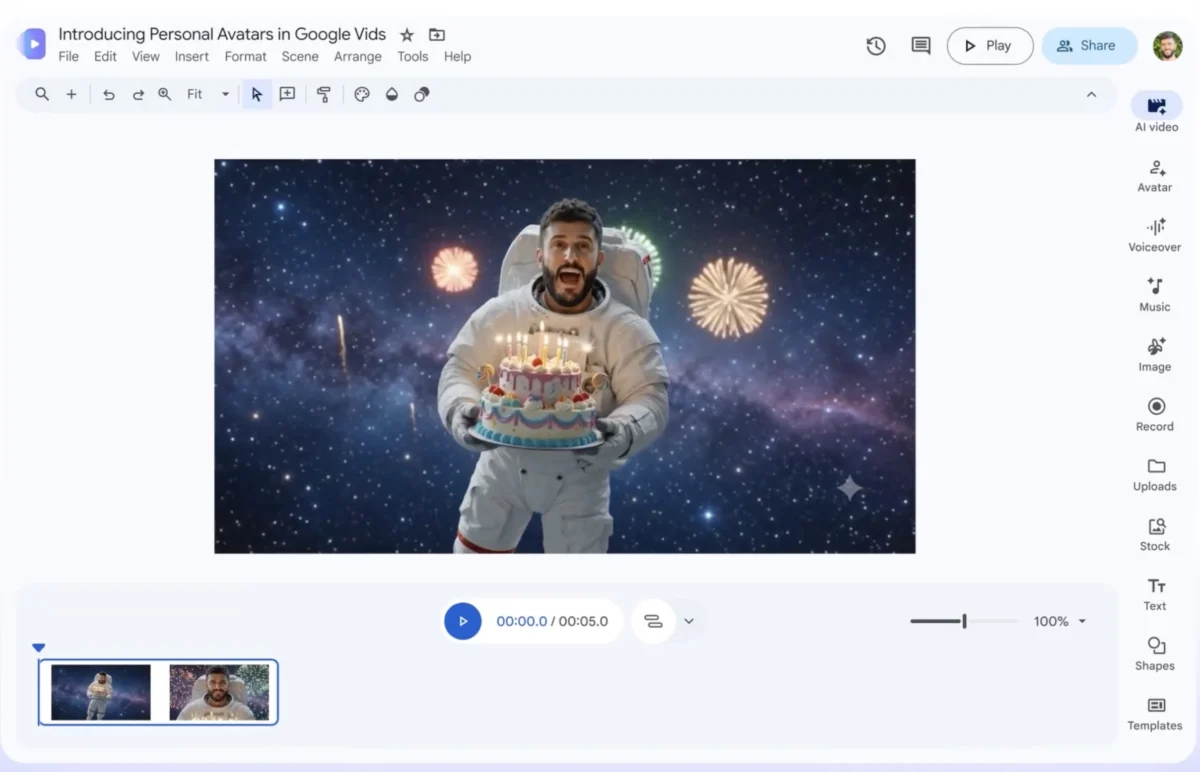
The most striking feature is the new ability to create a "Personal Avatar." Users can now upload a single selfie and a brief voice recording to generate a digital clone that mirrors their appearance and cadence. This functionality is not merely for entertainment; it is engineered for efficiency. A manager, for instance, can record a script once and have their digital twin deliver that message across multiple languages or in different professional contexts without requiring constant re-recording.
Gemini Omni Integration
Gemini Omni serves as the engine behind this transformation. Unlike previous iterations of video AI that relied solely on text-to-video prompts, Omni allows for a "mixed-input" approach. Users can provide a written prompt alongside reference images, allowing the model to synthesize the aesthetic and narrative direction requested by the user.
Furthermore, the integration introduces:
- Intelligent Editing: Omni can now perform background swaps, lighting corrections, and visual effect overlays on raw footage captured via smartphone.
- Iterative Workflow: The "step-by-step" editing feature allows users to refine specific segments of a video without the need to re-render the entire project, a significant time-saver for corporate communications teams.
A Chronology of the AI Video Evolution
To understand the weight of this announcement, one must look at the turbulent timeline of AI video development over the past 18 months.
- Early 2026 (The Sora Era): OpenAI introduced Sora to massive acclaim, showcasing high-fidelity, long-form AI video generation. It quickly became the "creepiest" and most debated app on smartphones, as users pushed the boundaries of deepfakes and surrealist imagery.
- March 2026 (The Shutdown): Faced with mounting ethical concerns, safety risks, and the immense compute costs required to maintain high-quality video generation, OpenAI made the surprise decision to shutter Sora, pivoting its focus back to core language models and internal research.
- May 2026 (The Rise of Omni): Google unveiled Gemini Omni, a model specifically architected to handle audio, vision, and text simultaneously in real-time. This laid the foundation for the video-editing capabilities announced today.
- July 2026 (The Vids Expansion): Google officially repositions Vids from a niche "Workspace presentation" plugin to a primary video creation platform, directly targeting the enterprise market.
Supporting Data and Market Positioning
The decision to bake these features into Google Workspace is a calculated play for market dominance. Currently, the enterprise video creation space is fragmented. Companies like HeyGen and Synthesia have successfully carved out niches by providing high-end avatars for HR onboarding, training, and marketing. Captions has similarly dominated the mobile-first content creation space.
By integrating these features directly into Google Drive and the Workspace ecosystem, Google is eliminating the "friction of movement." Users no longer need to export raw footage to third-party AI sites; the entire lifecycle—from filming on a phone to final edit and distribution—happens within the familiar Google interface.
Security and Ethical Guardrails
Google is acutely aware of the "deepfake" stigma associated with AI avatars. To mitigate these risks, the company has implemented several safeguards:
- SynthID Watermarking: All AI-generated content produced via Vids will feature an invisible, cryptographically verifiable watermark.
- Account-Bound Likeness: Personal Avatars are strictly tied to the verified identity of the Google account holder.
- Age Restrictions: Access to the avatar generation tool is restricted to users 18 and older, and availability is geographically gated to ensure compliance with local AI regulations.
Official Responses and Strategic Implications
In their blog post, the Google Workspace team emphasized that these tools are intended to "democratize professional storytelling."
"We want to move beyond the idea that video creation requires a studio, a crew, or specialized editing software," a Google spokesperson stated. "By bringing the power of Gemini Omni into the flow of work, we are enabling teams to share updates and training material at the speed of thought."
Industry analysts, however, are watching the move with a mix of optimism and caution. The primary question is whether enterprises will embrace AI-cloned avatars for internal communication. While the efficiency gains are undeniable, the cultural shift required for employees to accept being "replaced" by their own digital twins in training videos is a hurdle that technology alone cannot overcome.
Implications: The Future of Corporate Content
The shift toward AI-generated video in the workplace has profound implications for several sectors:
1. The Death of the "Corporate Video Shoot"
For years, large organizations have spent thousands of dollars hiring production crews for simple internal updates. If an employee can generate a studio-quality video from their desk using a single selfie, the demand for traditional corporate video production may shrink, forcing agencies to pivot toward high-concept, high-production-value creative work.
2. The Multi-Lingual Enterprise
One of the most immediate benefits of the new Vids update is the ability to easily translate video content. By combining an avatar with AI-driven voice synthesis, a CEO in California can deliver a company-wide update in French, Japanese, and Mandarin, all while appearing to speak those languages naturally. This represents a massive leap in global inclusivity for multinational corporations.
3. The New Regulatory Frontier
Google’s implementation of SynthID and strict account-binding is a direct response to the legislative pressure currently mounting in both the U.S. and the EU. By proactively adopting these standards, Google is attempting to set the "rules of the road" for the industry, hoping that regulators will view their platform as a "safe" harbor compared to the wild-west of open-source video models.
Conclusion: A Turning Point for Google
The expansion of Google Vids is more than just a feature update; it is a declaration of intent. Google is betting that the future of business communication is visual, automated, and personalized. While the technology is impressive, the company’s success will ultimately depend on its ability to balance this powerful capability with the necessary human oversight.
As OpenAI’s Sora fades into the history books as a cautionary tale of "too much, too soon," Google is playing a different game. By tethering its AI video ambitions to the established, secure, and regulated infrastructure of Google Workspace, the company is betting that reliability, rather than just raw generative capability, is what the market wants most.
Whether these tools will be viewed as a productivity miracle or an intrusive, uncanny-valley step too far remains to be seen. For now, however, the tools are ready, and the workplace of 2026 is about to look—and sound—a lot more like you.