As artificial intelligence rapidly reshapes the digital landscape, consumer habits are undergoing a seismic shift. No longer relying solely on traditional search engines to navigate the web, millions of users now turn directly to conversational AI assistants for research, discovery, and purchasing decisions. At the epicenter of this shift is ChatGPT, which currently commands over 800 million monthly active users—roughly one-tenth of the global population—processing an astonishing two billion prompts every single day.
For digital marketers and performance-driven brands, this presents a monumental opportunity. With roughly 70% of all AI assistant traffic originating on the platform, and users increasingly utilizing it for high-intent activities like product comparison (53%) and deep research (63%), the battleground for consumer consideration has moved into the chat window.
To understand the mechanics, costs, and practical realities of this emerging digital advertising channel, industry experts recently put ChatGPT’s native ad units to the test. Here is a comprehensive look at what the channel actually does, how it performs, and what marketers need to know before allocating budget.
Main Facts: Deconstructing the ChatGPT Ad Unit
The introduction of advertising to conversational AI represents a completely new paradigm for digital marketing. Unlike traditional banner ads or search engine results pages (SERPs), ads within ChatGPT are integrated natively into the user experience, though clearly demarcated.
Anatomy of the Ad Unit
When an ad is triggered, it appears directly beneath the AI-generated response in a dedicated, clearly labeled box marked “Sponsored.” The current creative framework is straightforward and minimalist, consisting of:
- A single 1×1 image
- A headline
- A short, punchy description
- A direct call-to-action link driving traffic to the brand’s website
Targeting: Contextual, Not Demographic
For marketers accustomed to the hyper-targeted parameters of Meta, Google, or TikTok, ChatGPT’s targeting capabilities currently feel somewhat blunt. The system relies strictly on contextual targeting tied directly to the user’s prompt rather than the model’s textual reply.

Crucially, there is no audience targeting, no demographic overlay, and very little geographic control. Relevance to the specific words and intent of the user’s prompt is the primary—and often only—factor that determines whether an ad will be served.
Chronology: The Evolution of Conversational AI Monetization
The journey toward monetizing generative AI has been rapid, moving from speculative platform design to live, enterprise-level ad placements in a remarkably short timeframe.
- Late 2022 to 2023: OpenAI launches ChatGPT, capturing global attention and rapidly scaling to tens of millions of users. The platform is entirely ad-free, functioning purely as an information and productivity tool.
- 2024 to 2025: User adoption explodes globally, pushing active user metrics into hundreds of millions. Brands begin utilizing SEO and AI optimization (AIO) techniques to earn organic mentions in LLM outputs, realizing that traditional digital ad channels are missing the growing share of discovery-phase traffic happening inside chat interfaces.
- Early 2026: OpenAI rolls out structured advertising frameworks, partnering with select ad tech platforms like Criteo and StackAdapt alongside direct-buying options. Advertisers gain the ability to bid on contextual prompt triggers.
- Mid-2026 (Present Day): Initial performance data emerges from early testers. While measurement tools and audience overlays remain in their infancy, brands begin establishing benchmarks for CPMs, click-through rates (CTRs), and high-intent site behavior.
Supporting Data: Costs, Bidding Strategies, and Performance
One of the most revealing aspects of recent testing involves the financial economics of the channel. Because OpenAI utilizes an opaque relevancy model layered on top of a proto-auction system, pricing fluctuates based on the competitiveness of the prompt.
The Economics of CPMs
- Niche Prompts (Low Competition): Advertisers bidding on highly specific, low-competition prompts can secure impressions for around a $15 CPM.
- Contested Prompts (High Competition): When multiple brands fight for high-intent, broad-category prompts, prices climb rapidly, pushing toward a $60 CPM.
- Average Market Spread: Across various early-adopting brands, CPMs are generally settling between $25 and $35, while specialized testing averages out closer to $40.
[Niche Prompt: ~$15 CPM] ---> [Average Market: $25 - $35 CPM] ---> [Contested Prompt: Up to $60 CPM]Bidding Strategies: CPM vs. CPC
Industry testers strongly advise steering away from Cost-Per-Click (CPC) models within this specific channel. Because the underlying algorithmic methodology is currently opaque, bidding on a Cost-Per-Mille (CPM) basis and allowing clicks to accumulate naturally delivers a much more favorable and predictable effective cost-per-click. Furthermore, the data shows that the more tightly a brand’s creative maps to the contextual intent of the prompt, the higher the overall efficiency and click-through rates.
The Measurement Hurdle
Marketers diving into ChatGPT ads must navigate a significant transparency gap. Currently, platforms provide standard top-of-funnel metrics: impressions and clicks. There is no native conversion optimization yet, meaning brands cannot instruct the algorithm to actively chase downstream sales or lead-generation outcomes.
To evaluate ROI, performance marketers must rely on a foundational qualitative question: Do visitors arriving from ChatGPT exhibit higher downstream intent than those coming from native display, video, social, or traditional search?

By sharing pixel and conversion data with ecosystem partners, early tests reveal encouraging signs. Click-through rates are currently running comparably to native ad formats—an impressive feat for a channel this novel.
Official Routes and Investment Tiers
For brands looking to secure inventory, entry points vary significantly depending on scale, technical integration, and campaign goals. Industry partners offer three primary pathways:
- Criteo (Commerce-Focused): Ideal for retail and consumer packaged goods (CPG) brands. Criteo can ingest massive product feeds, allowing companies to stand up thousands of dynamic ads simultaneously.
- Estimated Investment: $50,000 to $100,000 per month.
- StackAdapt (Mid-Tier & Flexibility): This route provides added promotional incentives and enhanced geographic targeting capabilities.
- Estimated Investment: Approximately $50,000 per month.
- Direct with OpenAI (Enterprise): Going straight to the source offers direct platform access, though it comes with a steep financial commitment.
- Estimated Investment: Minimums sit near $250,000 per month.
Because data regarding optimal format pairings is still evolving, experts recommend establishing a clear evaluation framework before spending a dime. Define how visitor behavior will be tracked and compared against other channels, and let those metrics dictate the budget rather than jumping in blindly based on hype.
Implications for the Future of Digital Marketing
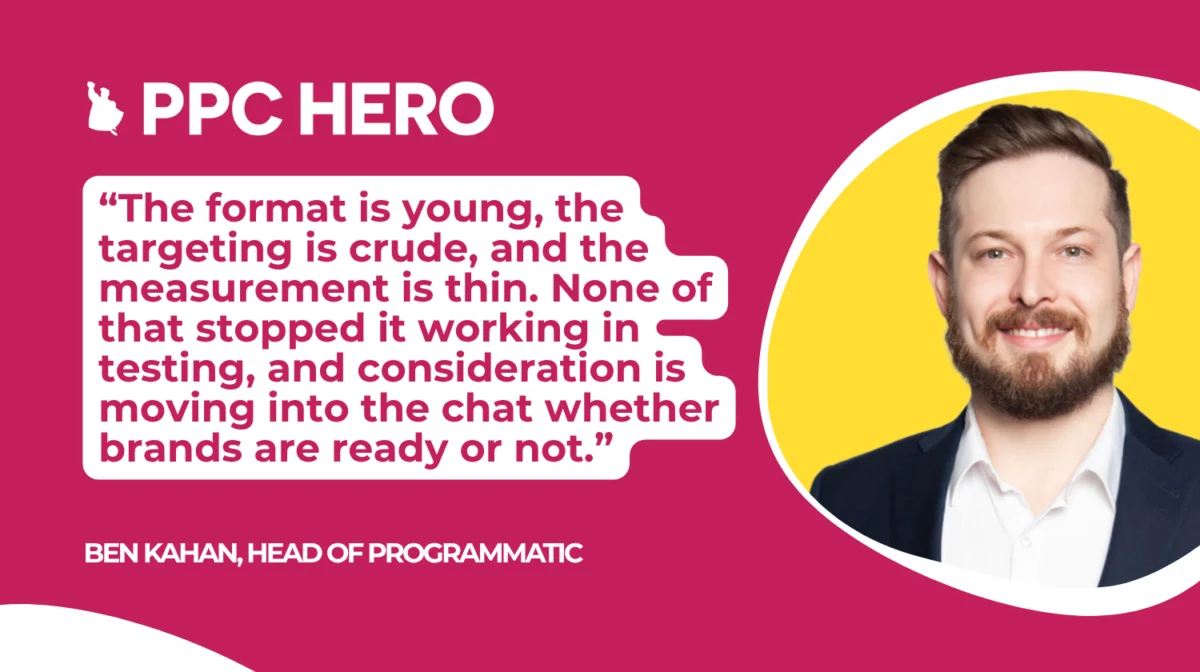
The current iteration of ChatGPT advertising is undeniably young, featuring crude contextual targeting and thin measurement tools. Yet, in real-world testing, these limitations have not stopped the channel from delivering results. Consumer consideration has permanently expanded into conversational chat interfaces, and brands cannot afford to sit on the sidelines.
For anyone who has watched programmatic advertising mature over the last decade, the trajectory ahead is entirely predictable:
- Advanced Audience Targeting: As OpenAI gathers deeper first-party interaction data, audience segmentation and user profiling are inevitable additions to the platform.
- Conversion Optimization: Algorithmic optimization for lower-funnel actions will eventually replace raw traffic generation.
- Transparent Auctions and Rising Costs: As more brands pile into the channel, competition will intensify, driving CPMs upward until ChatGPT advertising resembles the mature, highly structured channels marketers manage today.
Brands that test, learn, and adapt to conversational AI advertising today will secure a vital head start. Once the channel matures, competition heats up, and costs rise, the early-mover advantage will evaporate. The question for marketing leadership is no longer if chat interfaces will become a dominant ad medium, but whether their brand will be ready when they do.