By Andrew Bonar | Co-Founder and Editor, emailexpert
Published: October 26, 2026
Main Facts: Critical Security Patches Deployed for Mautic Ecosystem
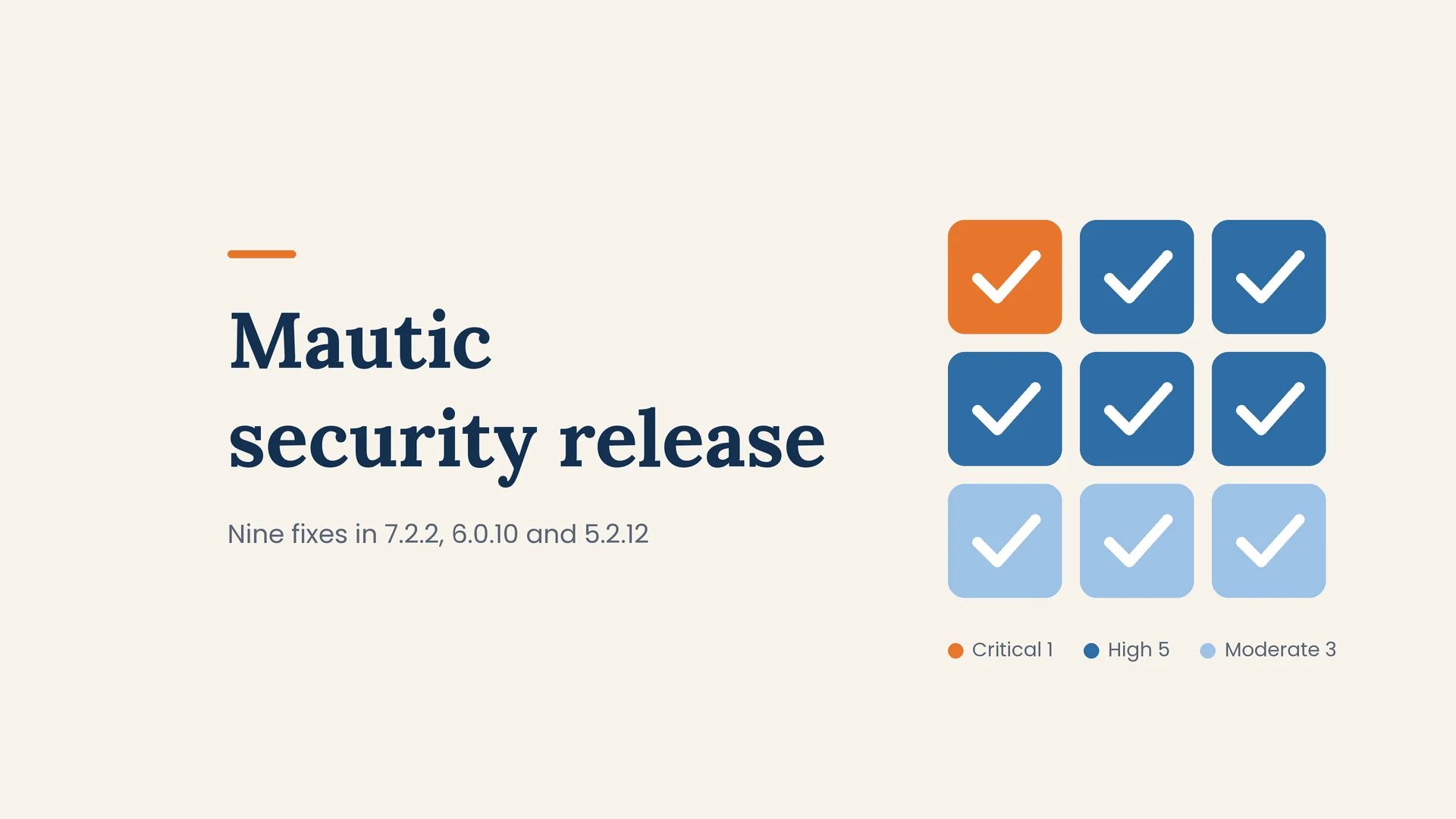
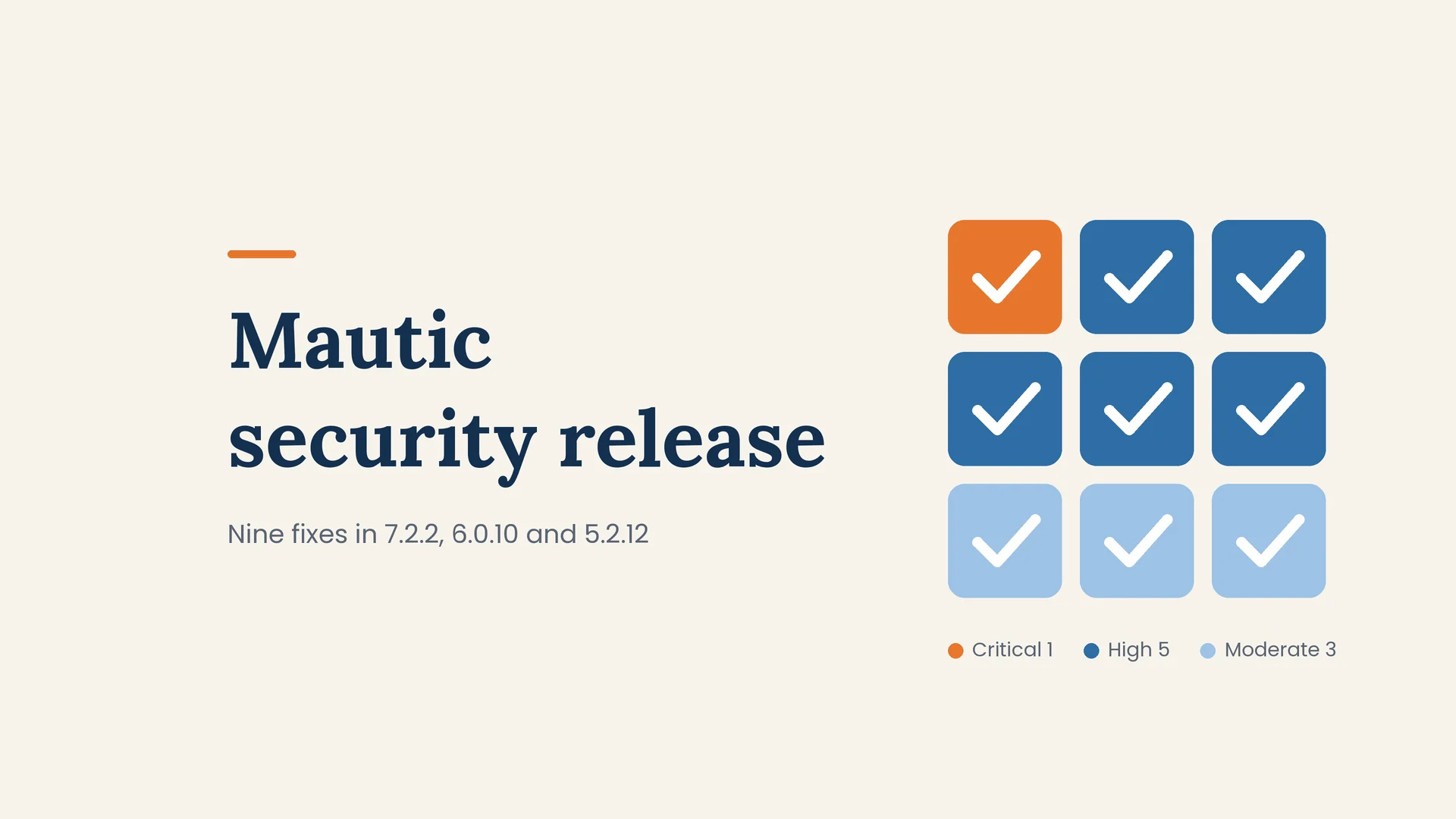
The open-source marketing automation community is on high alert following an emergency security advisory from the Mautic project. Released on October 26, 2026, the urgent updates address a total of nine distinct vulnerabilities spanning every actively maintained branch of the popular platform.
Administrators and DevOps teams managing marketing infrastructure are strongly advised to apply the latest patches immediately. The newly published versions—Mautic 7.2.2, Mautic 6.0.10, and Mautic 5.2.12—are now available on GitHub.
Among the nine fixed flaws is a critical-severity remote code execution (RCE) vulnerability exclusive to Mautic 7, alongside several high-severity issues including Twig sandbox escapes, SQL injections, and stored cross-site scripting (XSS). Because no official workarounds have been published to mitigate these vectors safely without upgrading, the project maintainers emphasize that updating the software is the only definitive defense. Operators are urged to perform full system backups, test the upgrade procedures within a staging environment, and deploy the patches to production at the earliest possible opportunity.
Chronology: From Vulnerability Discovery to Coordinated Disclosure
The discovery and remediation of these nine vulnerabilities represent a massive, multi-party effort involving the core Mautic security team, independent researchers, and corporate sponsors.
- Early 2026: Mautic introduces a template sandboxing mechanism designed to restrict uploaded themes and prevent unauthorized server execution. However, sophisticated bypass techniques are subsequently discovered by external security researchers.
- Weeks Preceding October 26, 2026: A coordinated disclosure pipeline goes into motion. A total of 47 outside security reporters collaborate to flag vulnerabilities across the Mautic codebase. Notably, 15 independent researchers contribute to identifying and reporting nuances related to the theme sandbox bypass alone.
- October 26, 2026: The Mautic project officially publishes security advisories on GitHub along with patches for branches 5, 6, and 7. The release is made possible through community-driven code reviews and is commercially sponsored by digital agency and Mautic contributor Leuchtfeuer.
- Present Day: System administrators race to patch their installations. Organizations running older, unsupported iterations—such as Mautic 4.4—find themselves forced to evaluate their options, as security backports for legacy software are restricted exclusively to the platform’s paid Extended Long Term Support (ELTS) program.
Supporting Data: Comprehensive Vulnerability Breakdown
The severity and scope of the vulnerabilities patched in the October 26 security release vary widely, ranging from critical remote code execution vectors down to moderate open redirect flaws. The table below details the CVE identifiers, impacted branches, issue descriptions, and CVSS severity ratings.
| CVE Identifier | Issue Description | Severity (CVSS) | Affected Branches |
|---|---|---|---|
| CVE-2026-115188 | Remote code execution via campaign import | Critical (9.9) | Branch 7 |
| CVE-2026-115189 | Twig sandbox escape in theme templates | High (8.8) | Branches 5, 6, 7 |
| CVE-2026-115193 | Stored cross-site scripting in HTML custom contact fields | High (8.2) | Branch 7 |
| CVE-2026-115190 | Insecure deserialization in segment filters and custom fields | High (8.0) | Branches 5, 6 (Fixed in 7.2.0 for Branch 7) |
| CVE-2026-115191 | SQL injection in contact lookup endpoint | High (7.1) | Branches 5, 6, 7 |
| CVE-2026-115192 | SQL injection in dashboard widget API | High (7.1) | Branches 5, 6, 7 |
| CVE-2026-115194 | File read via path traversal in Asset API | Moderate (6.5) | Branches 5, 6, 7 |
| CVE-2026-115195 | Broken access control in Stats API | Moderate (6.5) | Branches 5, 6, 7 |
| CVE-2026-115196 | Open redirect in form submission | Moderate (5.4) | Branches 5, 6, 7 |
Deep Dive into High-Risk Attack Vectors
1. The Critical Campaign Import RCE (CVE-2026-115188)
Rated at a severe 9.9 on the CVSS scale, this vulnerability affects Mautic 7 exclusively. It targets the platform’s campaign import mechanism, allowing any logged-in user who possesses campaign import permissions to strategically place files directly into a public web directory through either the standard web interface or the API. Crucially, full administrator rights are not required to execute this attack.
On server configurations that honor per-directory configuration rules—including the default Apache setup embedded within the official Mautic Docker image—this file placement directly triggers remote code execution. An attacker could theoretically upload a malicious script and execute arbitrary system commands under the permissions of the web server user.
2. Twig Sandbox Escape (CVE-2026-115189)
Affecting branches 5, 6, and 7 with an 8.8 CVSS score, this vulnerability exploits template rendering engines. Mautic previously implemented a Twig template sandbox to prevent uploaded custom themes from executing arbitrary code on the underlying host operating system. However, this flaw allows users with theme-creation privileges (which are granted to administrators by default) to bypass the sandbox restrictions and achieve server-side code execution. The new patch introduces significantly tighter validation and isolation rules to close the escape vector.
3. Asset API Path Traversal (CVE-2026-115194)
While classified with a moderate CVSS score of 6.5, this path traversal vulnerability carries immense indirect risk for enterprise deployments. An authenticated API user with asset-creation rights can leverage the flaw to read arbitrary files accessible to the web server user. This includes sensitive system files and, most dangerously, Mautic’s core configuration files containing plaintext database passwords and outbound SMTP credentials. Because published assets are typically public-facing, successful exploitation could expose critical infrastructure credentials to unauthorized external actors.
Official Responses and Community Collaboration
The sheer volume of vulnerabilities addressed in this patch cycle highlights both the complex attack surface inherent to enterprise marketing automation platforms and the resilience of open-source security collaboration.
The Mautic project publicly acknowledged and credited 47 separate external security researchers for discovering and responsibly disclosing the vulnerabilities. The overwhelming response—particularly the 15 independent disclosures dedicated to the template sandbox escape—demonstrates robust external auditing of the codebase.
Furthermore, the operational weight of coordinating, testing, and releasing updates across three distinct software branches was heavily supported by enterprise partners. The core team highlighted the financial and organizational backing of Leuchtfeuer, a prominent European digital agency and long-time Mautic contributor, which sponsored the release cycle to ensure timely delivery of the patches.
In their official release notes, project maintainers reiterated that no official workarounds or hotfixes exist for these vulnerabilities outside of applying the official updates. Organizations running legacy environments face tough choices:
- Mautic 7 users must upgrade immediately to version 7.2.2.
- Mautic 6 users must upgrade to version 6.0.10.
- Mautic 5 users must upgrade to version 5.2.12.
- Mautic 4.4 users are left in a precarious position, as patches for legacy branches are locked behind Mautic’s commercial Extended Long Term Support (ELTS) program. Organizations still running Mautic 4 without an ELTS subscription must either budget for the support program or accelerate their migration plans to a supported branch.
Implications for Marketing Operations and Enterprise Security
The discovery of critical RCE and SQL injection flaws in an enterprise marketing platform underscores a broader security reality: marketing technology (MarTech) stacks are increasingly becoming prime targets for cybercriminals.
Marketing platforms like Mautic sit at the intersection of customer data repositories, third-party API integrations, and outbound communication channels. A successful breach via an unpatched RCE vulnerability does not merely compromise a single landing page; it provides malicious actors with a permanent foothold inside corporate internal networks. From there, attackers can pivot to harvest customer personally identifiable information (PII), abuse SMTP relays to dispatch massive spam and phishing campaigns, or execute ransomware payloads.
Recommended Action Plan for DevOps and IT Teams
- Immediate Staging Tests: Clone current production databases and file systems into an isolated staging environment.
- Apply Version-Specific Patches: Deploy Mautic 7.2.2, 6.0.10, or 5.2.12 depending on the active environment.
- Audit User Permissions: Review role-based access controls (RBAC) across the Mautic instance. Restrict high-risk capabilities—such as campaign imports, custom HTML contact fields, and theme management—strictly to verified, trusted administrative personnel.
- Monitor API Token Usage: Audit existing API keys and tokens associated with asset creation and statistics endpoints to ensure no unauthorized actors have established persistence.
- Evaluate Legacy Deployments: Organizations lingering on Mautic 4 must immediately assess their exposure and consider enrolling in the ELTS program or executing an emergency migration to Mautic 5 or 7.
As cyber threats targeting open-source marketing software evolve, proactive patching and strict adherence to the principle of least privilege remain the absolute gold standard for safeguarding enterprise data pipelines.
Disclosure: emailexpert proudly supports the Mautic World Conference 2026.