
SAN FRANCISCO — In what may prove to be one of the most consequential product shifts since the introduction of ChatGPT, OpenAI used its annual DevDay keynote today to launch "Dots"—a new class of always-on autonomous agents powered by the company’s next-generation GPT-6 Astra model.
Unlike traditional chat interfaces that wait passively for user prompts, Dots are persistent, proactive digital workers equipped with their own dedicated cloud computers and isolated web browsers. Capable of executing complex, multi-step workflows independently, these agents represent a massive leap toward generalized artificial intelligence agents that can operate across digital environments just as a human employee would.
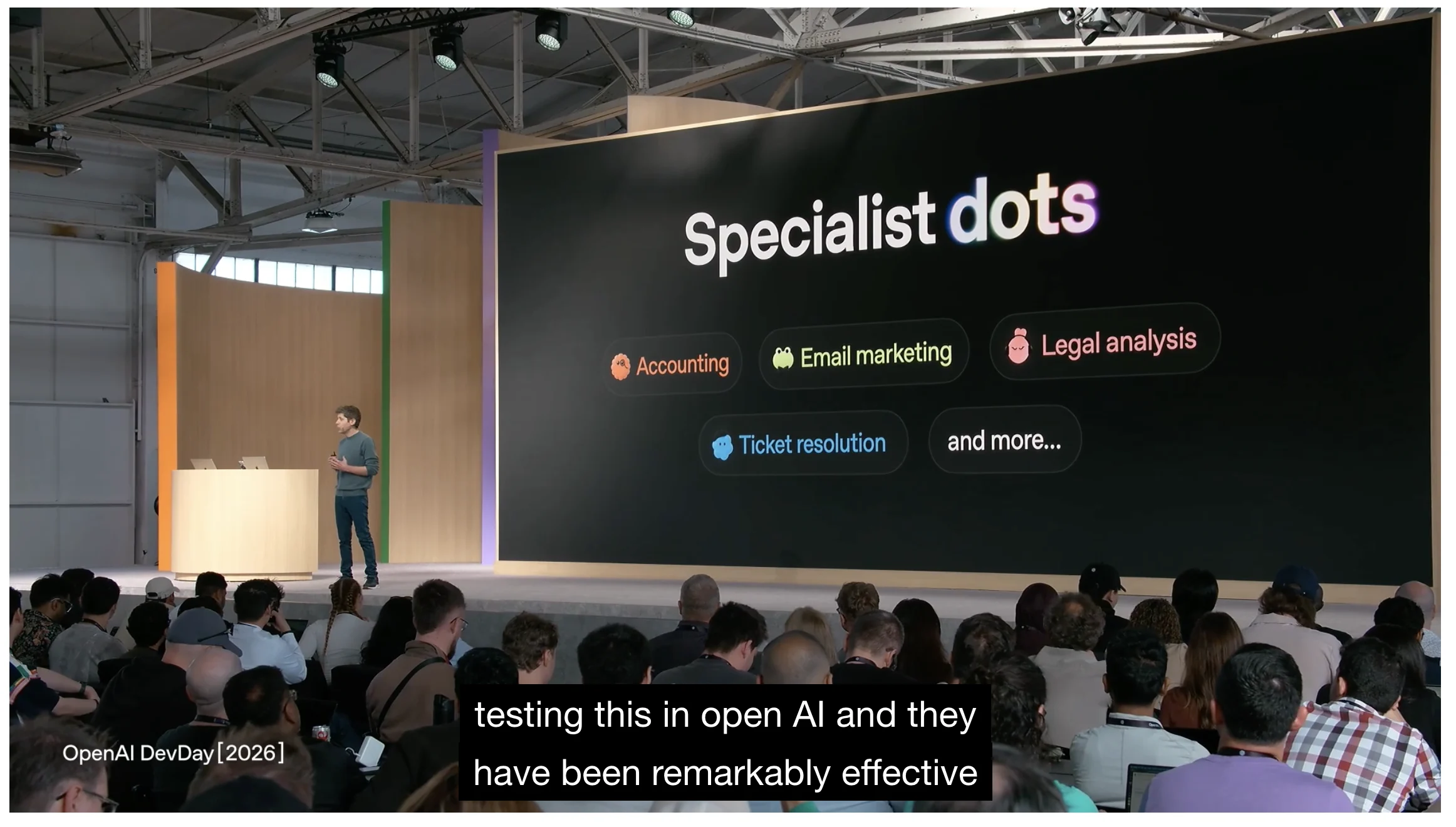
Alongside the general-purpose consumer and business rollout, OpenAI CEO Sam Altman introduced "Specialist Dots"—tailored iterations of the technology designed to execute specialized white-collar functions ranging from email marketing and accounting to legal analysis, procurement, and customer support.
While the consumer-facing general-purpose Dot is beginning its rollout to select paid tiers immediately, the specialist enterprise solutions are entering a tightly managed pilot phase, raising both high expectations and critical questions regarding security, regulatory compliance, and the future of knowledge work.
Main Facts
The launch of Dots introduces several groundbreaking capabilities and structural changes to how users and enterprises interact with OpenAI’s ecosystem:
- The Technology Engine: Dots are powered by GPT-6 Astra, an advanced multimodal model optimized for real-time reasoning, environment navigation, and tool execution.
- Infrastructure: Each Dot operates with its own dedicated cloud computing environment and a managed browser instance, allowing it to navigate the web, interact with software applications, and manage files autonomously.
- Specialist vs. General Purpose: General-purpose Dots are rolling out to ChatGPT Pro, Business Premium, and Enterprise subscribers. Conversely, Specialist Dots are currently locked behind an enterprise pilot program where OpenAI engineering teams collaborate directly with corporate clients to scope out capabilities.
- Targeted Enterprise Roles: Initial internal testing and pilot offerings for Specialist Dots focus on five core corporate functions: email marketing, invoice processing/accounting, commercial contracting/legal analysis, procurement, and ticket resolution (customer support).
- Geographic and Plan Restrictions: While Business Premium and Enterprise users in supported regions gain access, Pro users in the European Economic Area (EEA), Switzerland, and the UK are currently excluded from the initial rollout due to regulatory hurdles.
Chronology: The Journey to Autonomous Agents
To understand the significance of the DevDay announcement, it is necessary to examine the evolutionary path OpenAI has traveled over the past several years:
- Late 2022: The launch of ChatGPT introduces the world to generative conversational AI, operating strictly on a prompt-and-response paradigm.
- 2023–2024: OpenAI incrementally releases advanced reasoning models (such as the o-series) and API tool-calling features, allowing models to interact with external code interpreters and search engines. However, these tools remain tethered to active user supervision.
- Early 2025: Rumors intensify regarding "Operator," OpenAI’s internally developed browser-use agent. Early demonstrations hint at autonomous web navigation, though public access remains restricted.
- Today (DevDay Keynote): Sam Altman officially retires the "Operator" moniker in favor of the unified "Dots" brand. The company debuts the underlying GPT-6 Astra architecture, unveiling both general-purpose desktop/browser agents and verticalized Specialist Dots. Simultaneously, enterprise pilots open, and phased rollouts begin for paid subscribers.
Supporting Data and Implementation Details
As organizations digest the announcement, finer details regarding accessibility, technical constraints, and data handling have begun to emerge through OpenAI’s newly published documentation and help center guides.
Rollout Schedule and Availability
The deployment of Dots is deliberately staggered to prevent server overload and ensure administrative control:
- General-Purpose Dots: Rolling out progressively to ChatGPT Pro, Business Premium, and Enterprise tiers. Administrators of Enterprise accounts must manually enable a beta toggle, as the feature is turned off by default. OpenAI warns that the rollout is gradual and may take several days to propagate across all accounts.
- Geographic Caveats: Strict regional limitations apply. Most notably, users on Pro plans residing in the EEA, Switzerland, and the UK will not receive access at launch, reflecting the complex compliance landscape of the European Union’s Artificial Intelligence Act. Conversely, Business Premium users in all supported regions are included.
Integration with Personal Workflows
For professionals looking to leverage Dots for daily administration, the system offers deep integration capabilities tempered by strict security boundaries:
- Email Connectivity: A Dot can connect directly to a user’s personal email account to read, draft, and act upon messages. However, at launch, individual Dots cannot be assigned their own dedicated, standalone email addresses; they must interface through existing user accounts.
- Safety and Access Controls: OpenAI has released a dedicated security framework detailing read-only background access protocols and mandatory human-in-the-loop approval rules for sensitive actions, such as sending financial transactions or publishing external communications.
Official Responses and Industry Reactions
During his keynote presentation, Sam Altman emphasized the radical shift in utility that persistent agents provide compared to traditional chatbots.
"We are moving past the era where you must sit and babysit a text box," Altman told the DevDay audience. Discussing the internal trials of Specialist Dots, he noted that they had been "remarkably effective in many roles," outperforming initial expectations in cross-functional corporate environments.
Internal testing across OpenAI saw Specialist Dots deployed in procurement pipelines, invoice processing desks, customer support queues, and commercial contracting workflows. According to company disclosures, these agents successfully reduced administrative friction by handling repetitive document cross-referencing and vendor communication without human intervention.
However, industry analysts and marketing professionals have immediately pointed out critical information gaps—particularly concerning the email marketing Specialist Dot. Currently, OpenAI’s published materials offer zero transparency regarding:
- The exact nature and volume of content the email marketing dot will generate.
- The underlying infrastructure or SMTP pathways used for dispatching campaigns.
- How regulatory requirements such as GDPR, CAN-SPAM, opt-in consent, and list management hygiene will be enforced by an autonomous agent.
Implications: What Dots Mean for the Future of Work
The introduction of Dots and the GPT-6 Astra model carries profound implications for the enterprise software landscape, digital marketing, and the broader labor market.
1. The Disruption of SaaS and Workflow Software
For decades, businesses have purchased specialized Software-as-a-Service (SaaS) subscriptions for accounting, customer support ticketing, and email marketing. Dots threaten to intermediate these platforms. By granting an AI agent its own cloud computer and browser, OpenAI is effectively creating a universal software layer that can operate legacy web applications just as a human remote worker would. If a Dot can log into Salesforce, cross-reference an invoice in QuickBooks, and draft a response in Gmail autonomously, the traditional software interface begins to look less like a destination and more like background infrastructure.
2. Regulatory and Compliance Minefields
The exclusion of European Pro users highlights the widening chasm between rapid technological capability and stringent regulatory frameworks. Autonomous agents that can read personal emails, execute financial transactions, and launch marketing campaigns independently test the absolute limits of existing privacy laws. Questions of liability remain entirely unresolved: If an autonomous email marketing Dot inadvertently violates anti-spam laws or hallucinates false claims about a product, does liability fall on the user, the enterprise, or OpenAI?
3. The Evolution of Knowledge Work
While Specialist Dots are currently restricted to enterprise pilots—requiring custom scoping with OpenAI’s engineering teams—their eventual democratization will fundamentally alter white-collar productivity. Tasks that once required junior analysts, virtual assistants, or customer support associates to spend hours performing repetitive data entry and browser navigation can now be delegated to an always-on cloud computer that never sleeps.
Looking Ahead
As OpenAI refines its enterprise pilot program and gathers telemetry data from the phased rollout of general-purpose Dots, the industry awaits further technical disclosures. Until OpenAI publishes comprehensive documentation on how safety, consent, and infrastructure management are handled within sensitive verticals like email marketing, enterprises are advised to proceed with measured caution.
Further updates will be provided as OpenAI releases additional details regarding the email marketing pilot or as independent testers gain hands-on access to the GPT-6 Astra agent ecosystem.