
As the global demand for exceptional digital experiences continues its meteoric rise, User Experience (UX) practices have expanded exponentially. Yet, this rapid business growth has introduced a persistent bottleneck: traditional user research is often too slow to keep pace with iterative product development and agile sprint cycles.
To resolve this friction, leading organizations are turning to a transformative operational model known as Rapid Research. By standardizing, templatizing, and compartmentalizing the research lifecycle, these programs deliver actionable end-user insights at unprecedented speeds, ultimately unlocking massive return on investment (ROI) and fueling organizational growth.

Main Facts: The Anatomy of Rapid Research
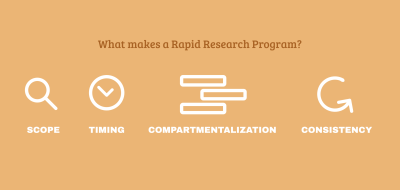
At its core, a Rapid Research program is a structured framework designed to provide quick, reliable insights into key user problems on a consistent, repeatable cadence—often weekly. Unlike ad-hoc feedback collection, Rapid Research relies on four core pillars: Scope, Timing, Compartmentalization, and Consistency.
- Scope: Teams deliberately select research methodologies that can be executed within tight windows (such as 1-to-2-week increments), while scaling back sample sizes and session durations to keep data analysis manageable.
- Timing: End-to-end project timelines are drastically compressed compared to traditional studies, ensuring that insights arrive well before product sprint deadlines pass.
- Compartmentalization: Workflow bottlenecks are eliminated by decoupling interdependent tasks—such as separating project intake from study kick-offs, or designing modular discussion guides that do not rely heavily on custom recruitment.
- Consistency: By maintaining an expectable, steady cadence, organizations avoid the trap of wildly unpredictable research schedules, allowing stakeholders to reliably fold user feedback into agile workflows.
Chronology: From Bottleneck to Breakthrough
The evolution of Rapid Research has largely been driven by the maturation of internal UX teams grappling with the demands of fast-scaling enterprises.
- The Growth Phase: Initially, UX teams start small—often numbering just a handful of practitioners. As human insight becomes central to product strategy, demand for research increases exponentially.
- The Evaluative Trap: Product teams frequently bring researchers in too late in the development cycle simply to validate pre-existing ideas. Researchers find themselves perpetually rushed, trapped doing reactive, evaluative work that stifles deep innovation and demoralizes senior staff seeking generative discovery.
- Strategic Restructuring: Recognizing the unsustainability of this model, UX leadership steps in to diversify the research portfolio. Alongside democratization initiatives and quarterly planning, organizations introduce specialized Rapid Research tracks.
- Implementation and Pilot Phase: Teams audit past research timelines, establish strategic vendor partnerships or dedicated junior staff pipelines, build out standardized templates, and launch pilot projects to test the new frameworks.
- Maturity and Evolution: Over a ramp-up period lasting anywhere from three months to a year, the program matures—scaling throughput, catching usability issues upstream, and shifting core team members back toward high-impact generative research.
Supporting Data and Operational Impact
Implementing a Rapid Research program yields measurable, highly favorable operational metrics across enterprise environments. Organizations that successfully transition to this model typically witness several distinct performance boosts:
- Doubled Throughput: By utilizing standardized templates, dedicated vendor resources, or specialized junior staff, teams can effectively double their project output, accommodating a vastly higher volume of organizational requests.
- Upstream Risk Mitigation: Catching usability issues further upstream in the design phase can save organizations exponential amounts in downstream business and engineering costs. According to industry analyses, catching design flaws early can prevent costly overhauls.
- Sprint Alignment: Research cycles are successfully compressed to fit neatly within standard 2-week agile development sprints.
- Balanced Portfolios: Rapid Research acts as a buffer, absorbing fast-paced tactical evaluations and freeing up senior researchers to focus on deep discovery and long-term product roadmaps.
However, building such a program requires careful calibration of participant recruitment. Sourcing participants too broadly yields unhelpful feedback, while hyper-specific profiles can stall recruitment and break the "rapid" timeline. Successful teams strike a deliberate balance between profiles that are specific enough to be useful and broad enough to reach effortlessly.
Official Perspectives and Guidance
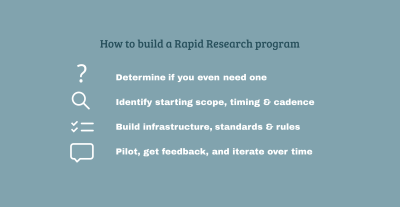
Industry experts and enterprise leaders emphasize that the first step in building a Rapid Research program is evaluating whether your organization actually needs one. Prematurely deploying a rapid infrastructure without executive buy-in or clear organizational demand can waste valuable time and resources.
Furthermore, leadership must clearly communicate the inherent limitations of the model. Rapid Research is not a replacement for deep, longitudinal, or complex generative studies. It is designed for tactical, iterative evaluations.
When establishing a program, organizations are advised to follow a four-step roadmap:
- Assess Necessity: Document current request types, conduct stakeholder interviews, and analyze past research gaps.
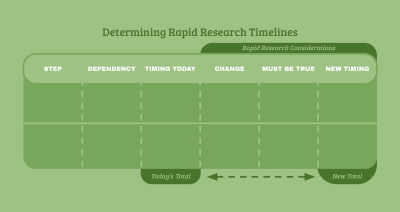
- Define Scope and Timing: Map out participant profiles, choose appropriate rapid methodologies, and draft a timeline-comparison table to ensure projected workflows are genuinely faster than legacy processes.
- Build Infrastructure: Secure stakeholder buy-in, establish legal and compliance guardrails, develop reusable templates, and secure dedicated staffing (whether through internal hiring or trusted research vendors).
- Pilot and Iterate: Treat initial projects as experimental pilots. Gather candid feedback from close stakeholder partners, identify operational bottlenecks, and iteratively refine the framework over time.
Implications for the Future of UX
As agile development methodologies continue to dominate the software and product engineering landscapes, the pressure on UX research to deliver at lightning speed will only intensify. The implications of adopting a Rapid Research program extend far beyond mere operational efficiency; they fundamentally alter the relationship between design, research, and engineering.
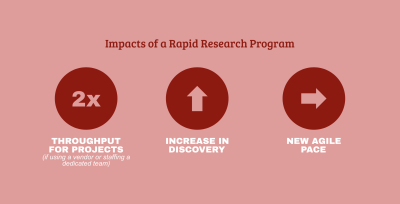
By institutionalizing speed without sacrificing core quality, organizations empower their product teams to make data-backed decisions continuously rather than reactively. The ultimate result is a mature, resilient insight ecosystem where research is no longer viewed as a developmental speed bump, but rather as an active engine driving ongoing innovation, reduced overhead costs, and maximized ROI.