
By Carrie Webster
We are living in an era defined by a staggering paradox: while humanity has never had greater access to the sum total of human knowledge, we have never felt more overwhelmed by it. Information flows in an unceasing, global torrent via the internet, transforming how we work, govern, and communicate. Yet, the sheer volume of data creates a new kind of friction.

In a world where digital content multiplies exponentially, how do users find what is relevant to them precisely when they need it?
The answer lies in Information Architecture (IA)—the structural blueprint that organizes, categorizes, and structures data to give it meaning. Far beyond a mere technical discipline, good information architecture is the critical compass that helps humanity navigate through the mountains of data we have constructed for ourselves.

1. Main Facts: Defining Information Architecture and Its Core Value
At its foundational level, the Information Architecture Institute defines IA as "the practice of deciding how to arrange the parts of something to be understandable."
From a user experience (UX) perspective, effective IA requires deeply understanding how target audiences think, what problems they are trying to solve, and presenting information in a logical framework that aligns with their mental models. Whether applied to an enterprise website, a complex SaaS application, or a mobile utility app, IA is the invisible scaffolding that shapes navigation hierarchies and content grouping.

Good IA delivers profound benefits across two primary fronts:
For the User
- Reduced Cognitive Load: Users can scan, locate, and digest information quickly without feeling overwhelmed.
- Seamless Wayfinding: Clear hierarchies allow users to understand where they are, where they can go, and how to return to their starting point.
- Contextual Clarity: Language and labels mirror the user’s natural vocabulary rather than internal corporate jargon.
For the Business
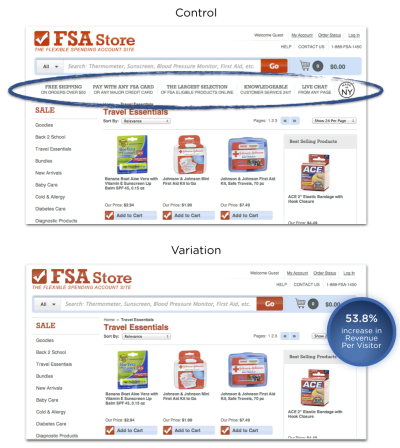
- Enhanced Conversion Rates: Removing structural friction directly impacts the bottom line. Case studies in e-commerce optimization show that streamlining page architecture and eliminating superfluous navigational elements can boost customer revenue by over 50%.
- Lower Bounce Rates: When visitors immediately find what they are looking for, engagement deepens, building trust and brand loyalty.
2. Chronology: The Evolution of Search Versus Navigation
The debate over how users seek information online has evolved alongside the web itself. Understanding this evolution helps digital architects design hybrid systems that accommodate diverse user behaviors.
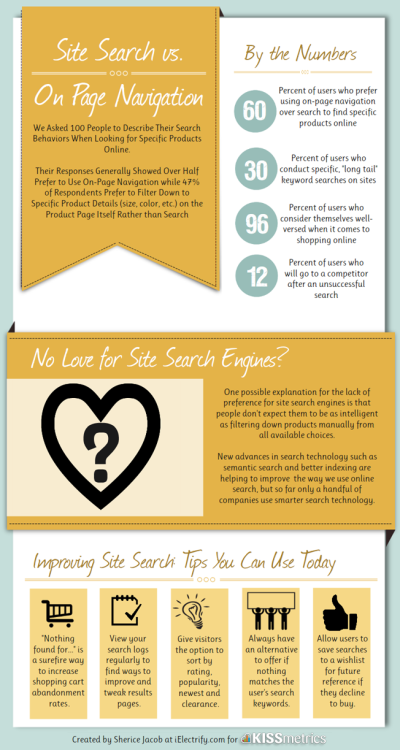
- 1997 — The Early Search Shift: Usability pioneer Jakob Nielsen conducted a landmark study indicating that over 50% of website visitors naturally gravitated toward using search functions rather than clicking through site navigation.
- 2010 — The Rebalancing: Gerry McGovern’s research demonstrated that roughly 30% of users actively preferred search, highlighting that browsing through structured categories remained a dominant entry point for many.
- 2012 — E-Commerce Insights: Econsultancy and Kissmetrics reported that between 30% and 40% of visitors on e-commerce platforms immediately turned to the search bar. However, subsequent studies by MeasuringU revealed a consistent baseline: approximately 14% of users begin with search, while the overwhelming majority (86%) start by browsing navigation structures.
This historical data underscores a vital rule for modern designers: Search and navigation are not mutually exclusive; they are symbiotic. While a well-structured mega-menu serves browsers, a robust, metatag-driven search engine catches users who use varied terminology—such as searching for "hygienic soap" instead of "antibacterial hand wash."
3. Supporting Data: Good Versus Bad IA in Practice
Examining real-world implementations highlights the tangible difference between intuitive structures and information overload.
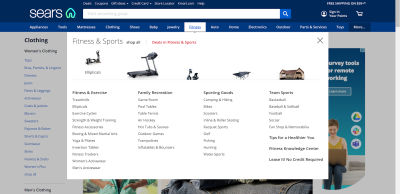
- Successful Navigation (Sears / Pinterest): Platforms like Sears utilize expansive mega-drop-down menus paired with visual cues to accelerate cognitive processing. Meanwhile, platforms like Pinterest make search the navigation, accommodating massive quantities of user-generated content where traditional categorical trees would fail.
- The Cost of Overload (Legacy Fry’s Electronics): Historic web examples characterized by cramped layouts, poor use of white space, and endless unorganized links illustrate "information overload." When presented with too many untamed choices, user decision fatigue skyrockets, leading to immediate site abandonment.
To combat this, designers utilize proven validation tools and methodologies:
- Card Sorting: Open and closed card sorting exercises invite users to group content topics, revealing natural mental models.
- Treejack Testing: Evaluates hierarchical findability by tracking how users navigate text-based outlines to complete specific tasks.
- Keyword Research: Leveraging tools like AnswerThePublic ensures that navigational terminology matches actual user search language.
4. Official Responses: The Societal Impact and Power of Information
Information is neither inherently good nor evil; it is a neutral commodity whose value is defined by its application. In the broader context of the Information Age, this power carries immense societal weight.

The late internet activist Aaron Swartz championed the democratization of knowledge, famously arguing for the liberation of gated academic and corporate data. His advocacy highlighted a fundamental truth: information only creates value when it is accessible, discoverable, and actionable.
When managed responsibly by governments and institutions, information protects public health, drives policy, and empowers citizens. However, when weaponized, it can destabilize systems in a heartbeat.

5. Implications: The Dangers of Misinformation and the Imperative of Security
As global connectivity accelerates, the improper handling of information manifests in severe real-world consequences, ranging from public confusion to massive security failures.
Rapid Policy Pivots and Public Confusion
During global crises, such as the COVID-19 pandemic, the rapid influx of shifting data forced governments to continuously pivot guidelines. In Australia, sudden announcements regarding elective surgery suspensions—modified hours later following stakeholder consultations—demonstrated how poorly synchronized information releases can generate widespread public panic and institutional strain.

The Rise of "Fake News" and Conspiracy Theories
The proliferation of unverified claims, partisan framing, and unfounded conspiracy theories has eroded public trust in traditional journalism and official institutions. Without proper analytical frameworks and media literacy, individuals easily fall prey to fabricated connections between unrelated data points.
The Data Security Crisis
The digital age has turned personal data into currency, making information security paramount.
- The 2018 Facebook Breach: Hackers exploited vulnerabilities to compromise the personal data of 50 million user accounts.
- The Equifax Breach (2017): Social security numbers, birth dates, and credit card details of over 147 million Americans were exposed, resulting in multi-billion-dollar security overhauls and protracted class-action lawsuits.
These incidents have driven global legislative change. Currently, 132 out of 194 nations have enacted formal data protection laws to regulate the collection and sharing of personal information, reflecting a 10% global rise in privacy legislation over recent years.
Conclusion
We live in an extraordinary epoch of human history where the boundaries of communication have dissolved. Yet, the sheer volume of data we generate threatens to drown us in noise.

Information architecture is our technological life jacket. By applying rigorous structural design, intuitive navigation hierarchies, and robust search methodologies to digital systems, we transform chaotic oceans of data into navigable landscapes. Whether designing an e-commerce storefront or a national news portal, the mandate for modern information architects is clear: organize with empathy, structure for clarity, and deliver meaning to an information-overloaded world.