
In the modern digital landscape, User Experience (UX) practices have expanded exponentially, and this growth shows no signs of slowing down. Alongside this broader maturation, specialized sub-disciplines like content strategy, operations, and user research have evolved into critical pillars of product development. However, as organizations increasingly embrace agile frameworks and rapid, iterative product cycles, traditional user research models often find themselves bottlenecked.
To resolve this friction, leading product organizations are turning to a transformative solution: Rapid Research. By standardizing and templatizing operations to deliver insights on a reliable, accelerated cadence—often matching 1-to-2-week product sprints—Rapid Research provides teams with actionable end-user feedback without sacrificing developmental momentum.
Main Facts: What Is Rapid Research and Why Does It Matter?
Rapid Research is a structured operational program where typical user research practices are streamlined, standardized, and templatized to deliver faster-than-average insights. Rather than launching bespoke, multi-week studies for every project, a Rapid Research program relies on strict guardrails, repeatable frameworks, and predictable cadences—frequently operating on a weekly delivery schedule.
The Core Pillars of Rapid Research
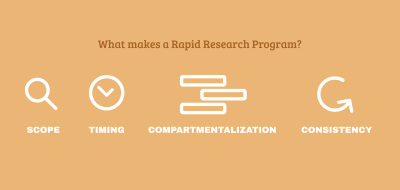
A successful Rapid Research program is built upon four foundational pillars:

- Scope: Intentionally limiting research methodologies, sample sizes, and session durations to fit within tight timeframes.
- Timing: Compressing end-to-end project timelines so that findings are delivered significantly faster than traditional studies.
- Compartmentalization: Breaking down the traditional study workflow (such as separating intake from kickoff, or decoupling discussion guides from participant recruitment) to eliminate dependencies.
- Consistency: Maintaining a dependable, predictable cadence so stakeholders know exactly when and how insights will be delivered.
By implementing these pillars, organizations can unlock monumental operational advantages. According to industry metrics, well-executed Rapid Research programs can double project throughput, free up senior researchers to focus on high-level generative and strategic discovery, and catch usability issues far upstream—ultimately saving exponential amounts in downstream business overhead.
Chronology: The Evolution and Implementation of Accelerated Insights
The concept of rapid, sprint-integrated research support has evolved organically across various industries, taking distinct shapes depending on corporate culture and compliance requirements. Historically, user researchers found themselves trapped in a reactive cycle: brought in late by product teams merely to validate preconceived ideas. This dynamic relegated research strictly to evaluative tasks, stifling true innovation and burning out researchers hungry for deep generative discovery.
To trace how organizations transition from traditional bottlenecks to streamlined agility, consider the standard implementation lifecycle:
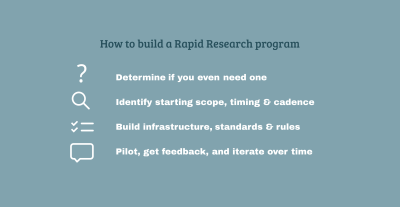
- Phase 1: Diagnosis & Audit (Months 1–2): Teams analyze the previous year’s research requests, mapping out average timelines, most common methodologies, and primary customer profiles. Leadership determines whether a rapid program is genuinely required based on team bandwidth and product demands.
- Phase 2: Scaffolding & Infrastructure (Months 3–6): Organizations secure buy-in and budget, establish standardized templates (for screeners, discussion guides, and reporting), and define staffing models—whether through dedicated junior hires, internal generalists, or external research vendors.
- Phase 3: Piloting & Iteration (Months 6–9): The program launches with trusted internal partners. Initial projects are treated as operational pilots, allowing teams to gather real-time feedback, identify friction points (such as compliance delays), and refine their workflows.
- Phase 4: Full Scale & Evolution (Months 9–12+): The program matures into a predictable ecosystem, running parallel to quarterly planning and deep exploratory research streams, perfectly synchronized with agile development sprints.
Supporting Data & Metrics
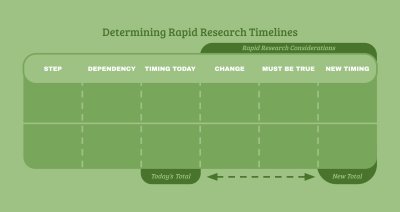
Implementing a Rapid Research program requires rigorous quantitative and qualitative baseline tracking. Organizations must meticulously audit their current processes to understand where time is lost.
+------------------+-----------------------+---------------------+-------------------+
| Current Step     | Traditional Timeline  | Rapid Adjustments   | New Target Timing |
+------------------+-----------------------+---------------------+-------------------+
| Project Intake   | 3–5 Days              | Templated Form      | < 24 Hours        |
| Recruitment      | 7–14 Days             | Pre-sourced Panels  | 2–3 Days          |
| Moderation/Test  | 5 Days (15+ users)    | 3 Days (5–8 users)  | 2 Days            |
| Analysis & Readout| 5–7 Days             | Standardized Deck   | 1 Day             |
+------------------+-----------------------+---------------------+-------------------+
| TOTAL TIMELINE   | 20–31 Days            |                     | 6–7 Days          |
+------------------+-----------------------+---------------------+-------------------+
Key Quantitative Impacts
- Throughput Multiplier: Utilizing a dedicated rapid framework or vendor partnership effectively doubles a team’s project output.
- Cost Efficiency: Identifying UX friction points in early upstream rapid tests can reduce costly post-release code refactoring and customer support overhead by orders of magnitude.
- Balanced Portfolios: Successful programs routinely shift organizational research distribution, allowing up to 50% more focus on long-form, generative discovery that drives long-term product strategy.
Official Perspectives and Industry Responses
Industry leaders and UX authorities have widely endorsed the shift toward scalable, operationalized research frameworks, though experts urge caution regarding implementation pitfalls.
Balancing Specificity and Reach
One of the most delicate challenges in building a Rapid Research program is participant recruitment. Sourcing highly specialized users can severely compromise program velocity. As noted by industry research analysts at UserZoom:
"Why is sourcing participants such a challenge? Well, you could probably find as many users as you like by spreading the net as wide as possible and offering generous incentives, but you won’t necessarily find the ‘right’ participants."
To counter this, program directors emphasize striking a strategic balance: participant profiles must be broad enough to be reached quickly via standard panels, yet specific enough to yield actionable insights for core product use cases.
The Value of Piloting
Change management experts underscore the necessity of piloting new internal frameworks before rolling them out globally. According to Entrepreneur:
"Piloting offers a realistic preview experience for users at the earliest stages of development. It allows the organization and design team to gather real-time insights that can be used to shape and refine the product and prepare it for commercialization."
By treating the first wave of rapid studies as structured experiments, UX leaders can isolate internal bottlenecks—such as sluggish legal or compliance reviews—before they derail the program’s credibility.
Implications for Organizations and the Future of UX
The widespread adoption of Rapid Research carries profound implications for enterprise product development, organizational culture, and the professional trajectories of UX practitioners.
1. Cultural Alignment with Agile Engineering
By aligning research cadences with 2-week engineering sprints, organizations eliminate the historical friction between design thinking and rapid software deployment. Product managers no longer view research as a "slow down" phase, but rather as an integrated, continuous feedback loop.
2. Redefining the Role of the Researcher
Far from diluting the value of professional user researchers, Rapid Research elevates them. By automating and templatizing repetitive evaluative tasks—often empowering junior staff, product designers, or external vendors to run standard tests—expert researchers are liberated to pursue complex, multi-month generative studies. This directly addresses researcher burnout and satisfies the desire for deep, strategic innovation.
3. Limitations and Strategic Guardrails
Despite its numerous benefits, leadership must acknowledge the inherent limitations of Rapid Research. It is not designed for longitudinal diary studies, highly complex ethnographic research, or foundational market pivoting. Organizations must clearly communicate these boundaries to stakeholders, ensuring that rapid evaluative tests complement—rather than entirely replace—deep, exploratory discovery.
Conclusion
Building a Rapid Research program is an intentional, strategic undertaking. By carefully defining scope, timing, compartmentalization, and consistency, organizations can scale their user research practices to match the unprecedented speed of modern product development. When executed with clear guardrails and robust infrastructure, Rapid Research transforms user insights from a periodic checkpoint into a continuous engine for enterprise growth and innovation.