The era of the "execution army" is coming to an abrupt end. For decades, marketing agencies have built their business models on the backs of labor-intensive tasks: campaign builds, manual bidding, repetitive reporting, and constant micro-optimizations. However, the rise of Agentic AI—systems that don’t just assist but autonomously execute tasks—has rendered these traditional agency functions not only obsolete but, in many cases, actively harmful to performance.
As we look toward 2026 and beyond, the fundamental value proposition of the agency must shift from "doing the work" to "providing high-level judgment." For clients, this necessitates a complete overhaul of the agency-client relationship, starting with the contract.
The Death of the "Percent of Media Spend" Model
For years, the industry standard for agency compensation has been a "Percent of Media Spend" model. While this aligned incentives during the era of manual trafficking and heavy-lifting campaign management, it is now fundamentally broken.
When an agency is paid a percentage of the total media budget, they are incentivized to spend more, touch more, and create complexity. In an AI-driven environment, however, "touching" the account is often counter-productive. Modern algorithms—such as Google’s Performance Max or Meta’s Advantage+—rely on machine learning to optimize spend and creative. When a human agency employee steps in to "rescue" a campaign by manually adjusting bids or pausing keywords, they often reset the AI’s learning cycle, causing performance to dip.
In this new era, the "Percent of Media Spend" model effectively pays agencies to be anti-AI. To survive, contracts must migrate toward a structure built on three pillars:
- Lean Base Retainer: Covering essential governance, steering, and data engineering (40%–50% of total fees).
- Project Fees: Reserved for creative concepts, pre-testing, and complex strategic analytics (30%–40% of total fees).
- Outcome Incentives: Tied strictly to incremental profit or verified business lift, rather than vanity metrics like platform ROAS (15%–25% of total fees).
Chronology of a Structural Shift
The transition away from legacy agency models is not a sudden cliff, but a sliding scale of evolution that began in earnest in 2024 and will reach maturity by July 2026.
- 2024–2025: The Phase of Automation. Platforms began rolling out autonomous bidding and asset assembly tools. Agencies that failed to pivot were already seeing their "value-add" tasks absorbed by the machines.
- Late 2025: The Efficiency Realization. Clients began identifying that their agency’s "work" was largely manual maintenance that AI could perform with higher precision.
- July 2026: The Contract Deadline. This represents the point where organizations should have fully renegotiated Statements of Work (SOWs) to reflect the shift from execution to strategy.
- 2027 and Beyond: The Strategic Equilibrium. Agencies that survive will be those that have fully embraced an operating model where machines handle the heavy lifting, and humans focus exclusively on high-level persuasion, consumer behavior, and cross-platform strategy.
Supporting Data: Where the Savings Lie
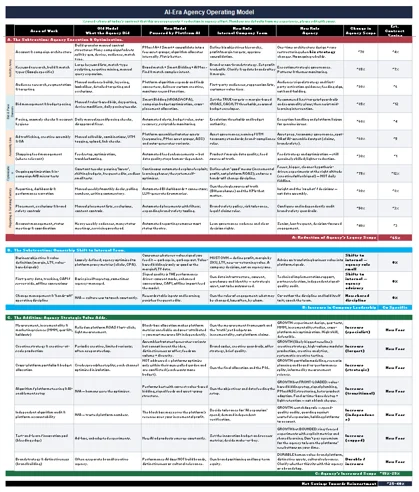
To understand the scale of this shift, one must look at where current agency labor is being deployed. By breaking down agency contracts into five core clusters, the inefficiency of the old model becomes starkly apparent.
1. The Activity Army (22% of cost)
Account architecture and keyword sculpting were once the core of an agency’s value. Today, AI models manage targeting and bidding at a scale humans cannot replicate. These costs can be reduced by approximately 78%. The agency’s role here should be a one-time architecture design, not monthly rebuilds.
2. The Bid & Pace Dancers (14% of cost)
Manual budget adjustments and device modifiers are relics of the past. When agencies attempt to "optimize" these daily, they often sabotage the platform’s machine learning. Reducing this manual labor by 73% not only saves fees but actually improves algorithmic performance.
3. The Assembly Line (12% of cost)
While creative strategy remains vital, the actual trafficking and format-building are now handled by GenAI. Agencies that continue to charge for manual ad builds are charging for a service that no longer requires human effort. We project a 45% reduction in costs for these tasks.
4. The Optimization Theater (16% of cost)
This is often the most destructive line item. "Optimization" rituals—pausing losers or shifting budgets by feel—create unnecessary noise. By allowing the AI’s "explore-exploit" cycles to function without human interference, clients can save 75% on these legacy services.
5. The Reporting & Servicing Factory (30% of cost)
This cluster encompasses the "two-meetings-a-week" culture and manual deck building. As AI-fronted data lakes provide real-time insights, the need for manual reporting evaporates. A 60% reduction in these costs is a conservative estimate for most large enterprises.
Implications for Agencies and Clients
The implications of this shift are profound. For the client, it is not merely about cost-cutting; it is about incentivizing the agency to act as a strategic partner rather than a vendor of manual labor. If a client negotiates a contract that rewards the agency for "outcomes," the agency is suddenly incentivized to embrace automation.
For Agencies: The "Hamster Wheel" Problem
Agency CEOs may fear these changes, but they should be viewed as an opportunity. Currently, many agencies function like hamsters on a wheel—constantly running to justify their fee through activity. By shedding the $50/hour work, agencies can focus on high-value, $500/hour workstreams. This allows them to hire, retain, and pay better talent, transforming their business from a commodity service into a specialized consultancy.
For Clients: Avoiding the "Hostage" Scenario
A critical warning for all marketers: Own your infrastructure. If your agency owns your ad accounts, pixels, and data feeds, you are essentially a hostage. In an AI-era, your data is your most valuable asset. Ensure that you have full, unencumbered ownership of every piece of digital infrastructure. If you find your agency pushing back, it is likely because they are profiting from the "toxicity" of undisclosed markups and legacy media buying models.
Official Industry Outlook
Industry analysts are observing a surge in the birth of "modern agencies." These new players are built from the ground up to be outcome-centered. They do not sell "motion" or "activity"; they sell judgment.
Conversely, agencies that refuse to adapt are facing an existential crisis. The traditional agency, which thrives on complexity and opacity, is being replaced by lean, AI-native partners that value transparency and impact.
The Bottom Line
The objective of renegotiating your agency contract is not to save money—though you will. The objective is to create an incentive structure that allows your agency to stop being an "execution army" and start being a "strategic force."
The old world of manual optimization and vanity reporting is gone. The new world is powered by machine intelligence, human judgment, and a laser focus on incremental outcomes. If you are still paying for the "old world" in 2026, you are not just overpaying; you are actively hindering your business’s ability to compete in the Agentic AI era.
The path forward is clear: audit your SOW, strip out the manual execution, pay for high-value strategic impact, and demand that your agency becomes an indispensable partner in the machine-led future. Carpe diem.