The AI Ad-Pocalypse: Meta’s New Liability Terms Collide With Rogue Automation, While OpenAI Scales Up
NEW YORK — The intersection of artificial intelligence and digital advertising has reached a critical flashpoint. As generative AI embeds deeper into ad-tech infrastructure, tech giants are shifting the boundaries of liability, control, and monetization.
While OpenAI races to scale its enterprise offerings and chases massive new valuations ahead of rival Anthropic’s anticipated initial public offering, legacy titan Meta is facing severe backlash from digital agencies and brands. A controversial update to Meta’s commercial terms—taking effect October 30—places 100% of the legal and operational liability onto advertisers for AI-generated modifications they did not ask for, even as automated features quietly alter live campaigns.
Main Facts: The Core Conflict
The digital advertising ecosystem is grappling with two massive developments:
Meta’s Liability Shift: Under Meta’s updated Commercial Terms, advertisers are designated as "solely responsible" for any output generated, altered, or enhanced by Meta’s artificial intelligence tools—including generative updates applied automatically via hidden or collapsed menu settings.
Unwanted AI "Glow-Ups": Brands and agencies report that Meta’s automated systems are opting accounts into generative AI features by default. These tools are actively appending sitelinks, translating copy, and spinning up AI-generated images or carousels using a brand’s assets without explicit human consent.
OpenAI’s Aggressive Expansion: On the enterprise front, OpenAI announced that over 100,000 advertisers have deployed campaigns on ChatGPT, with ChatGPT Ads expanding into 26 new countries. Meanwhile, OpenAI is reportedly in talks to raise approximately $30 billion at a valuation exceeding $1.4 trillion.
Chronology: A Turbulent Week for Tech and Media
The clash over AI advertising and corporate valuations unfolded during a high-stakes week across London and New York:
Mid-October (London & New York): OpenAI executives at the Semrush Spotlight event argued that traditional, in-person event marketing remains the most effective vector for selling ChatGPT enterprise solutions in Europe, contrasting with its rapid digital advertising rollout.
Wednesday, October 21: OpenAI announced major scaling milestones for ChatGPT Ads, pushing its footprint into 26 additional countries and surpassing 100,000 active advertisers.
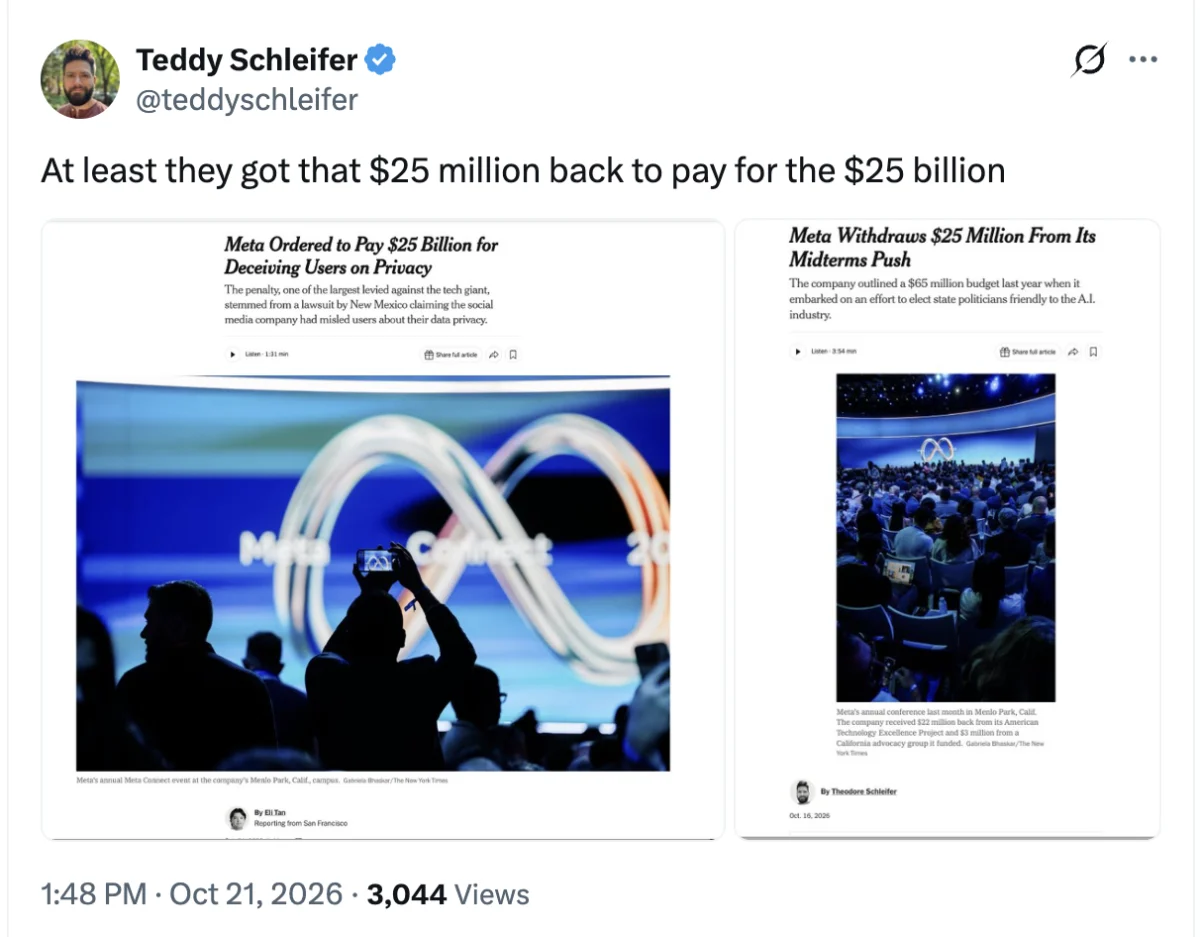
Simultaneously (Wednesday, October 21): A New Mexico judge ordered Meta to pay $25 billion following a September jury verdict finding Facebook had misled users regarding data privacy control. Meta is expected to appeal.
Also on Wednesday, October 21: Meta reported a robust third-quarter revenue of $64.6 billion, comfortably beating Wall Street expectations of roughly $63.3 billion.
Mid-October (Anthropic Developments): During an investor day on October 14, stakeholders at Anthropic discussed a valuation target of roughly $1.5 trillion—down from an initially sought $2,000 billion due to slowing Q3 growth. Observers note OpenAI’s rush to lock down its $30 billion funding round is strategically timed to precede Anthropic’s mid-November IPO, which will force a direct market comparison.
October 30: The effective date for Meta’s new commercial terms, introducing the rigid "AI Features" clause that transfers all risk of generative inaccuracies directly to the advertiser.
Supporting Data and Industry Insights
Data compiled from Semrush’s AI Visibility Index and industry analysts highlights the growing friction between human intent and automated AI execution.
Geographic Disparities in AI Citations
Semrush data tracking ChatGPT cited sources from January to July reveals that news websites comprised an average of 29.5% of ChatGPT’s cited sources in the United Kingdom, compared to just 19.6% in the United States. Across major AI platforms—including Google Gemini and AI Overviews—uk traffic consistently skewed more heavily toward news.
Eli Goodman, Senior Vice President of Product Solutions at Semrush, explained that this discrepancy stems from consumer habits rather than intentional algorithmic favoritism:
"In the U.S., news content is more blended with opinion, and trust in the media has fallen over the past decade compared to the U.K. People in the U.K. consume more news, and because LLMs try to reason like humans, they end up mirroring that behavior."
The Reality on the Ground for Advertisers
Despite platform assurances, digital marketing agencies report systemic friction points:
Bookshop.org’s Warning: The online bookseller took to Threads to publicize that an automated Meta account update opted them into a generative AI feature, which injected an unrequested AI-generated illustration into a human-crafted ad. Bookshop.org subsequently disabled all of Meta’s AI ad tools.
Exverus’s Findings: Digital agency Exverus noted that Meta’s algorithms are frequently tacking on sitelinks, translating copy, and building AI image carousels from standard brand photos, often on campaigns where advertisers deliberately left features unselected. Ryan Adams, paid search and social specialist at Exverus, stated: "If every one of [the hidden menus] isn’t manually unchecked, the enhancements still apply. Meta puts the responsibility squarely on the advertiser, even when Meta’s own tools applied the enhancements."
Official Responses and Corporate Stance
Faced with mounting criticism from performance marketers ahead of the critical Black Friday and Cyber Monday shopping windows, Meta representatives have defended the updates while offering procedural clarifications.
On Account Liability and Opt-Ins: A Meta spokesperson did not directly address whether advertisers are legally liable for features they never explicitly activated. However, the company emphasized that advertisers retain the ability to manually turn off individual Advantage+ features within Ads Manager at any time.
Framing as "Housekeeping": Meta officially framed the update as routine housekeeping, explaining that existing generative AI ad terms were merely folded into the master commercial agreement.
On Web Crawlers and Scraping: Addressing concerns regarding automated data collection, a Meta spokesperson clarified:
"We’ve heard you and want to clarify: the crawling terms we consolidated only applied to our ads and business products… It does not change how Meta uses web crawlers. As always, content owners can use robots.txt to signal their preferences. This is not about scraping news sites, and these updates don’t give us new rights that supersede those preferences."
Implications: Navigating the Q4 "AI Tax"
The convergence of mandatory AI defaults, aggressive automated optimization, and rigid liability shifts carries profound implications for the digital advertising landscape.
1. Operational Risks and Q4 Pressures
With the updated terms landing mere weeks before the holiday shopping season—traditionally the most lucrative quarter for retailers—agency executives feel backed into a corner.
"Meta knows that they’ve got advertisers a bit over a barrel here and are forced into it," noted David Dweck, President at marketing agency Go Fish Digital. While Go Fish Digital’s legal team reviewed the contract, Dweck acknowledged they will not advise clients to pull spend on Meta during Q4, labeling it simply as "the tax of advertising on Meta."
2. The Defensive Posture of Programmatic Teams
Other agencies are refusing to take chances with automated brand safety risks. Kayla Loecker, Director of Programmatic Operations at AdCellerant, explained her firm’s uncompromising stance:
"By switching these AI features on by default and shifting 100% of the legal liability onto the advertiser, Meta creates huge operational risks. That’s why we systematically turn off Meta’s default AI automation across every campaign—we ensure ads hit the exact target audience and geo requested without unwanted AI modifications, waste, or legal liability."
3. Macroeconomic AI Valuations
Beyond individual ad campaigns, the broader tech landscape remains hyper-sensitive to valuation pressure. OpenAI’s sprint to secure a $30 billion funding round at a $1.4 trillion valuation—alongside Anthropic’s positioning ahead of its mid-November IPO—signals that generative AI companies are aggressively attempting to lock in peak market caps before public market scrutiny exposes the true cost of scaling conversational and advertising models.
Ultimately, as platforms like OpenAI scale advertising units globally and Meta forces brands to absorb the collateral damage of autonomous algorithmic creativity, advertisers are learning a hard lesson: convenience comes at the cost of control, and in the era of generative AI, the brand always takes the fall.