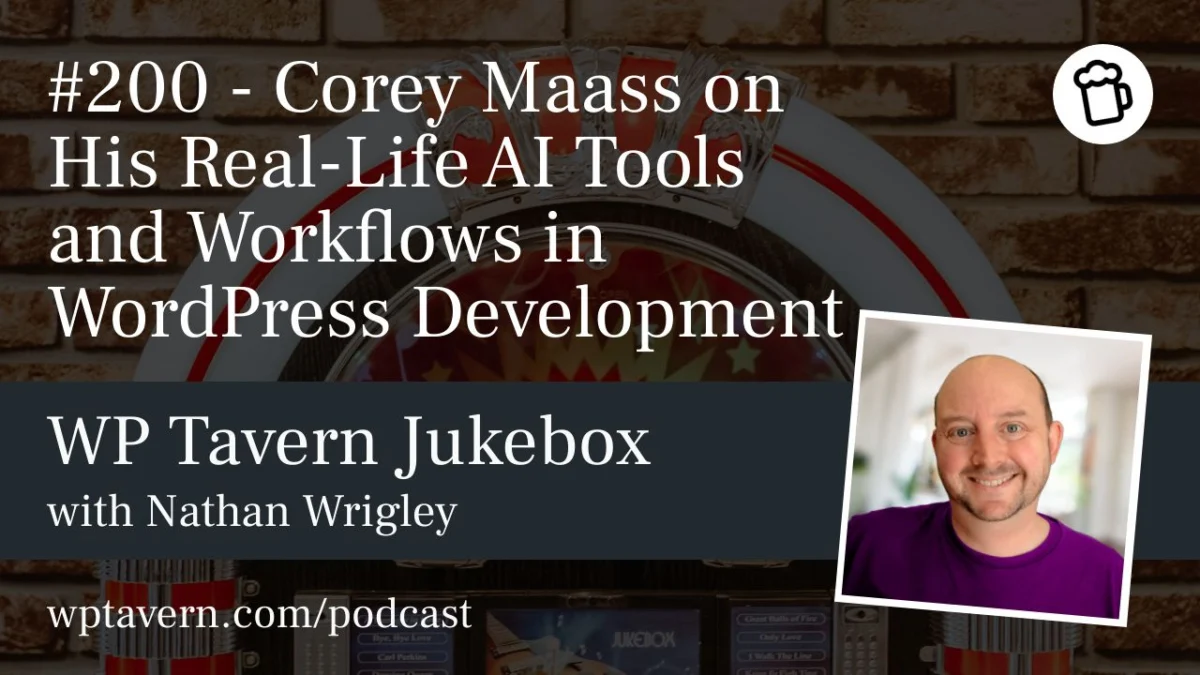
The landscape of web development has undergone a seismic shift since the emergence of sophisticated artificial intelligence tools. While the headlines have been dominated by the rapid advancement of Large Language Models (LLMs), the real-world implications for developers—specifically within the WordPress ecosystem—are only just beginning to be fully realized. In a recent episode of the Jukebox Podcast from WP Tavern, host Nathan Wrigley sat down with veteran developer Corey Maass to explore how AI has transitioned from a novelty gimmick to a foundational element of modern software engineering.
For Maass, a developer who has been building for the web since 1997, the journey into AI has been both a technical evolution and a philosophical exploration of what it means to create in the digital age.
The Evolution of the Modern Tech Stack
To understand the current state of development, one must look at the trajectory of the tools involved. Maass, whose background spans the era of Photoshop-slicing and table-based layouts to modern SaaS architecture, notes that his current stack is in a state of constant flux.
As of late 2025, Maass relies on a curated set of tools that prioritize pragmatism over "bleeding-edge" experimentation. His primary IDE is Cursor, but he notes an interesting nuance: he often bypasses the built-in AI in favor of using Claude Code directly within the terminal. This is complemented by GitHub Copilot, which he utilizes primarily for automated code reviews.
Chronology of Adoption
- Pre-2023: Development was manual, relying on traditional coding standards and human-only debugging.
- Early 2024: Initial experimentation with ChatGPT as a "dumb typing companion" for basic tasks and email drafting.
- March 2025: A pivotal period during a working trip to Thailand, where Maass committed to integrating AI into his workflow, specifically for rebuilding his productivity app, Timerdoro.
- Late 2025: The shift from simple time-saving to using AI as a sophisticated creative "sounding board" and automated coding partner.
This progression reflects a broader trend in the industry: developers are moving away from treating AI as a glorified autocomplete and toward treating it as a specialized collaborator capable of managing complex architectural decisions.
The Shift: From Efficiency to Creativity
While the primary argument for AI adoption is almost always productivity, the conversation with Maass highlights a more profound benefit: the unlocking of creativity.
The "Randomness" Factor
Maass draws a compelling parallel to Brian Eno’s "Oblique Strategies"—a deck of cards used by musicians to break creative blocks. He argues that AI can serve the same purpose for developers and artists alike. By introducing "negatives," constraints, or unexpected prompts (such as "rewrite this as a 5-year-old would"), AI injects a degree of controlled randomness into the workflow.
This is not merely about writing code faster; it is about using the model to explore variations on a theme, which often leads to solutions that a human developer might not have reached in isolation. This creative assistance extends beyond code into fields like music production, where AI can now provide technical insights—such as frequency balancing and dynamic compression—that previously required years of specialized training to master.
Supporting Data: The Human-AI Symbiosis
The integration of AI has fundamentally changed the economics of client work. Maass shared a case study involving a client who had a partially completed, non-functional piece of software and a depleted budget. By leveraging AI to assist in the rewrite, Maass was able to deliver the project for roughly 50% of the original estimated hours.
Key Performance Indicators in the AI Era:
- Reduced Development Time: Routine tasks that once took hours are now executed in minutes.
- Increased Code Coverage: With AI-assisted testing and automated pull request reviews, the baseline for code quality has risen.
- Lower Barrier to Entry for Complex Projects: Features that were previously "too expensive" to build become viable, allowing freelancers to punch above their weight.
However, these gains come with a caveat. As Maass noted, the developer’s role is shifting from "typist" to "project manager and code reviewer." The responsibility for the final output remains firmly with the human, necessitating a higher level of diligence in checking the code produced by models.
The Question of Authenticity and Responsibility
One of the most profound aspects of the discussion concerns the "point" of the work being performed. In the world of SaaS, where the primary objective is functional utility, the provenance of the code matters far less than its performance. Clients care that the application functions reliably; they are generally indifferent to whether the logic was generated by a human or an AI.
Defining "Authentic" Creativity
Conversely, in artistic endeavors, the human struggle is the point. When an audience engages with a piece of music or a graphic novel, they are often connecting with the human history, failure, and persistence behind the work.
This creates a dichotomy for modern developers:
- The Pragmatic Sphere: In client work, AI is a tool for optimization and reliability. The ethical bar is set at "does it work safely?"
- The Human Sphere: In personal projects or art, the "human touch" is a feature, not a bug.
Maass notes that while he uses AI to clean up photos or suggest improvements, he remains keenly aware of the "uncanny valley" of generated content. His wife’s ability to instinctively identify AI-generated imagery suggests that we are developing a societal "radar" for authenticity, which will likely influence how AI is used in public-facing media.
Implications for the Future of WordPress
As we look toward 2026 and beyond, the implications for the WordPress ecosystem are significant. WordPress is inherently "clicky"—a visual, interface-driven platform. Currently, AI struggles to interact with the deep, proprietary databases of complex page builders like Beaver Builder or Elementor.
The Path Forward: API Agnosticism
Maass envisions a future where WordPress plugins expose their capabilities through standardized APIs, allowing AI to perform complex site updates through natural language prompts. This would transform the role of the site creator from a hands-on technician to an orchestrator of automated workflows.
"I think we’re going to get to a point where certain stacks are going to work better with AI," Maass predicted. He anticipates a transition where developers will prioritize plugin ecosystems that are "AI-friendly"—those that store data in clean, readable formats like JSON, enabling seamless interaction between the AI and the WordPress database.
Final Thoughts: The New Developer Identity
The fear that AI will replace developers is increasingly being replaced by the reality that it will replace outdated development methods. The developers who thrive in this new era will be those who:
- Embrace the "Project Manager" Mindset: Focus on architectural oversight rather than line-by-line coding.
- Curate the AI Stack: Understand which models and tools (Cursor, Claude, Copilot) provide the best results for specific project types.
- Maintain Human Oversight: Recognize that while AI is an exceptional partner, the "human-in-the-loop" is still the final arbiter of quality, security, and project intent.
In conclusion, the integration of AI into the WordPress space is not just an efficiency play; it is an expansion of what is possible. For developers like Corey Maass, the goal remains the same—building great things for the web—but the tools at their disposal have transformed from simple hammers and saws into sophisticated, cognitive collaborators. As the industry matures, the focus will continue to shift from the mechanics of how we build to the creativity of what we can build.