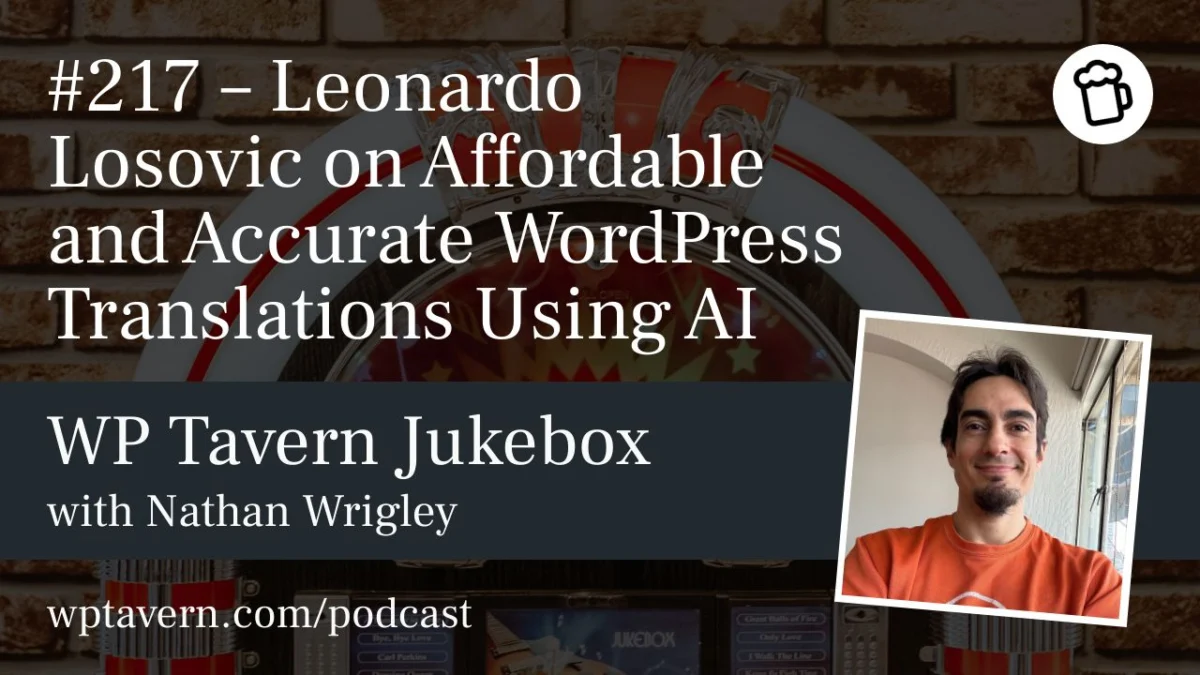
The landscape of web development and content management is undergoing a seismic shift, driven by the rapid evolution of Artificial Intelligence. For over a decade, WordPress site owners looking to expand their reach into international markets faced a daunting triad of obstacles: prohibitive costs, complex technical workflows, and the logistical nightmare of managing localized content. However, as discussed on the latest episode of the WP Tavern Jukebox podcast, these barriers are being dismantled by a new generation of AI-powered translation tools.
Leonardo Losoviz, a long-time WordPress developer and creator of the Gato AI Translations for Polylang plugin, suggests that the "should we translate" debate is effectively over. In an era where technological efficiency has lowered the barrier to entry to mere fractions of a cent, the question is no longer whether one can afford to translate a website, but rather, why one would choose to remain limited by language.
The Evolution of WordPress Translation: From Human Labor to AI Automation
To understand the current state of translation, one must look at the trajectory of the last ten years. Historically, creating a multilingual WordPress site was a "lengthy, costly enterprise." Site owners were required to identify every translatable string, hire professional human translators, negotiate rates, and manually integrate the translated output back into the site’s database—a workflow prone to human error and significant delays.
The Old Guard vs. The New Paradigm
In the traditional model, scaling to multiple languages was exponentially expensive. Hiring professional translators could cost upwards of $50 to $100 per hour. If a single blog post required five hours of translation, the financial burden became unsustainable for many small to mid-sized businesses.
Today, the integration of Large Language Models (LLMs) like OpenAI’s GPT, Anthropic’s Claude, and Google’s Gemini has transformed this process. By leveraging APIs, plugins like Gato AI Translations can now process content at machine speed. As Losoviz notes, while professional human oversight remains vital for highly technical, legal, or industry-specific content, the "heavy lifting" of translation is now automated with 99% accuracy. The cost has shifted from expensive hourly rates to micro-payments based on token usage, effectively democratizing multilingual content.
Chronology of Translation Strategy
The transition from manual to automated workflows has been marked by several key technological milestones:
- Pre-2015: The "Manual Era." Translation was entirely reliant on human effort, often requiring complex plugin architectures to manage localized strings separately.
- 2015–2022: The "Machine Translation Era." Tools like DeepL and Google Translate became standard. While faster, these tools often lacked the contextual awareness required for high-quality, readable content.
- 2023–Present: The "AI Integration Era." The emergence of generative AI allows for context-aware translations that understand tone, nuance, and technical jargon. Plugins are now moving away from simple string replacement to full-page, context-aware content generation.
Supporting Data: Efficiency and ROI
While precise global statistics on translation ROI vary, the economic argument for automation is clear. Previously, a business might have limited itself to two languages due to budget constraints. With AI, that same budget can now support ten or twenty languages.
The primary cost reduction comes from the shift in labor:
- Direct Costs: Moving from hourly translator rates to API token fees reduces costs by an estimated 90–95%.
- Time-to-Market: What previously took days or weeks now happens in seconds.
- Maintenance: Modern plugins allow for the "parallel" creation of posts, meaning the site structure is handled automatically, reducing the need for expensive developer intervention.
The "Arms Race" of Digital Presence
Perhaps the most compelling argument for adopting AI translation is competitive pressure. Losoviz describes a "translation arms race." As translation becomes easier and cheaper, it is becoming the new baseline for professional websites.
If a competitor translates their site into five different languages, they gain a massive advantage in search engine discoverability and user trust. Consequently, businesses that do not adopt these tools risk falling behind. In this environment, translating your site is no longer just an "expansion strategy"; it is a defensive necessity to remain relevant in a globalized digital marketplace.
Technical Implementation: How Modern Plugins Work
Modern translation solutions, such as those built for the Polylang ecosystem, handle the complexity behind the scenes. When a user initiates a translation, the plugin typically performs the following:
- Post Duplication: The system creates a new entry for the target language, maintaining the relationship with the original content via a common taxonomy or identifier.
- SEO Management: Proper
hreflangtags are automatically generated, signaling to search engines that the new page is a localized version of the original, thus preventing "duplicate content" penalties. - Media Handling: Advanced systems now allow for the translation of media metadata (titles, alt text, and captions) without duplicating the actual binary image files, keeping the server lean and performant.
The Future: WordPress 7.0 and Collaborative AI
The conversation also touched on the future of the WordPress editor, specifically the upcoming developments in "Phase 3" of the Gutenberg project. Collaborative editing—the ability for multiple users to edit a page simultaneously, similar to Google Docs—is set to fundamentally change how humans interact with AI.
Losoviz posits that the future of translation will involve a "conversational interface" within the editor. Imagine a sidebar where an AI agent provides real-time feedback on translated text, highlighting sections where confidence is low or where a human review is recommended. This moves the workflow from a "set it and forget it" model to an interactive partnership between human and machine.
Official Perspectives and Best Practices
For those looking to implement these tools, Losoviz offers several critical pieces of advice:
- The "Finality" Rule: Never initiate a mass translation until the source content is 100% complete. Making edits after the fact creates a fragmented and costly mess of version control.
- Image Strategy: Avoid "hard-coding" text into images. If you must use images with text, use overlays in your page builder so that the text remains translatable as text, rather than as a pixelated graphic.
- Human-in-the-Loop: Even with 99% accuracy, there is a remaining 1% of ambiguity. Use professional translators to "polish" the final output, specifically for technical manuals, medical information, or legal documents.
- SEO Hygiene: Always ensure that your chosen translation plugin correctly implements the
hreflangattribute. This is the difference between reaching a new audience and being penalized by Google for spammy content.
Implications for Site Owners
The implications of this shift are profound. Small bloggers, e-commerce store owners, and corporate entities now have the same capabilities that were once reserved for enterprise-level organizations.
The "invisible gotchas" of translation—such as the way date formats, cultural references, and technical acronyms differ across regions—can now be managed with greater ease. However, the ease of technology does not absolve the site owner of the responsibility for quality. As Losoviz emphasized, the technology is a tool, not a replacement for a sound content strategy.
Conclusion
The era of the monolingual website is drawing to a close. As the barriers of cost and complexity vanish, the expectation from global users for localized content will only increase. By leveraging AI-powered WordPress plugins, site owners can now navigate the global market with unprecedented speed and accuracy. The challenge moving forward is not the how—the technology is already here—but the why. By treating translation as a standard, essential component of the publishing workflow rather than an optional luxury, businesses can secure their place in the increasingly competitive global digital economy.
For those ready to take the leap, the advice remains clear: finalize your source content, leverage the AI to handle the scale, and keep a watchful eye on the details that define your brand’s voice in every language.