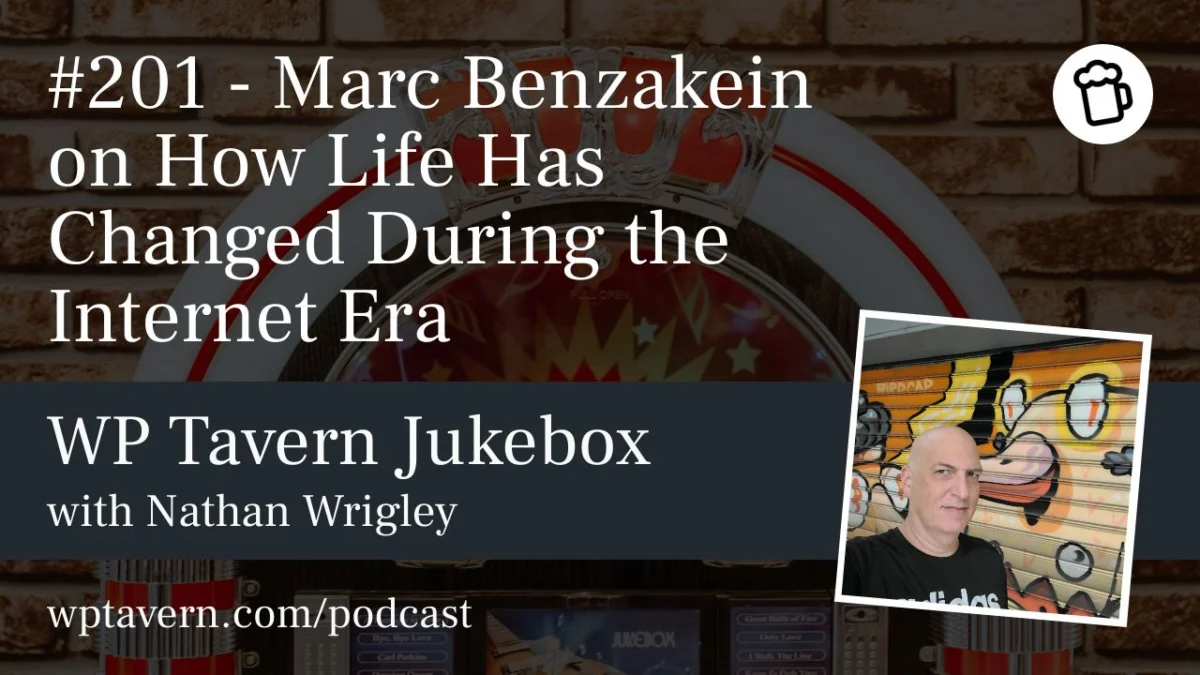
In the landscape of modern technology, where high-speed connectivity is treated as an invisible, ubiquitous utility, it is easy to forget that the internet was once a frontier—a wild, slow, and profoundly experimental space. In a recent episode of the Jukebox Podcast from WP Tavern, host Nathan Wrigley sat down with veteran technologist Marc Benzakein to embark on a reflective journey through the history of the internet. Their conversation moved beyond the standard discourse of plugins and WordPress updates, offering a poignant look at how the digital era has fundamentally reshaped human behavior, the pace of work, and the social fabric of our society.
The Dawn of the Connected Era: A Chronology of Innovation
To understand the current digital climate, one must look back to the mid-1990s. For Benzakein, this era was not defined by smartphones or cloud computing, but by the painstaking, intentional act of getting online.
The BBS and the Dial-Up Dream
Benzakein’s entry into the digital world predates the mainstream web browsers of the late 90s. He recounts his time managing a Bulletin Board System (BBS)—a precursor to modern social forums. In those days, a single user could connect to his system at a time via a phone line. "I had a one-gigabyte SCSI hard drive," Benzakein recalls, noting that this hardware was a "badge of honor" in a time when most users were operating on 2,400-baud modems.
This period was characterized by "hobbyist enthusiasm." Users were not merely consumers of content; they were architects of their own small digital communities. Whether it was using Gopher to conduct research or manually configuring token-ring networks for local businesses, the internet required a level of technical literacy that is now largely abstracted away by modern software.
From Coffee Imports to Internet Infrastructure
Benzakein’s career trajectory offers a unique window into the transition from analog business to digital operations. While importing coffee from Burundi, he witnessed firsthand the shift from snail mail and fax machines to early email. When political unrest destabilized his coffee business, he pivoted toward the burgeoning internet service industry. Working alongside partners like Greg Franklin, he helped wire schools for high-speed access—a task that, at the time, involved grappling with the complexities of early ISDN and US Robotics modems.
This era was the "Wild West." Regulations were sparse, and the technology was inherently fragile. Yet, it was this fragility that fostered a sense of community among the early pioneers, who often had to rely on long-distance phone calls to troubleshoot routing or DNS issues with strangers across the country.
Supporting Data: The Cost of Always-On Living
As the conversation turned toward the implications of today’s technology, both Wrigley and Benzakein analyzed the hidden costs of our hyper-connected reality.
The Myth of Efficiency
A recurring theme in the history of the internet is the promise of time-saving. The narrative was simple: technology would automate tasks, freeing humans for leisure. However, the reality has been the inverse. "I very quickly learned that nobody was working a two-hour day once technology came into our homes," Benzakein observes. "People were not only bringing their work home, but they were working 14 and 16-hour days."
The data on modern productivity suggests that technology has not shortened the workday; rather, it has expanded the scope of our obligations. Because communication is instantaneous—via email, Slack, or SMS—the expectations for response times have shifted, effectively erasing the boundaries between professional and personal life.
The Atrophy of Attention
The pace of life has accelerated to the point where "slow" is often viewed as a failure. Benzakein notes a personal trend of consuming podcasts and media at 1.5x or 2x speed—a habit that bleeds into real-world interactions. "I become impatient talking to people because they talk so slowly," he admits. This creates a feedback loop where the brain constantly seeks higher-bandwidth input, potentially contributing to the rise in attention-deficit symptoms seen across modern society.
Official Observations: The Cultural Shift
The evolution of the internet has not been a linear progression toward "better" technology; it has been a cultural shift that has redefined our expectations of reality.
The Death of Intentionality
In the early days, getting online was an intentional, physical act. You had to sit at a desk, engage a modem, and wait. Today, the internet is an "always-on utility." This shift has fundamentally changed how younger generations interact with the world. Wrigley and Benzakein discussed the phenomenon of the "on-demand" generation, who find the concept of waiting for a television show to air at a specific time—or the limitations of a physical media library—to be utterly alien.
The Rise of Digital Minimalism
Interestingly, both participants pointed to a burgeoning trend among younger adults: digital minimalism. Benzakein shared that his 21-year-old son and his circle of peers are actively retreating from the tech-heavy lifestyle that characterized the previous two decades. They prioritize analog experiences—hiking, reading physical books, and favoring phone calls over constant text-based surveillance. This suggests a generational pushback against the "walled gardens" of social media and the relentless churn of new digital interfaces.
Implications for the Future: AI and the Level Playing Field
As we stand on the precipice of the AI revolution, the conversation shifted toward the future. Is the internet still the "great equalizer" it was promised to be?
The Level Playing Field vs. Monopolistic Dominance
Benzakein reflects on the early mission of the internet: to level the playing field between small businesses and global corporations. "On the web, it all looks the same," he once believed. While this remains partially true, the rise of search engine giants and monolithic platforms has made it increasingly difficult for smaller players to gain visibility without significant investment.
Despite this, the core ethos of open standards—the foundation of the internet—remains a powerful tool for democratization. The WordPress ecosystem, which both Wrigley and Benzakein navigate, serves as a prime example of an open-source space where the "have-nots" can still build, publish, and compete on a global scale.
Looking Toward the Horizon
The overarching sentiment of the discussion is one of cautious optimism. The internet is undeniably the eighth wonder of the world, a repository of human knowledge and connection that has no historical precedent. While it has brought unintended consequences—distraction, longer work hours, and the erosion of privacy—it has also unlocked human potential at an unprecedented scale.
The challenge for the next generation, according to Benzakein, is not necessarily to reject technology, but to exercise the discipline to manage it. "We need to recognize that while, yes, we need to take up a hundred percent of our time, what are the important things that we need to do… some of that is downtime. Some of that is sleep, some of that is eating, some of that is interacting with people."
Conclusion
The history of the internet is a mirror reflecting our own humanity—our curiosity, our greed, our capacity for connection, and our propensity for over-extension. As Benzakein and Wrigley concluded, we are living through a "breathtaking time." While the rapid pace of change, particularly with artificial intelligence, can feel overwhelming, it is also a moment of immense opportunity. The genie of the digital age will never go back in the bottle, but as the pendulum swings toward a more balanced, intentional engagement with our tools, there is hope that we can harness the internet for its original purpose: to bring us together, rather than keep us tethered.