In a significant expansion of its enterprise AI strategy, Anthropic has unveiled “Claude Tag,” a new feature currently entering research preview that aims to transform how artificial intelligence functions within the workplace. By evolving from a passive, on-demand tool into an “always-on” participant, Claude is moving beyond simple query-response interactions to become a persistent, context-aware member of the team.
Available to users of Claude Enterprise and Claude Team, this new integration promises to bridge the gap between static AI assistants and truly collaborative digital coworkers. As the enterprise AI landscape becomes increasingly competitive, Anthropic’s move signals a shift in focus from raw model performance to the importance of institutional memory and workflow integration.
The Evolution of the Digital Teammate
For years, users have interacted with AI in Slack through direct messages or sporadic mentions. While these interactions were helpful for drafting emails or summarizing short texts, they lacked the "long-term memory" required for complex, multi-day projects.
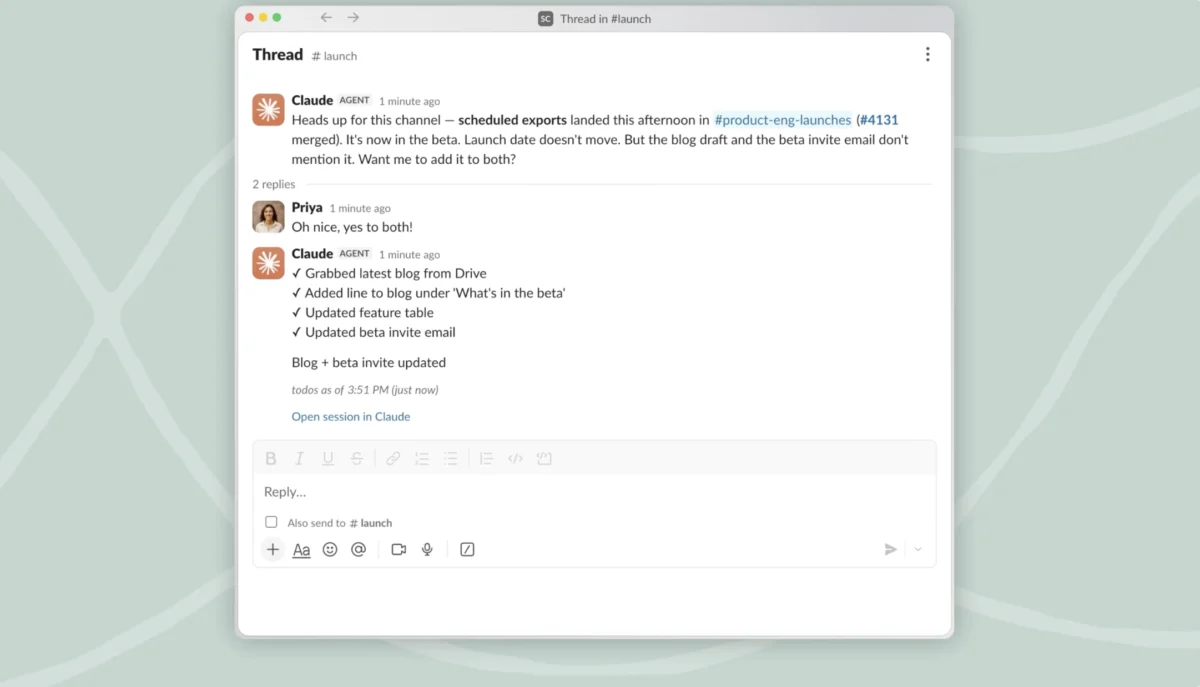
Claude Tag represents a fundamental shift. By allowing users to tag @Claude in a channel, the model does more than just answer a question—it begins to "follow" the project’s trajectory. It acts as a persistent observer, ingesting the nuances of team discussions, tracking task progression, and maintaining a shared history that every team member can access.
This is not a standalone app but an evolution of Anthropic’s existing ecosystem. It builds upon previous integrations such as Claude Code, which already allows for the routing of technical tasks from Slack to web-based coding environments. However, while those tools were task-specific, Claude Tag is designed to be relationship-oriented. It creates a single, unified identity for the AI within a channel, ensuring that if one team member assigns a task, the next person to join the thread can see exactly what the AI has already produced or processed.
A Chronology of Integration: From Chatbots to Agents
To understand the gravity of this release, one must look at the timeline of AI integration in the workplace over the last two years:
- Late 2025: Anthropic launched "Claude Code" for Slack, marking the first major move to bridge the gap between communication platforms and deep technical execution. This allowed developers to initiate coding sessions directly from a chat thread.
- Early 2026: Anthropic rolled out a suite of interactive Claude apps, setting the stage for more fluid workplace integrations. These apps established the foundation for the current API-driven architecture that allows Claude to interact with external tools.
- Present Day: The announcement of Claude Tag marks the transition into the "Agentic" era. By moving from a reactive model to an "ambient" mode—where the AI can proactively offer updates, flag risks, and follow up on forgotten tasks—Anthropic is attempting to simulate the behavior of a human colleague.
The Power of Persistent Context
The primary challenge for enterprise AI has never been the intelligence of the models themselves, but their lack of institutional context. An AI that knows the prompt but not the project history is inherently limited.
Claude Tag addresses this through what Anthropic describes as "persistent context." When active, the model learns the specific lexicon, goals, and recurring challenges of a channel. If granted the necessary permissions by system administrators, Claude can even pull information from other authorized channels, synthesizing facts from across the organization to provide comprehensive answers.
Security and Scoping
Anthropic is acutely aware of the risks associated with persistent AI. To mitigate concerns regarding data leakage and privacy, Claude Tag features a robust administrative framework:
- Channel Scoping: Administrators define exactly which channels the AI can monitor. A Claude instance configured for the legal department will remain strictly partitioned from the engineering channel, preventing cross-contamination of sensitive information.
- Permissioning: The model only accesses the data it is explicitly authorized to view, maintaining the principle of least privilege within the corporate Slack environment.
- Public Transparency: Because the AI operates in public view, team members can verify, edit, and audit the AI’s contributions in real-time, preventing the "black box" syndrome that often plagues automated systems.
The Competitive Landscape: The Battle for the Enterprise “Brain”
Anthropic is entering a crowded arena. As enterprises look to consolidate their AI tooling, the "intelligence layer" has become the most valuable real estate in the software industry.
Microsoft has already established a massive footprint with Microsoft Graph, which powers Copilot and Work IQ. By indexing a user’s entire digital existence—emails, calendars, documents, and chats—Microsoft is attempting to build a comprehensive map of the enterprise.
Similarly, data-centric companies like Snowflake and Databricks are positioning their platforms as the definitive source of truth. They argue that an AI agent is only as good as the data it sits on top of, and they are moving to provide the back-end "memory" for agents to tap into.
Meanwhile, Glean has carved out a niche by building a sophisticated intelligence layer that sits between the AI model and the enterprise’s messy, fragmented data stores. By searching across disparate applications and understanding the company’s internal structure, Glean is essentially providing the "connective tissue" that Anthropic is now attempting to embed directly into the Slack workflow.
Implications for the Future of Work
The introduction of Claude Tag suggests that the future of work is not just about using AI as a tool, but working with AI as an entity.
1. The Death of the "Hand-Off"
In traditional project management, time is often lost during hand-offs. A team member goes on vacation, and their replacement spends hours reading back-threads to understand the status of a project. With an always-on Claude, the AI functions as the institutional memory. The new team member can simply ask, "@Claude, what is the status of the project, and what are my outstanding action items?" and receive an accurate, context-aware summary.
2. Proactive Workflow Management
Perhaps the most disruptive aspect of Claude Tag is its "ambient mode." By proactively jumping into a chat to flag a forgotten task or alert a team to a potential conflict identified in another channel, the AI shifts from a service provider to a manager of sorts. This requires a high degree of trust and reliability; if the AI flags something that isn’t important, it risks becoming a source of noise rather than a source of signal.
3. The Public Performance of Work
Anthropic’s vision emphasizes that the AI "produces work in public view." This is a departure from the private, siloed interactions of standard LLM interfaces. By performing tasks in a Slack thread, the AI becomes accountable to the team. If the AI makes a mistake, the team sees it immediately and can correct it, fostering a culture of collaborative refinement.
Official Stance and Moving Forward
Anthropic has framed this release as a major step toward its ultimate goal of "AI-augmented collaboration." In their official statement, the company noted, "Claude Tag makes it feel like you’re working with a real colleague—one that can produce work in public view, with far greater context and understanding than before."
For the end user, this represents a lower barrier to entry for AI adoption. Instead of learning new software or toggling between different interfaces, the AI meets the employee where they already spend the majority of their day: in Slack.
As the research preview progresses, the industry will be watching closely to see if Anthropic can strike the balance between helpfulness and over-activity. The success of Claude Tag will ultimately depend on its ability to provide value without cluttering the digital workspace. If successful, it may well prove that the most effective AI is not the one with the highest benchmark score, but the one that understands the team best.
Conclusion
The introduction of Claude Tag is a strategic masterstroke in the battle for enterprise AI dominance. By embedding itself into the fabric of Slack, Anthropic is betting that the winning AI platform will be the one that becomes an indispensable, persistent, and context-aware member of the workforce. Whether this will lead to a new era of hyper-productivity or a world of "AI-induced notification fatigue" remains to be seen. However, one thing is clear: the era of the passive chatbot is ending, and the era of the active, always-on AI teammate has officially begun.