Main Facts: The New Paradigm of Data Interaction
In the rapidly evolving landscape of digital marketing, the methodology for analyzing Pay-Per-Click (PPC) performance is undergoing a fundamental shift. At the heart of this transformation is the Model Context Protocol (MCP), an open-source standard introduced to facilitate seamless communication between Large Language Models (LLMs)—specifically Anthropic’s Claude—and external data silos.
While MCP has been hailed as a "game-changer" for its ability to eliminate the tedious "CSV-to-Chat" workflow, a critical distinction has emerged among industry experts: MCP is an investigative tool, not a reporting system. The core facts of the current reporting environment are as follows:
- MCP as a Connector: MCP serves as a standardized "translator" that allows an AI assistant to query live databases like Google Ads, GA4, or BigQuery directly.
- The Governance Gap: Direct MCP connections to live platforms lack "memory" and consistent logic. Without a middle layer, the AI may interpret data differently across separate sessions.
- The BigQuery Necessity: For any data that informs client-facing reports or high-stakes budget decisions, BigQuery remains the essential "Single Source of Truth."
- Native AI Integration: Google Ads has integrated its own AI, Gemini, to handle internal account checks, creating a multi-tiered ecosystem where different tools serve distinct analytical purposes.
As agencies and in-house teams rush to adopt AI, the challenge is no longer about accessing data, but about governing it. The mistake many practitioners make is assuming that because an AI can "see" the data via MCP, it is ready to "report" on the data to a client.
Chronology: From Pivot Tables to Protocol-Driven Analysis
To understand where we are, we must examine the evolution of the PPC analyst’s workflow. This chronology highlights the transition from manual labor to automated reasoning.
The Manual Era (2000s – 2015)
For over a decade, PPC reporting was defined by the "Export and Pivot" cycle. Analysts would download massive CSV files from Google AdWords (as it was then known), import them into Microsoft Excel, and spend hours building pivot tables. This era was characterized by high latency and a high margin for human error.
The Dashboard Era (2016 – 2022)
The rise of API-based connectors and visualization tools like Looker Studio (formerly Google Data Studio) allowed for "live" reporting. While this solved the latency issue, these dashboards often became "data graveyards"—complex, multi-page reports that clients rarely looked at and analysts struggled to maintain.

The Generative AI Explosion (2023 – Early 2024)
With the launch of ChatGPT and Claude, analysts began copying and pasting data into chats to ask for insights. This provided immediate "ad-hoc" value but was hampered by context window limits and the security risks of manual data handling.
The MCP and Native AI Era (Late 2024 – Present)
The introduction of the Model Context Protocol (MCP) by Anthropic changed the architecture. Instead of the user bringing data to the AI, the AI can now reach out and pull the specific data it needs. Simultaneously, Google integrated Gemini directly into the Ads interface. This has created a "tri-fold" workflow:
- Native AI for quick, platform-specific checks.
- MCP for exploratory, cross-platform investigation.
- BigQuery for governed, repeatable client reporting.
Supporting Data and Technical Analysis: Why the Stack Matters
The technical argument for a tiered reporting system—moving from native tools to MCP and finally to BigQuery—rests on three pillars: Token Economics, Logic Governance, and Data Joinery.
1. The Token Economics of MCP
When a user asks Claude to analyze last week’s performance via a direct MCP connection to Google Ads, the underlying process is resource-intensive. The API sends raw data—every campaign ID, ad group metric, and timestamp—into the AI’s context window.
- Cost: This consumes a significant number of "tokens," which are the units of measurement for AI processing.
- Efficiency: For a large account, a single query can "clog" the context window, making follow-up questions less accurate as the AI loses track of earlier parts of the conversation.
2. Logic Governance through BigQuery Views
The most significant risk in AI-led reporting is "hallucinated logic." If you ask an AI to "split performance by brand vs. non-brand," it must decide on the fly which campaigns fit those categories. If you ask the same question next week, the AI might use a slightly different criteria.
By using BigQuery, analysts can create SQL Views. A view is a virtual table where the logic is hard-coded. For example:

SELECT * FROM ads_data WHERE campaign_name LIKE '%Brand%'
When Claude queries this BigQuery view via MCP, it isn’t "guessing" what brand traffic is; it is pulling from a pre-defined, governed table. This ensures that the data in a client report on Monday matches the data in a budget meeting on Friday.
3. The "Joined Data" Problem
Google Ads is inherently biased toward its own ecosystem. It reports on what happened within its own attribution window. However, a client’s reality often involves a mix of Shopify sales, GA4 events, and CRM leads.
- Direct MCP: Queries one source at a time (e.g., just Google Ads).
- BigQuery Stack: Allows for the "joining" of datasets. An analyst can merge Google Ads spend with actual closed-won revenue from a CRM. When the AI queries this joined table, it provides business-level insights rather than platform-level metrics.
Official Responses and Platform Philosophies
The shift toward this hybrid model is reflected in the strategic directions of the major players in the space.
Anthropic’s Vision for MCP
Anthropic has positioned MCP as an open standard, inviting the developer community to build connectors (like GoMarble) for every imaginable data source. Their philosophy is that the AI should be an "orchestrator" of tools. By allowing Claude to connect to BigQuery or Google Ads, they are moving the AI from a chatbot to an "AI Agent" capable of performing complex research tasks.
Google’s "Native-First" Strategy
Google’s response has been to embed Gemini directly into the Google Ads interface. Their "Gemini Report Generator" allows users to describe a report in plain English and see it built instantly. Google’s goal is to keep the user within their ecosystem, offering a "decent enough" reporting experience for internal account work that reduces the need for external tools.
The Middleware Perspective
Third-party connectors like Supermetrics and Weavely have adapted by becoming the "plumbing" for BigQuery. Their official stance emphasizes that while AI can analyze data, the "data pipeline" must be robust, scheduled, and error-free—something that live, ad-hoc AI queries cannot yet guarantee.
Implications: The Future of the PPC Analyst
The adoption of this "Combined Stack" (Google Ads Native + MCP + BigQuery) has profound implications for the digital marketing profession.

The Death of the "Reporting Specialist"
The role of the junior analyst whose primary job was to "pull numbers" is effectively over. AI can now do this faster and with fewer errors. The new requirement is for Data Architects—individuals who understand how to structure BigQuery views and how to prompt an AI to extract meaningful commentary from those views.
From Dashboards to Narratives
The industry is moving away from static dashboards. Clients are increasingly fatigued by 50-page slide decks. The implication of the MCP/BigQuery stack is that reporting can now be narrative-driven. Instead of a graph showing a spike in CPC, the AI can query the BigQuery view, identify that the spike was driven by a specific competitor entering the auction, and write a three-sentence summary for the client.
The "Double-Query" Rule
A new best practice is emerging for agencies: "If you ask it twice, automate it."
- Ad-hoc (One-off): "Why did CVR drop yesterday in the Florida campaign?" -> Use Direct MCP.
- Systemic (Recurring): "What is our rolling 30-day ROAS across all brand terms?" -> Use BigQuery View.
Conclusion: Trust, but Verify
Ultimately, the integration of MCP into the PPC workflow represents a leap forward in speed, but it introduces a "trust gap." Direct AI queries are ephemeral and prone to shifting logic. To bridge this gap, BigQuery serves as the "anchor."
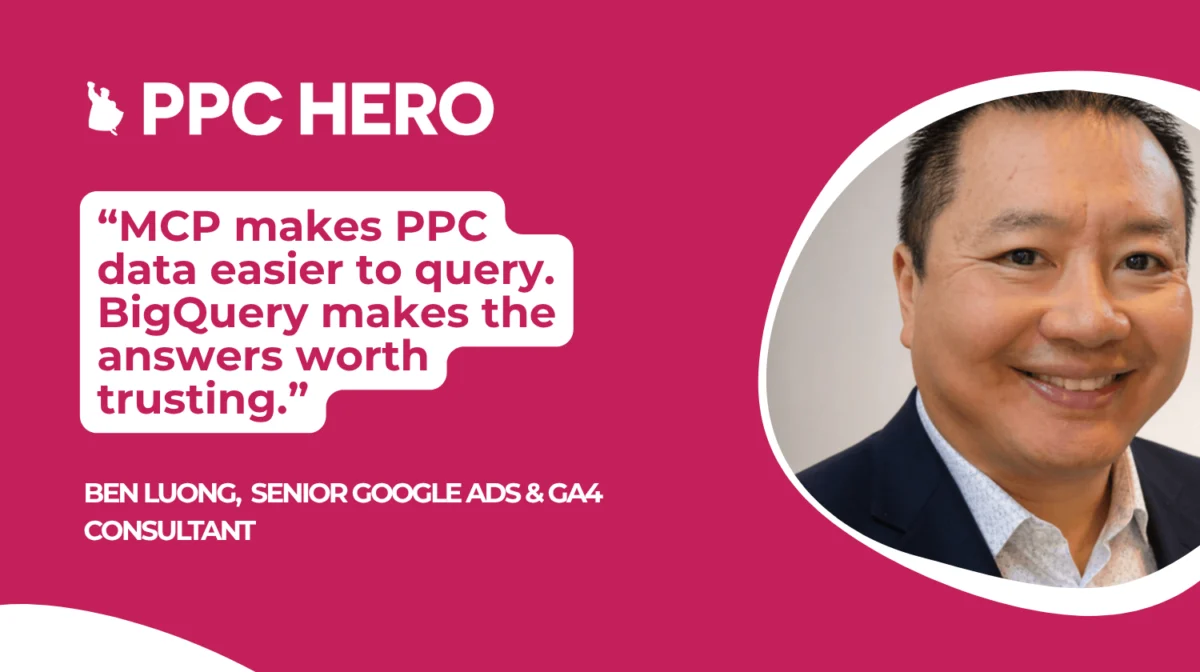
The winning strategy for 2025 and beyond is clear: Use Google Ads’ native AI for quick internal checks, use MCP for exploratory investigation, but never present a number to a client unless it has been filtered through the governed, reliable environment of a BigQuery data warehouse. MCP makes the data easier to talk to, but BigQuery makes the answers worth trusting.