By PPC Hero Insights
Main Facts: The Anatomy of Modern B2B Indecision
For years, the foundational playbook of B2B marketing has operated on a straightforward, linear premise: identify a decision-maker, articulate a unique selling proposition (USP), contrast your product against the competition, and drive a hard conversion. This single-buyer model formed the backbone of pipeline generation, digital advertising, and sales outreach.
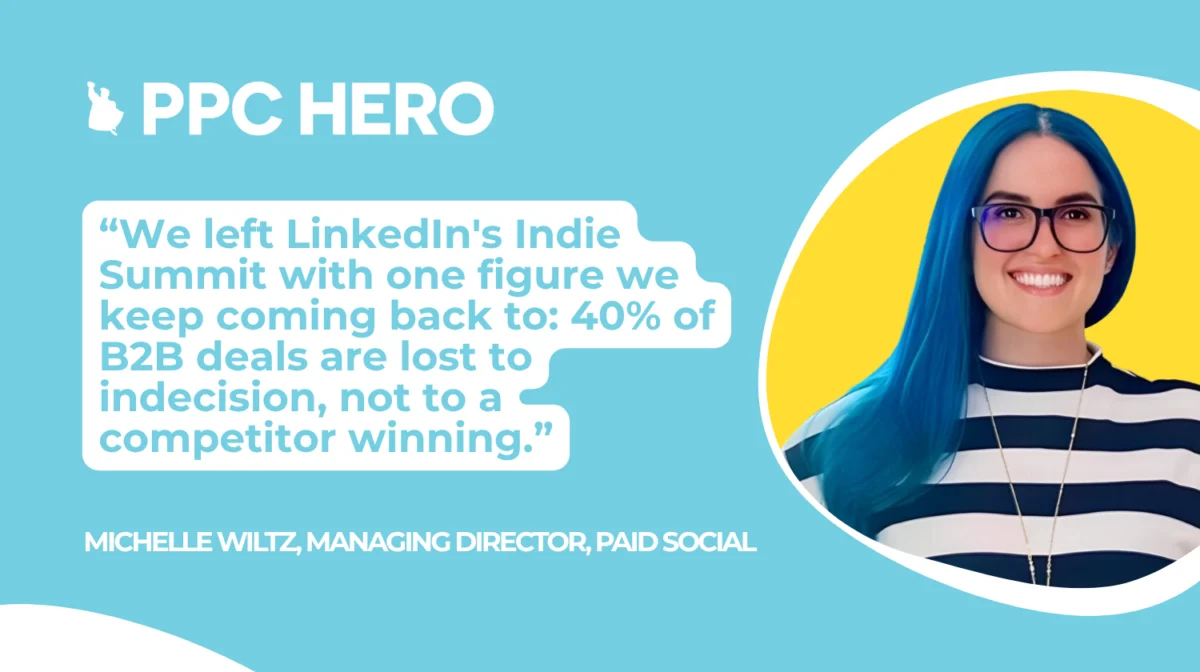
However, emerging insights from industry gatherings—most notably the recent LinkedIn Indie Summit—reveal a structural fracture in this traditional methodology. Industry data indicates a striking baseline reality: 40% of B2B deals are lost not to aggressive competitors, but to sheer indecision.
When deals stall out, the knee-jerk reaction for many marketing and sales teams is to diagnose it as a product pricing issue, a feature gap, or a failure of the sales pitch. In reality, the root cause is rarely tactical; it is architectural. The modern B2B buying group has expanded dramatically. On average, any given enterprise purchasing decision now involves roughly ten distinct stakeholders.
This committee typically includes a Chief Marketing Officer (CMO), a Chief Financial Officer (CFO), a security lead, procurement officers, frontline team leads, and technical evaluators. Each individual carries a unique set of departmental key performance indicators (KPIs), distinct risk tolerances, and specific internal questions they must answer before signing off on a vendor.
When no single stakeholder is actively opposed to a vendor, yet no one possesses the comprehensive confidence to force the deal across the finish line, the momentum dies. The deal does not migrate to a competitor; it simply evaporates into organizational paralysis. Traditional B2B campaigns—obsessed with converting a solitary persona—are fundamentally unequipped to resolve this collective friction.
Chronology: The Evolution of the Modern Buying Journey
To understand why traditional campaigns are failing, it is necessary to examine how the B2B buyer’s journey has transformed over the past decade.
Phase One: The Sales-Led Era (Pre-2015)
Historically, the buyer’s journey was heavily gated and controlled by vendors. A prospective buyer recognized a pain point, initiated contact with a sales representative, and relied on the vendor to educate them on category solutions, feature comparisons, and pricing models. Marketing’s primary role was top-of-funnel lead generation—handing over raw contact details to a sales development representative (SDR) who would then nurture the committee one-by-one.
Phase Two: The Digital Content Expansion (2015–2020)
As information became widely accessible online, the balance of power shifted. Buyers began conducting independent research via whitepapers, comparison blogs, and webinars before ever speaking to a sales rep. Marketing strategies adapted by producing vast libraries of bottom-of-funnel consideration content designed to prove product superiority over direct rivals. Yet, these campaigns still targeted an idealized, monolithic "buyer persona."
Phase Three: The AI-Accelerated, Committee-Driven Present (2026 and Beyond)
Today, the dynamic has shifted entirely. Data presented at the LinkedIn Indie Summit revealed that an astonishing 94% of B2B buyers now utilize Large Language Models (LLMs) and generative AI at some point during their purchasing process.
Before a vendor’s paid campaign even registers in their feed, members of the ten-person buying committee have already prompted an AI tool to map out the vendor landscape, summarize category trends, and cross-reference competitor claims. They arrive at the negotiating table armed with synthesized insights and a healthy dose of organizational skepticism. Consequently, the traditional battleground—fighting to prove you are better than Competitor X—has largely been rendered obsolete, because the buyer has often already settled that debate independently via artificial intelligence.
Supporting Data: Metrics Transforming B2B Strategy
Modern enterprise marketing requires a radical shift in measurement, format, and distribution. Industry metrics and platform performance indicators highlight a clear path forward for brands willing to adapt.
| Metric / Data Point | Source / Context | Strategic Implication |
|---|---|---|
| 40% | LinkedIn Indie Summit | Percentage of B2B deals lost to internal indecision rather than a competitor winning the business. |
| 10 People | Average B2B Enterprise Buying Group | Campaigns must build consensus across multiple departmental priorities, not just convert a single persona. |
| 94% | B2B Buyer Behavioral Data | Proportion of modern buyers utilizing LLMs for preliminary vendor and category research before human contact. |
| 1.6x Lift | LinkedIn Platform Research | Increase in lead generation form completion rates for members previously exposed to brand video ads. |
| 95% / +60% | Content Consumption Trends | Video retention rates on professional feeds; video consumption is growing 60% faster than other formats. |
| +36% CTR | Creative Optimization Data | Click-through rate lift achieved when video hooks open with a specific number, statistic, or data point. |
| +130% | BrandLink Performance Data | Higher video completion rates delivered by BrandLink formats compared to standard in-feed video. |
As these numbers demonstrate, video has emerged as the premier medium for navigating multi-stakeholder indecision. Unlike a written whitepaper—which is typically consumed in isolation by a single individual—video possesses a unique distribution lifecycle within corporate ecosystems.

When a compelling B2B video asset hits a platform like LinkedIn or connected television (CTV), it travels. It gets dropped into internal Slack channels, embedded in cross-departmental email chains, and played during internal alignment meetings. The CFO, the security lead, and the team lead can absorb the exact same context from the same source material. This shared exposure creates the psychological safety net required for a cautious group to reach a collective consensus.
Furthermore, creative execution matters deeply. Modern audiences scroll past generic corporate messaging. Data shows that hooks opening with precise metrics secure a 36% higher click-through rate, while contrarian statements and genuine pain-point questions instantly cut through feed fatigue. Interestingly, high production polish is increasingly taking a backseat to authenticity: lo-fi, behind-the-scenes, and workplace culture snippets frequently outperform heavily budgeted commercials because they signal genuine organizational trust to skeptical buyers.
Official Responses and Industry Perspectives
B2B marketing leaders, agency executives, and platform strategists are increasingly vocal about the need to overhaul outdated campaign architectures.
Industry analysts emphasize that the transition from a conversion-focused mindset to a consensus-building mindset requires a cultural shift within marketing departments. Speaking on the sidelines of recent B2B marketing forums, platform strategists noted that accountability metrics must evolve. Measuring success strictly on immediate, single-touch lead generation rewards surface-level metrics while ignoring the deep pipeline erosion caused by committee deadlock.
"For too long, B2B marketers have treated enterprise sales as an individual transaction writ large," notes one senior demand-generation strategist. "We build campaigns to win an argument against a competitor, when the real battle is happening internally inside the client’s conference room. If the security lead doesn’t understand your compliance framework, or the CFO can’t articulate your ROI to the board, your product features don’t matter. The deal stalls because the internal champions lack the shared ammunition to defend the purchase."
Agency leaders who have shifted their client briefs away from feature comparisons and toward risk-mitigation messaging report sustained year-over-year growth, even in flat economic climates. By addressing existential customer anxieties head-on—transforming the brief from "Here is why we beat our rivals" to "Here is why the operational risk you are afraid of is manageable"—brands are successfully unfreezing stalled pipelines.
Implications: What This Means for Your Next Campaign Brief
The reality of modern B2B buyer behavior forces marketing teams to ask hard questions before drafting their next quarterly campaign brief. The implications touch every pillar of modern go-to-market strategy:
1. Shift from Feature Wars to Risk Mitigation
Because modern buyers have already utilized LLMs to vet your feature set against competitors, your marketing collateral must evolve. Consideration content should aggressively confront the elephant in the room: operational risk, implementation friction, change management, and security compliance. Alleviating the specific anxieties of the CFO and the security lead accelerates consensus faster than listing marginal product differentiators.
2. Design for the Group, Not the Individual
Media planning must account for multi-channel, multi-touchpoint reinforcement. If ten people are involved in the purchase, your media mix must ensure that content reaches the broader committee contextually over time. Utilizing high-retention formats like video—and expanding reach through formats like BrandLink or CTV (which boasts a 2.6 times stronger awareness lift than linear TV)—ensures brand familiarity permeates the entire buying group.
3. Rewrite the Hook Strategy
With mobile feeds acting as intensely crowded battlegrounds, creative hooks must rely on radical specificity. Vague value propositions are instantly ignored. Openings featuring hard data points, contrarian industry observations, or direct confrontations of known professional frustrations are essential for stopping the scroll.
4. Redefine Pipeline Attribution
Finance and leadership teams must be educated on the realities of non-linear, multi-stakeholder buying journeys. Relying entirely on last-click attribution models will continue to starve brand-building and consensus-nurturing video campaigns of necessary budget. Building a pipeline you can defend to finance means mapping attribution models to account-level engagement rather than isolated individual conversions.
The Ultimate Question
As B2B organizations look toward upcoming planning cycles, the core strategic question remains starkly simple: Are you building your campaigns to convince one individual, or are you building them to get ten skeptical stakeholders comfortable enough to move forward together?
Answering that question correctly is the difference between watching your pipeline steadily stall out or driving predictable, defensible enterprise growth.