Every PPC (Pay-Per-Click) manager is intimately familiar with a very specific, high-stakes brand of anxiety: the mechanics of scaling a winning campaign.
Imagine the scenario: A high-performing campaign is currently restricted to a modest $100 daily budget. Its target Cost Per Acquisition (CPA) is configured at $50, but Google’s Smart Bidding algorithm, operating within a constrained sandbox, has naturally settled at a pristine $35 actual CPA. The clients are thrilled, company leadership is nodding approvingly, and the next logical step appears glaringly obvious—increase the budget.
Acting on this momentum, the daily limit is pushed to $500. Within hours, managers watch in real time as performance destabilizes. The algorithm loses its footing, the learning phase resets, and the actual CPA violently skyrockets past the $50 target, wiping out profitability and inducing panic.
For years, budget-limited campaigns utilizing target-based bid strategies—specifically Target CPA and Target ROAS (Return on Ad Spend)—treated daily budgets as an artificial efficiency throttle. When the budget valve was suddenly opened, the algorithm’s underlying bidding mechanics shifted unpredictably.
That era is coming to a definitive close.
According to official Google documentation, a sweeping, permanent update scheduled for August 17, 2026, is fundamentally altering how Smart Bidding treats budget-constrained campaigns. While much of the initial reaction across digital marketing forums has hyper-focused on the anticipated loss of "cheap conversions," industry veterans are uncovering a massive strategic silver lining: Google is permanently uncoupling the budget lever from the efficiency lever.
Here is an exhaustive look at what is changing under the hood, how this shift impacts account architecture, and a four-step tactical framework to insulate and prepare your campaigns before the August deadline.
The Historical Flaw: Why Scaling Budgets Broke Campaigns
To fully comprehend why the August 17 update is a long-term strategic win, PPC professionals must deconstruct how Smart Bidding previously handled budget-constrained accounts.
Historically, when a campaign bore the dreaded "Limited by budget" status, Smart Bidding did much more than simply cut off spend when the dollar limit was met. It aggressively restricted its real-time auction behavior. The algorithm would cherry-pick only the absolute cheapest, highest-intent conversions available within that tight, localized financial boundary.
This created a deeply misleading performance baseline. A campaign configured with a $50 target CPA delivering a $35 actual CPA was not necessarily experiencing organic "overperformance." Instead, it was predominantly buying a microscopic, highly protected slice of inventory. Because the budget was heavily constrained, the system actively avoided entering broader, more competitive auctions.
The friction occurred the moment a manager scaled that budget. By unlocking additional funds, the smart bidding system was suddenly forced to re-evaluate broader auction pools that had been deliberately ignored during the campaign’s initial learning phase. The immediate collateral damage included wild CPA spikes, performance instability, and extended re-learning cycles that could take weeks to normalize.
The August 17 Shift: Disconnecting Budget and Efficiency
Effective August 17, 2026, Google is forcing Smart Bidding to optimize strictly toward the numerical target sitting in the settings box, irrespective of whether the campaign is heavily budget-constrained or fully funded with unlimited capital.
Google’s official documentation illustrates this behavioral change with stark clarity: if a campaign maintains a $10 Target CPA, but its recent actual performance has hovered at $5 due to budget constraints, the post-August 17 algorithm will no longer artificially protect that $5 CPA. Instead, it will deliver much closer to the designated $10 target.
At first glance, this reads like an efficiency penalty—a forced inflation of acquisition costs. In practice, however, it is a crucial algorithmic stabilization fix designed to make forecasting reliable.

By systematically separating efficiency from budget availability, Google is creating a linear scaling environment. If a marketing team increases the budget on a campaign locked into a $35 target, the algorithm will capture a higher volume of traffic at that exact $35 target, rather than wildly mutating its bidding parameters in an attempt to guess what efficiency tier the human manager actually intended.
Chronology of the Update: Key Milestones
To manage this transition smoothly, advertisers must track the rollout timeline provided by Google:
- July 6, 2026: Google officially rolls out the Bid Target Adjustment Tool across accounts globally. This tool serves as the primary diagnostic dashboard for identifying vulnerable campaigns.
- July 6 – August 17, 2026: The grace and adjustment window. Advertisers are given roughly six weeks to audit historical data, analyze past budget constraints, and manually adjust their bid targets to reflect true performance realities.
- August 17, 2026: The permanent enforcement date. Smart Bidding rules update globally across eligible networks, eliminating budget-cap overperformance and enforcing strict adherence to stated targets.
Campaign Impact Matrix: Who Is Affected?
Not every campaign type within a modern Google Ads account operates under these new rules. Understanding structural boundaries ensures that internal account audits focus strictly on vulnerable assets.
| Campaign Type / Category | Bidding Strategies Impacted | Post-August 17 Behavior |
|---|---|---|
| Search, Shopping, Performance Max, Demand Gen, Travel | Target CPA, Target ROAS, Target CPC (Demand Gen) | Changes: Will strictly deliver toward the stated target, eliminating budget-cap overperformance. |
| Display & Hotel | Target CPA, Target ROAS | No Change: Already operate under this strict target behavior historically. |
| App Campaigns, Video Reach, Video View (VVC) | Target CPA, Target ROAS / Cost-Per-View | Retain historical bidding behavior without modification. |
| Manual Bidding, Max Conversions, Max Value | Manual CPC, Target Impression Share | Unaffected by target-based bidding changes. |
Official Responses and Industry Sentiment
Initial reactions across digital marketing communities were understandably mixed. Specialized forums like PPC Hero and Reddit’s r/PPC lit up with discussions regarding the impending death of "accidental efficiency." Many mid-market agency owners expressed initial frustration over losing the aesthetic appeal of reporting a $35 CPA on a $50 target.
However, enterprise-level account directors have welcomed the structural predictability. In official statements accompanying the rollout documentation, Google emphasized that the change is designed to resolve enterprise complaints regarding the unpredictability of scaling budgets.
"Predictability is the cornerstone of modern digital media planning," noted one agency strategist. "While losing the illusion of out-performing targets due to starvation hurts our pride, gaining the ability to double a budget without blowing up the client’s unit economics is an exceptional trade-off."
Action Plan: How to Prepare Your Account
Because Google will not automatically adjust bid targets to compensate for historical budget starvation, doing nothing is an active choice that will let CPAs drift upward toward legacy numbers sitting idly in campaign settings.
To successfully navigate the transition, PPC managers should deploy this four-step execution framework using Google’s Bid Target Adjustment Tool:
1. Access the Bid Target Adjustment Tool
Open the system notification inside your Google Ads manager view to launch the Bid Target Adjustment Tool. Google automatically populates this interface with any campaign that hit a "Limited by budget" constraint over the trailing 12-month window.
- Manual Cross-Check: If you prefer to audit manually, filter your campaign data table by Search Lost IS (budget) > 0% over a 12-month date range, and cross-reference it against the last 30 days of performance to establish a realistic baseline.
2. Recalibrate CPA and ROAS Bids
Evaluate whether your historical targets match current operational realities. If a campaign has been running efficiently at a lower actual CPA because of a budget cap, adjust your target downward before August 17 to match that reality, preventing sudden cost inflation when the rules change.
3. Respect the Conversion Cycle Window
Smart Bidding requires time to recalibrate. Account teams must factor in 1 to 2 full conversion cycles for the algorithm to stabilize post-adjustment. If your business operates with a 1-week sales cycle, execute your bid adjustments well in advance so performance metrics normalize prior to the hard deadline.
4. Conduct Incremental Value Audits
Campaigns that previously overperformed at a lower CPA often relied heavily on low-hanging fruit, such as branded search queries or hyper-local traffic. Use this structural update as an opportunity to re-evaluate whether these campaigns generate true incremental value, making necessary negative keyword and targeting adjustments.
The Bottom Line
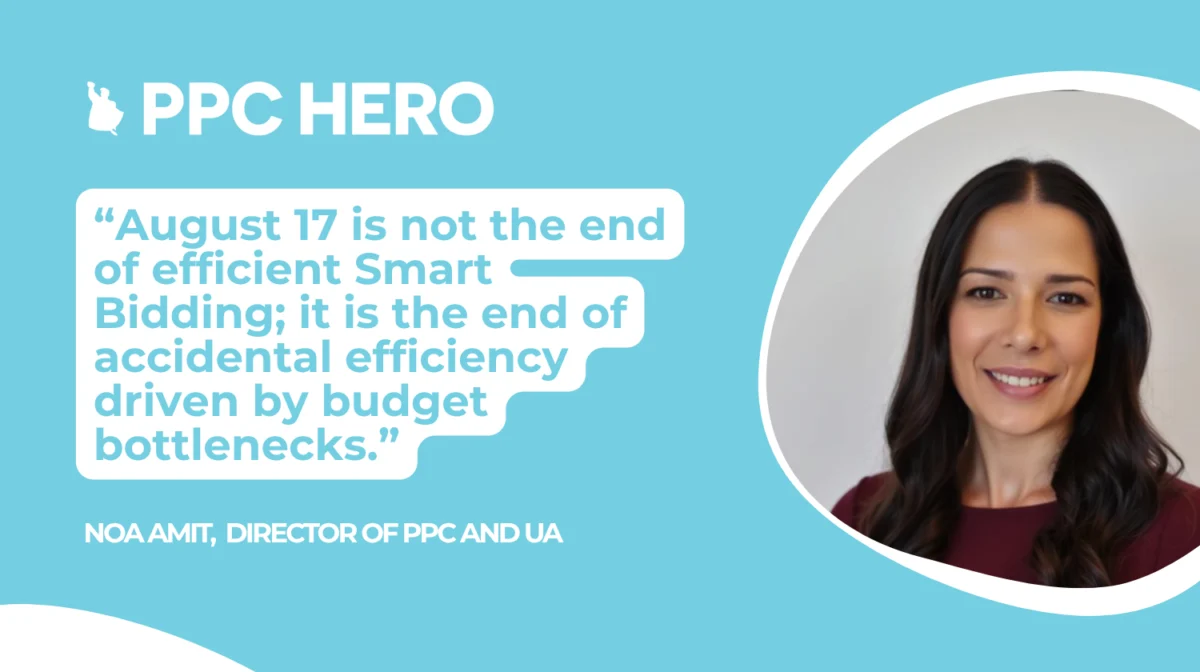
August 17, 2026, marks the end of an era, but not the end of efficient automated bidding. Rather, it represents the death of accidental efficiency driven entirely by artificial budget bottlenecks.
By pulling stale targets down to match true, day-to-day performance, PPC managers eliminate the lurking risk of unwanted CPA drift. More importantly, they lay the groundwork for a future where increasing a digital advertising budget finally does what it was always intended to do: scale revenue and lead volume predictably, without breaking what is already working.