At SaaStr AI 2026, the atmosphere was distinctly different from the breathless, hype-fueled gatherings of previous years. If 2024 and 2025 were defined by the "gold rush" of integrating Large Language Models (LLMs), 2026 signaled a harsh, necessary pivot toward maturity. Across six distinct sessions—covering everything from global payroll to e-commerce and legal tech—a singular, undeniable consensus emerged: The AI model has become a commodity.
For the modern B2B SaaS leader, the question is no longer "How do we implement AI?" but rather "Where is the moat?" As the barriers to entry for basic AI functionality have collapsed, the winners are separating themselves from the "AI tourists" by focusing on proprietary data, deterministic workflows, and high-stakes compliance.
The New Reality: AI as a Utility
Two years ago, a startup could secure venture funding simply by claiming they had an "AI-first" product. At SaaStr AI 2026, that pitch was met with indifference. Every company in attendance had access to the same foundational models—Claude, OpenAI, and specialized open-source iterations.
The sessions made it clear: if your entire value proposition relies on a wrapper around an LLM, you are not building a business; you are renting your existence from the model providers. The companies that commanded the room were those that stopped selling "AI" and started selling "Outcomes-as-a-Service."
Chronology of the Summit: Lessons from the Frontlines
The conference featured six distinct tracks, each highlighting a different facet of how vertical AI is evolving beyond the hype cycle.
1. Shoplazza and Subotiz: Data as the Definitive Moat
The commerce track kicked off with a look at how platforms like Shoplazza are scaling. With over 650,000 merchants and billions in transaction volume, their moat isn’t the generative AI that creates storefronts; it is the data feedback loop. When an AI agent handles payments, ad optimization, and operations, the platform gathers proprietary insights that no general-purpose model can replicate. The takeaway was clear: AI is the engine, but proprietary, vertical-specific data is the fuel that prevents churn.
2. Nue: Deterministic Guardrails in a Fluid World
For Nue, a Salesforce-native CPQ-to-billing platform, the challenge was speed versus accuracy. In enterprise finance, "hallucinations" are not just annoying—they are catastrophic. Nue demonstrated how AI can accelerate complex quoting processes from two hours to seconds, but only by wrapping the AI inside rigid, deterministic guardrails. They argued that the future of enterprise AI is not "creative" AI, but "highly constrained" AI.
3. Papaya Global: Compliance First, Features Second
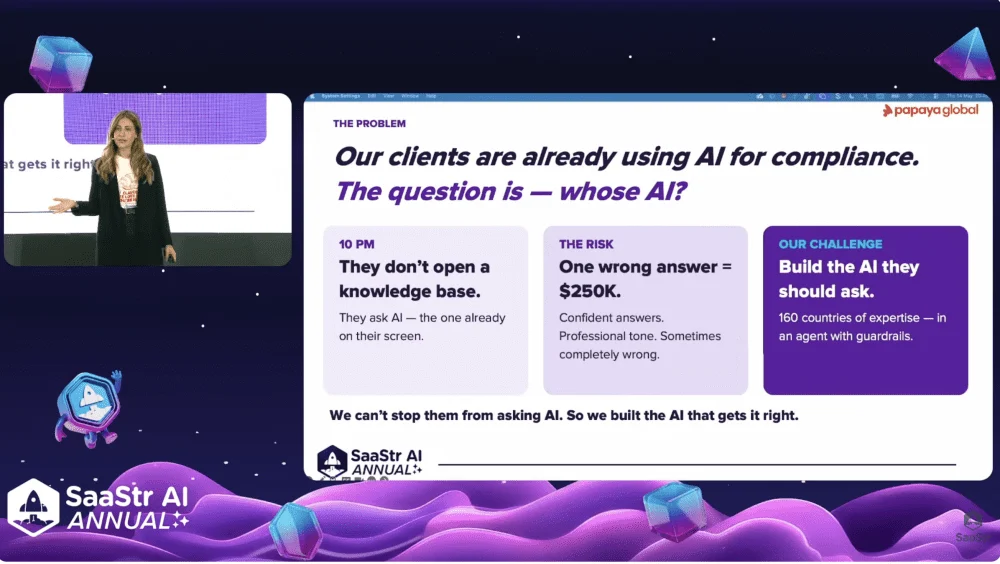
Papaya Global’s presentation was a masterclass in risk management. By building "Papaya 1," a compliance-hardened AI for payroll across 160 countries, they solved a massive liability issue. As the speakers noted, clients were previously using generic LLMs to ask sensitive questions about labor law, leading to potential $250,000 mistakes. Papaya proved that in regulated industries, trust is the product, and AI is merely the delivery mechanism.
4. Reevo: Preserving the Human Element
Reevo took a different stance, focusing on the "human-in-the-loop" philosophy. They identified that 70 to 80 percent of a seller’s day is consumed by administrative drudgery. Reevo’s AI agents aren’t designed to close deals; they are designed to kill the admin work so the human can focus on the relationship. The lesson: automate the friction, but never automate the trust.
5. Fisent and Launchpad: Outcome-Oriented Selling
Fisent (content intelligence) and Pegasystems’ Launchpad emphasized a shift in sales strategy. They stop talking about "models" and "parameters" and start talking about "outcomes." In the banking and fintech sectors, a client doesn’t care if you use a Transformer model or a decision tree; they care if their risk assessment accuracy improved by 15%. This shift to outcome-based pricing is the ultimate sign of a maturing market.
6. The Vertical AI Panel: Where the Value Lives
Scale Venture’s Jeremy Kaufmann moderated a powerhouse panel featuring founders from the legal and senior living sectors. The consensus? Vertical AI is winning because it understands the "nuance of the niche." A general-purpose model knows what a contract is, but a vertical legal AI knows the specific litigation risks in a single jurisdiction.
Supporting Data: The Four Pillars of the 2026 Moat
Across every session, the recurring themes coalesced into a framework for what constitutes a sustainable competitive advantage in the AI era. These four pillars represent the "moat" for the next generation of SaaS:
- Proprietary Workflow Integration: If your AI is a "sidecar," it can be replaced. If your AI is deeply woven into the user’s core workflow (like Nue or Papaya), it becomes part of the operating system.
- Domain-Specific Data Assets: The model is a commodity, but your dataset is not. The companies that win are those that own the "long tail" of data—the messy, industry-specific information that generic models weren’t trained on.
- Deterministic Guardrails: Enterprise customers have moved past the "gee-whiz" phase. They now demand certainty. Companies that provide "AI with a kill switch" or rigorous compliance layers are seeing significantly higher adoption rates.
- The "Outcomes" Narrative: Move the conversation away from the technology stack. If you can quantify the exact ROI in dollars or hours saved, you bypass the "Is this just a chat bot?" objection.
Implications: The Great Consolidation
The implications of the SaaStr AI 2026 findings are profound for the venture capital and startup ecosystem.
For founders, the era of the "thin wrapper" is ending. Investors are becoming increasingly sophisticated, looking for companies that own their distribution and their data. We are likely to see a massive consolidation in the market, where AI-first startups that lack a defensible moat are acquired for their talent or IP, while the vertical leaders begin to scale as the new incumbents of the enterprise.
For enterprise buyers, the message is one of cautious optimism. The chaos of 2024 is being replaced by reliable, outcome-focused tools. The risks of "hallucinations" are being mitigated by better infrastructure, and the ROI on AI investment is finally becoming measurable.
Conclusion: Beyond the Hype
As the curtains closed on SaaStr AI 2026, the overarching sentiment was one of sobriety. The "AI" label is no longer a badge of innovation; it is a baseline expectation, much like having a cloud-based login or a mobile app was in 2012.
The companies that succeed in the coming years will be the ones that view AI not as the product itself, but as the most powerful tool in their arsenal to deliver deep, vertical-specific value. They are the companies that have built their moat not on the intelligence of the model, but on the intelligence of their business design.
As we look toward 2027, the winners are clear: those who stopped trying to "build AI" and started building better, faster, and more compliant solutions for their specific customers. The commoditization of the model is not a threat to the industry—it is the catalyst for its next great leap.