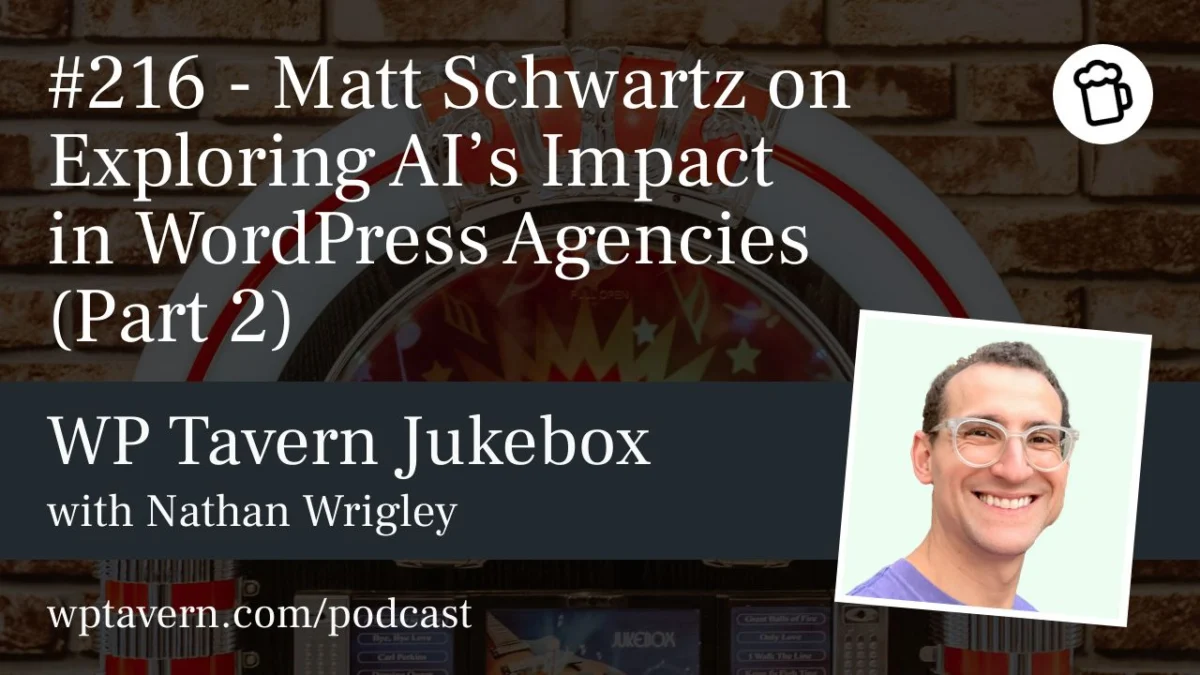
The rapid integration of Artificial Intelligence into the digital agency landscape has shifted from a novelty to a necessity. In a recent two-part special of the WP Tavern Jukebox podcast, host Nathan Wrigley sat down with Atlanta-based agency owner and developer Matt Schwartz to dissect how WordPress professionals can harness AI for tangible operational wins while navigating the inherent risks of this volatile technology.
Schwartz, who has been active in the WordPress ecosystem since 2011 and is the founder of the QA tool CheckView, advocates for a "cautious but curious" approach. This article synthesizes their comprehensive discussion, providing a roadmap for agencies looking to move beyond basic prompting toward high-level operational integration.
The Core Philosophy: Moving Beyond "Vibe Coding"
The conversation began by addressing the common pitfall of "vibe coding"—the tendency to rely on AI to generate code or solutions without deep understanding or rigorous testing. While AI is an exceptional tool for speed, both speakers emphasized that the "black box" nature of Large Language Models (LLMs) requires a fundamental shift in agency management.
The central thesis of the discussion is that AI should act as a force multiplier for existing processes, not a replacement for fundamental business logic. Agencies that succeed in this era will be those that treat AI as a junior partner—one that is incredibly fast but prone to "hallucinations" and in need of constant supervision.
Chronology of Integration: From Documentation to MCPs
Phase 1: Giving AI Access to the "Agency Brain"
The first actionable strategy identified is connecting AI chatbots to an agency’s internal knowledge base. By linking tools like ChatGPT or Claude to internal project management platforms—such as ClickUp or Asana—agencies can ensure that when an AI answers a query, it cross-references the agency’s specific SOPs and documentation. This reduces the risk of generic or incorrect advice and allows the AI to provide footnotes linking directly to the source of the truth.
Phase 2: The Rise of Model Context Protocol (MCP)
As agencies scale their use of AI, the complexity of managing API keys and individual connections becomes a bottleneck. This is where the Model Context Protocol (MCP) emerges as a game-changer.
MCP acts as a secure, standardized bridge between AI agents and internal systems. Instead of every employee maintaining disparate API connections, an agency can build a single, centralized MCP. This "gatekeeper" manages how the AI interacts with systems like WordPress, help desks, or CRMs, ensuring that the AI has the necessary context to perform tasks while operating within strict, pre-defined security guardrails.
Supporting Data: Risks and Security Concerns
The transition to AI-integrated operations is not without significant peril. The discussion highlighted several critical areas of concern:
- The Data Privacy Paradox: Many agencies are unknowingly inputting sensitive client data into public AI models. Both speakers noted that, legally, inputting data into many current LLMs may render that information non-confidential.
- Over-dependence on Vendors: The current AI landscape is dominated by a handful of major players. Agencies must consider the risk of "vendor lock-in" and the potential for sudden price hikes. If an agency’s entire workflow is predicated on a tool that increases costs by 10x, the business model may collapse.
- The "Hallucination" Factor: Despite advances, AI remains a pattern-matching engine, not a reasoning entity. Relying on AI to automate mission-critical, public-facing systems—such as automated website management dashboards—without manual code review is considered a high-risk gamble.
Official Outlook: The Future of WordPress Agencies
The Erosion of the Small Plugin Market
A significant implication of AI’s rise is the shifting economic landscape for plugin developers. The speakers noted that sales for smaller, utility-focused plugins are beginning to decline. Many agencies are now using AI to "vibe code" one-off, disposable solutions for their internal projects, bypassing the need for commercial third-party plugins. While this creates immediate efficiency, it raises questions about the long-term sustainability of the WordPress developer community.
The Human-in-the-Loop Requirement
Despite the automation potential, the role of the human professional is becoming more critical, not less. The "human-in-the-loop" model remains the gold standard for high-stakes tasks. Whether it is verifying that a "no-index" tag is correctly set on a site launch or auditing the code generated by an AI agent, human oversight is the final line of defense against catastrophic failure.
Implications for Agency Strategy
Productized Services and Niche Specialization
Schwartz suggests that the most successful agencies will be those that use AI to build highly nuanced, productized services. By leveraging AI to automate repetitive, low-risk tasks—like initial site audits, documentation, or basic QA checklists—agencies can free up their human talent to focus on high-level strategy and client relations.
The Shift in Hiring
Agencies are already witnessing a shift in hiring practices. The need for "junior-level" executors is diminishing as AI takes over those tasks. However, the need for "AI Managers"—professionals who can orchestrate AI tools, maintain MCPs, and perform high-level code audits—is growing. The agency of the future will likely have a smaller, more senior-heavy staff that oversees a vast, automated AI infrastructure.
Building Resilience
To remain competitive, agencies should adopt a "decoupled" strategy. This means building internal systems in a way that they remain functional even if a specific AI vendor changes their pricing or retires a feature. By maintaining a robust, human-led workflow as the foundation, agencies can use AI to accelerate their growth without becoming hostages to the technology.
Conclusion: A Measured Path Forward
The WP Tavern discussion serves as a sobering reminder that AI is not a "set-and-forget" solution. For WordPress agencies, the path to prosperity lies in a balanced approach:
- Document: Create a clear vision document for how AI will be used across the organization.
- Guardrail: Implement strict controls and logging for any AI tool that touches client infrastructure.
- Validate: Never allow an AI to push code to production without human review.
- Community: Continue to engage with the WordPress community, as the human-centric nature of open source remains the ecosystem’s greatest asset.
As the industry moves into 2026 and beyond, the agencies that thrive will be those that treat AI with the same professional rigor as they would any other critical business infrastructure. The technology is here, and the potential for efficiency is unprecedented—but the responsibility for the outcome remains, as always, firmly in human hands.