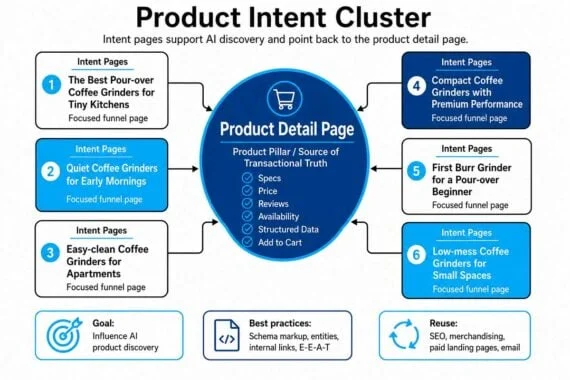
The rapid ascent of artificial intelligence has fundamentally altered the digital landscape, leading many observers to declare the "death" of traditional marketing channels. Yet, beneath the veneer of generative search and agentic commerce, the core architecture of e-commerce remains remarkably consistent. While AI has introduced unprecedented efficiency and new interfaces for discovery, the foundational requirements for merchants—visibility, trust, customer relationships, and profitable traffic—have not shifted.
As we navigate the post-2026 digital environment, it is becoming increasingly clear that the most successful brands are not abandoning traditional tactics. Instead, they are evolving them to serve a dual audience: the human consumer and the large language model (LLM).
The Chronology of Adaptation: From Static Search to Generative Discovery
The evolution of digital marketing can be viewed as a series of concentric circles. In the early 2000s, success was defined by keyword density and link building. By the 2010s, it shifted toward social engagement and mobile optimization. Today, we have entered the era of "Generative Engine Optimization" (GEO).
The turning point arrived in May 2026, when Google released its landmark guidance on optimizing for generative AI in Search. The industry braced for a complete overhaul of marketing theory, yet the guidance confirmed a long-held suspicion among veteran marketers: the signals that LLMs prioritize are the same signals that have always driven high-quality organic traffic.
This continuity is best exemplified by the rise of platforms like Smalk, a French AI startup that has popularized the concept of "Generative Engine Advertising" (GEA). While the terminology is modern, the mechanics—structured data, concise summarization, and contextual relevance—are the direct descendants of traditional SEO. We are witnessing a transition from "optimizing for a browser" to "optimizing for a brain," whether that brain is human or silicon.
SEO: The Bedrock of AI Visibility
Search Engine Optimization has not been rendered obsolete by AI; it has been elevated. Because LLMs are trained on the open web, they require the same clarity and structural integrity that human searchers do.
The core tenets of SEO remain immutable:
- Semantic Structure: Pages must be clearly organized with H-tags, lists, and schema markup that allow AI crawlers to parse information hierarchy without ambiguity.
- Conciseness: LLMs favor content that distills complex topics into digestible summaries. This mirrors the "Featured Snippet" strategy that dominated SEO for years.
- Authority and Context: Trust signals—backlinks from reputable sources, expertise, and authoritativeness—remain the primary indicators of truth for AI models.
When an AI provides an answer, it is effectively acting as a curator. If a merchant’s content is not crawlable, structured, and contextually rich, it simply does not exist in the generative ecosystem.
Sponsored Content: Influencing the "Answer Engine"
Sponsored and branded content has long served as a bridge between editorial trust and product conversion. Traditionally, these posts allowed advertisers to borrow the credibility of a publisher while creating high-converting landing pages.
In the AI era, the utility of sponsored content has expanded. New strategies, such as those championed by Smalk’s GEA model, allow brands to insert structured, promotional content into articles that LLMs are statistically likely to cite when answering user queries.
This represents a sophisticated evolution of the "advertorial." By positioning a brand within high-authority, context-heavy content, merchants can influence the information fed into an LLM’s generative output. This is not just about placing a banner ad; it is about becoming part of the "truth" that the AI presents to the user.
Advertising: Buying Attention in a Conversational Interface
Advertising has undergone the most visible transformation. The interface has shifted from a list of blue links to a conversational chat box, but the economic principles remain tethered to the concept of the "sponsored result."
When a shopper asks an AI assistant for recommendations—be it for high-end trail cameras or ergonomic running shoes—they are engaging in a high-intent search. AI platforms have responded by creating ad products that mimic paid search, but with a contextual twist. These sponsored recommendations are labeled, transparent, and integrated directly into the conversational flow.
For merchants, this is an opportunity to re-capture traffic that was previously lost to "zero-click" searches. By bidding on conversational intent, brands can ensure their products are mentioned when a consumer is at the precipice of a decision, effectively inserting their product into the "consideration phase" of the AI’s recommendation logic.
Email Marketing: The Renaissance of First-Party Data
Perhaps the most significant implication of the AI era is the decline of reliance on open-web traffic. As "zero-click" search results become the norm, the direct-to-consumer relationship has never been more vital. This is why email marketing—the industry’s most reliable workhorse—is currently undergoing a massive renaissance.
The strategy is shifting toward anonymous email retargeting. As third-party cookies crumble and AI-driven browsers become more restrictive, merchants are pivoting to media partnerships. The process works as follows:
- Content Association: A user reads a product-focused article on a trusted niche publisher site.
- Intent Capture: The publisher captures engagement signals without needing to identify the user immediately.
- Newsletter Retargeting: Through secure, privacy-compliant integrations, the merchant sends a highly relevant message to the user via the publisher’s newsletter, bypassing the "AI gatekeeper" entirely.
This strategy leverages the oldest trick in the book—permission-based direct communication—to solve the newest problem: the loss of organic traffic.
Implications for the Modern Merchant
The integration of AI into the e-commerce marketing funnel does not negate the need for a marketing strategy; it demands a more rigorous adherence to the fundamentals.
The Data Deficit
One of the most pressing implications of AI-driven commerce is the potential for data silos. As AI agents handle more of the customer journey, merchants risk losing the "middle" of the funnel. To mitigate this, brands must prioritize first-party data collection. The merchant who owns the customer’s email address owns the relationship; the merchant who relies solely on AI discovery platforms is merely a guest in someone else’s house.
The Trust Premium
As generative content floods the web, human trust will become a scarce commodity. Brands that invest in authentic storytelling, transparent sponsored content, and robust customer support will differentiate themselves from the sea of AI-generated noise. The "human element" is no longer just a nice-to-have; it is a competitive moat.
Agentic Commerce
We are on the cusp of "agentic commerce," where AI assistants will not just recommend products, but complete purchases on behalf of users. This creates a new challenge: how does a brand appeal to an AI agent? The answer lies in data clarity. APIs, structured product feeds, and clear brand-value propositions will be the primary language spoken between the merchant’s backend and the consumer’s AI assistant.
Conclusion: The Constants in a Changing World
The emergence of AI has been characterized by volatility, yet the professional marketer’s mandate remains unchanged. Merchants still need to solve the same four problems:
- Visibility: Being found by the machines that guide human choice.
- Trust: Ensuring that when the machine finds you, it recognizes you as the best option.
- Relationship: Building a direct line to the customer that exists outside of a search engine’s control.
- Profitability: Ensuring that the cost of customer acquisition remains lower than the lifetime value of that customer.
The tools—SEO, sponsored content, advertising, and email—are merely the instruments. The music remains the same. As the industry looks toward 2027 and beyond, the winners will not necessarily be those with the most complex AI algorithms. They will be the brands that master the art of being relevant, useful, and present at the exact moment a consumer—or their AI proxy—is ready to make a decision.
The digital landscape is changing, but the foundations of commerce are as solid as they have ever been. By leaning into these tried-and-true techniques, merchants can navigate the AI era not with fear, but with a distinct strategic advantage.