Apple’s official rollout of iOS 27 on Monday, September 14, has officially altered the inbox landscape. For years, the Apple Mail application has remained relatively predictable, serving as a clean, standardized conduit between senders and recipients. However, with the arrival of iOS 27, Apple has integrated advanced contextual ranking and deep Siri AI integration, profoundly altering how consumers interact with promotional content versus transactional communications.
For the digital marketing community, e-commerce brands, and email developers, this update is more than a routine software refresh. It introduces structural barriers to promotional reach while streamlining the visibility of transactional notifications, forcing a rapid evolution in email strategy.
Main Facts: What iOS 27 Changes in the Apple Mail Ecosystem
The core of the iOS 27 update centers on two major pillars: intent-based mail search and generative AI-powered inbox management via Siri AI.
1. Relevance and Intent-Based Mail Search
Historically, searching for an email in Apple Mail meant scanning a chronological list of results that matched specific keywords. Under iOS 27, search algorithms now rank results dynamically by relevance and user intent.
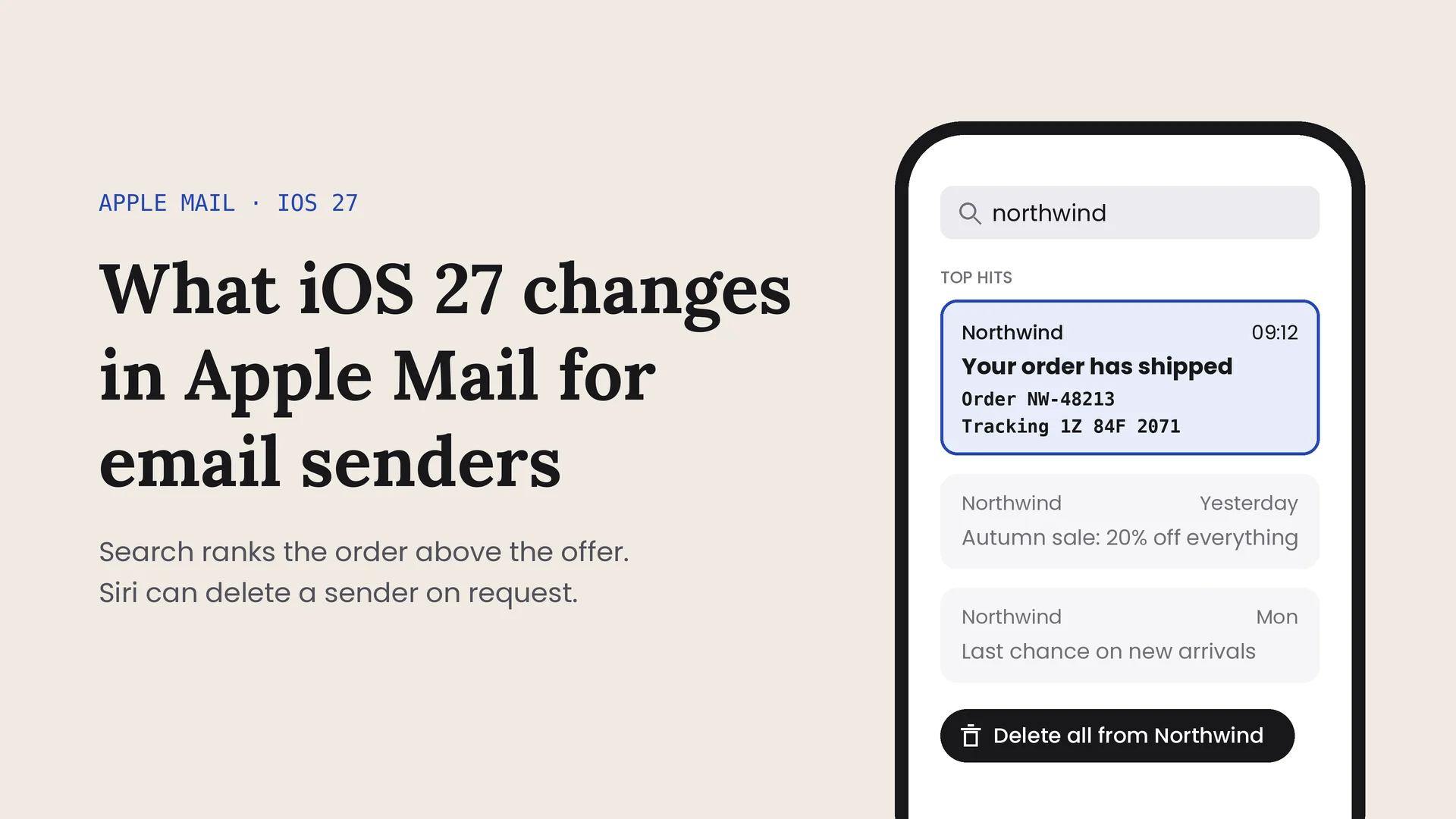
For example, when a user searches for a specific major retailer, the application no longer floods the screen with the brand’s latest promotional newsletters, holiday discount alerts, or flash-sale announcements. Instead, the search interface intelligently prioritizes the most critical transactional message—such as a recent order confirmation, a shipping update, or a flight itinerary—placing it at the very top of the results page. Promotional material is not entirely eradicated; it remains accessible, but it is effectively deprioritized, queuing quietly behind the receipt.
2. Siri AI and Natural Language Inbox Management
Beyond search, the integration of Siri AI introduces powerful shortcut capabilities directly into the Mail interface. By long-pressing on any email thread, users can invoke Siri to perform complex, multi-step actions using natural language commands.
According to early beta testing observations, users are frequently utilizing these capabilities to:
- Instantly summarize lengthy newsletters or updates into concise bullet points.
- Extract specific tracking numbers and delivery dates without opening the body of the message.
- Purge an entire history of communications from a specific sender with a single, conversational command.
This conversational "mass-deletion" feature has proven particularly potent. Beta testers have reported using the feature to quickly clean out brands perceived as digital spam, reducing the friction of unsubscribing or filtering down to a single conversational instruction: "Delete all emails from this sender."
3. Current Limitations and Regional Restrictions
While the updates apply broadly to every iPhone hardware model running iOS 27, the advanced Siri AI capabilities come with significant structural caveats:
- Hardware Requirements: Siri AI features are restricted to iPhone 15 Pro models and later, alongside Apple Silicon iPad and Mac equivalents.
- Language and Access: The features are currently limited to English-language users and operate on an opt-in beta basis, which includes a rolling waitlist for certain accounts.
- Regulatory Roadblocks: Due to ongoing compliance evaluations surrounding the Digital Markets Act (DMA), Siri AI features are entirely unavailable on iPhones and iPads within the European Union. Apple has not yet provided a projected timeline for a European rollout. Conversely, UK users have full access to the suite.
- Legacy Protocols: Mail Privacy Protection, automated categorization tabs, baseline automated summaries, and Branded Mail frameworks remain structurally unchanged. Traditional open-rate metrics remain fundamentally unreliable due to pre-fetching noise.
Chronology: The Road to iOS 27
To understand the sudden impact of the iOS 27 Mail overhaul, it is helpful to trace the timeline of announcements, developer rollouts, and regulatory hurdles leading up to the September release.
- June: During its Worldwide Developers Conference (WWDC), Apple previewed the sweeping software updates for its upcoming operating systems. At the same time, regulatory friction became apparent when Apple announced that due to DMA restrictions, the advanced Siri AI features would face indefinite delays within the European Union.
- July: Apple rolled out the initial developer and public beta builds of iOS 27. Early testing cycles provided technical analysts and early adopters with a glimpse of the new Siri AI capabilities. Observers noted how beta testers actively stress-tested the natural language processing to purge promotional senders, highlighting a looming challenge for brand retention.
- September 14: Apple officially released iOS 27 to the public. Millions of compatible devices worldwide downloaded the software, instantaneously shifting search rankings and introducing intent-based sorting to consumer inboxes.
- September 15: Following the public launch, demand for the opt-in Siri AI beta surged, resulting in the implementation of an official user waitlist managed directly through Apple’s support channels. Developers scrambled to parse documentation regarding live text integration and Branded Mail requirements.
Supporting Data and Technical Observations
While Apple is notoriously guarded regarding precise algorithmic weights, early observations from developers and email infrastructure engineers provide a clear picture of how iOS 27 handles different types of mail traffic.
Search Engine Behavioral Shifts
Internal testing by third-party mail client analysts indicates that search queries containing brand names now distribute visibility across three distinct tiers:
- Critical Transactional (Top Priority): Order confirmations, shipping notices, password resets, and account security alerts.
- Secondary Administrative: Customer service interactions, billing statements, and appointment reminders.
- Promotional (Deprioritized): Discount codes, weekly newsletters, product launches, and automated upsell campaigns.
This hierarchy means that if an e-commerce brand relies heavily on blending promotional messaging with transactional updates inside a single sending domain without proper structural separation, their discoverability during intent-based searches may suffer.
Adoption and Hardware Bottlenecks
Because Siri AI features require the Neural Engine capabilities found exclusively in iPhone 15 Pro and newer devices, market penetration of the conversational deletion and summarization tools will occur gradually. However, because older devices still benefit from the intent-based search ranking updates, the baseline suppression of promotional visibility in search results is already universal across the entire iOS 27 user base.
Official Responses and Industry Guidance
In response to the rollout, Apple has updated its enterprise and developer documentation, offering explicit directives on how businesses can optimize their messaging to remain visible and functional within the new ecosystem.
1. Live Text Integration for Orders and Tracking
Apple is strongly encouraging businesses to format transactional emails using its native Live Text guidelines. By ensuring that order numbers, tracking IDs, and delivery dates are clearly structured and machine-readable, brands allow iOS 27 to instantly surface these data points directly within the OS interface, bypassing the need for users to manually dig through email bodies.
2. Branded Mail Registration
To maintain consumer trust and bypass aggressive filtering or visual obscurity, Apple urges organizations to register their sending domains within the Branded Mail framework. Proper authentication and domain alignment ensure that corporate logos and verified sender badges appear correctly alongside the message, signaling legitimacy to both the recipient and Apple’s sorting algorithms.
3. The Absence of Schema.org Support
Notably, Apple’s official documentation still lacks guidance regarding the adoption of standard schema.org markup for email—a standard widely utilized by competitors like Google Gmail to generate rich snippets and interactive cards within the inbox. Senders are advised to continue utilizing schema.org primarily for Gmail optimization, while relying on Apple’s proprietary guidelines (such as Live Text and Branded Mail) for the iOS environment.
Implications: What Brands and Marketers Must Do Now
The release of iOS 27 is a clear signal that the era of indiscriminate, high-frequency promotional blasting is coming to a close. As operating systems become more intelligent, user-centric, and protective of attention spans, email marketing must mature in tandem.
1. Strict Domain and Content Separation
Brands should immediately audit their sending infrastructure. Sending marketing promotions from the exact same subdomains or IP pools used for high-priority transactional emails is no longer viable. If an intent-based search or an AI summarization script encounters a chaotic mix of receipts and marketing noise, the brand risks being flagged as low-value or dismissed entirely via a conversational delete command.
2. Prioritizing Utility Over Volume
With Siri AI making it effortless for users to wipe out an entire history of communications from an unwanted sender using a single spoken sentence, the cost of irrelevant emailing has skyrocketed. Marketers must pivot away from frequency-driven metrics and focus heavily on personalization, segmentation, and genuine utility. Every email sent must justify its existence in the inbox; otherwise, it risks becoming part of the user’s next AI-driven purge.
3. Optimizing for the Transactional Touchpoint
Because transactional emails (receipts, shipping updates, account alerts) now hold prime real estate in Apple Mail search results, they represent a vital, underutilized channel for gentle brand engagement. Rather than treating receipts as sterile, plain-text obligations, forward-thinking brands are turning them into polished, beautifully branded touchpoints that offer seamless paths back to the ecosystem without crossing into aggressive, spam-like promotion.
Ultimately, iOS 27 rewards relevance and penalizes clutter. Brands that respect the user’s inbox through clean architecture, transparent authentication, and high-value messaging will thrive; those that continue to rely on brute-force volume will find themselves quietly swept to the bottom of the queue—or deleted with a single sentence.