In the evolving landscape of enterprise software, few narratives have been as quietly transformative as that of ServiceTitan. Over the past decade, the company has transitioned from a specialized tool for HVAC, plumbing, and electrical contractors into the definitive, end-to-end operating system for the trades.
As of its fiscal Q1 2027 earnings report, ServiceTitan has achieved a milestone that many software companies spend decades pursuing: a $1 billion revenue run rate. What makes this achievement particularly noteworthy is the methodology behind it. Rather than relying on aggressive, debt-fueled M&A strategies to pad its top line, ServiceTitan has achieved this scale through sustained organic growth—clocking in at a consistent 25% year-over-year expansion.
However, the company’s current market position presents a complex paradox. Despite strong fundamental performance, the stock remains under significant pressure, trading down nearly 46% from its 52-week highs. This disconnect between operational excellence and public market valuation provides a masterclass in how modern investors are currently pricing vertical B2B software.
The Core Data: Fiscal Q1 2027 Highlights
ServiceTitan’s latest quarterly disclosure paints a picture of a company hitting its stride in operational efficiency while aggressively pivoting toward the next generation of technological integration.
- Revenue Growth: Revenue climbed to $268.8 million, representing a 25% increase year-over-year.
- Operating Margin: Non-GAAP operating margins saw a dramatic inflection, rising from 7.5% in the prior-year period to 15.2% today.
- Non-GAAP Operating Income: This metric more than doubled, jumping from $16.2 million to $40.8 million.
- Gross Transaction Volume (GTV): The system processed $21.7 billion in volume during the quarter, a 23% increase that annualizes to approximately $87 billion.
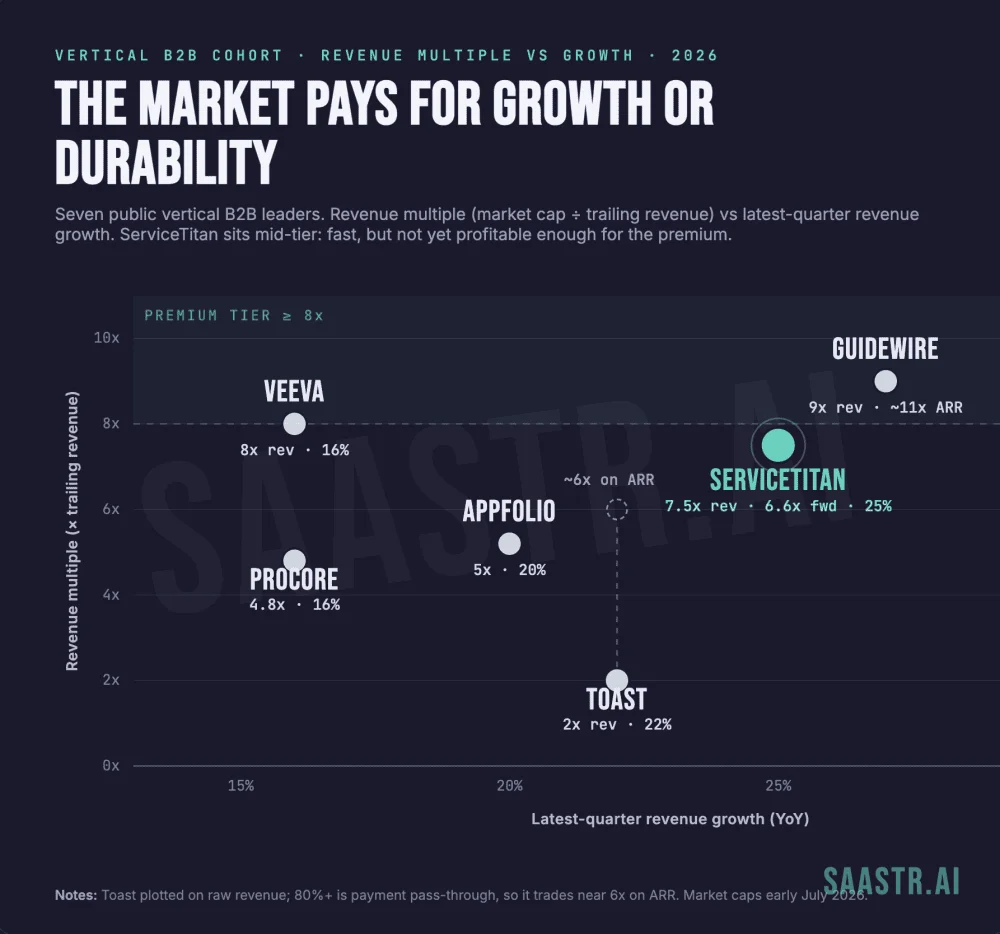
- Market Valuation: With a share price hovering around $78, the company commands a market cap of approximately $7.5 billion, reflecting a trailing revenue multiple of roughly 7.5x and a forward multiple closer to 6.6x.
Chronology of an Evolution: From Utility to Fintech
ServiceTitan’s journey mirrors the "Vertical SaaS plus Fintech" playbook popularized by industry titans like Shopify, Toast, and Bill.com.
The Subscription Phase
In its early years, ServiceTitan focused on establishing itself as the "system of record." By solving the specific, messy pain points of field service contractors—dispatching, inventory management, and scheduling—it made itself indispensable.
The Fintech Inflection
As the company matured, it moved beyond simple seat-based subscriptions. By embedding payments and financing into the platform, ServiceTitan began to capture a percentage of the actual money flowing through its customers’ businesses. This transition is now the primary engine of the company’s growth. Usage-based revenue, which is directly tied to the success and transaction volume of its users, is currently outpacing traditional software subscriptions. Today, usage revenue accounts for roughly 22% of the company’s platform earnings, proving that owning the workflow is the ultimate precursor to monetizing the commerce layer.
Supporting Data: Efficiency and Reinvestment
A recurring theme in the Q1 2027 report is the newfound discipline regarding Sales and Marketing (S&M). While revenue grew by 25% (adding $53 million to the top line), GAAP sales and marketing spend increased by a mere 5.6% (adding less than $4 million). This divergence is the primary driver of the company’s expanding margins.
However, ServiceTitan is not simply "banking" these gains. Instead, it is systematically reinvesting these efficiencies into R&D. During the quarter, R&D spend surged 27% to $88 million, now representing approximately 33% of total revenue.
The focus of this investment is an "Agentic Operating System for the Trades," anchored by their AI product, Max. Adoption metrics are compelling: the number of locations utilizing Max more than doubled in Q1, with guidance suggesting a repeat of that growth in Q2. This represents a strategic bet that proprietary operational data—the "how-to" of plumbing and electrical work—is the ultimate defensive moat in the age of artificial intelligence.

Market Disconnect: The Profitability Gap
Despite meeting the "Rule of 40"—a benchmark for balancing growth and profitability—ServiceTitan is facing skepticism from public markets. The primary friction point lies in the discrepancy between GAAP and non-GAAP figures.
While the company reported $36.7 million in non-GAAP net income, it still incurred a $22.8 million GAAP net loss. A significant portion of this gap is attributed to stock-based compensation (SBC), which totaled $54.6 million, or roughly 20% of revenue. In the current interest rate and fiscal environment, investors are increasingly intolerant of high SBC ratios, viewing them as a dilution of shareholder value that masks the true cost of operations.
Furthermore, the market has recalibrated its expectations for vertical software. The "grow-at-all-costs" era has been replaced by a demand for "fast plus profitable." While ServiceTitan is growing at an impressive clip, the market’s refusal to reward its current growth suggests that investors are waiting for the company to prove it can reach consistent GAAP profitability before awarding it a premium multiple.
Implications: The State of Vertical B2B
The broader cohort of vertical B2B leaders—including Procore, Samsara, Veeva, and Guidewire—all reported similar trends this quarter. This data allows for several broader conclusions about the industry:
1. The Myth of the Ceiling
For years, skeptics argued that vertical software was a "small market" play with a low ceiling. The recent performance of these companies proves otherwise. Growth rates in the mid-teens to low-30s at the $1 billion scale confirm that specialized platforms can achieve massive, durable revenue bases.
2. The Data Moat
Every major player in this space is aggressively pivoting toward AI. The "wedge" is no longer just software; it is the proprietary data that allows for the creation of autonomous agents. Whether it is ServiceTitan’s Max or Veeva’s AI initiatives, the strategy is identical: leverage the workflow to train the agent.
3. The Multiple Reset
The most striking takeaway is the collective nature of the market’s punishment. When companies with strong margins, double-digit growth, and dominant market shares see their valuations compress, it indicates a macro-level reset. The market is not judging individual execution as much as it is repricing the risk-reward ratio of the entire vertical software category.
4. Strategic Advice for Founders
For those building in the vertical B2B space, the lesson is clear: control what you can control. The current public market sentiment is indifferent to stellar execution in the short term. However, the fundamentals remain the only path to long-term success. By compounding growth, maintaining high Net Dollar Retention (NRR)—which for ServiceTitan remains safely above 110%—and achieving efficiency through fintech and AI, founders can build businesses that survive the current cycle.
Conclusion
ServiceTitan stands at the vanguard of a new era for B2B software. It has successfully moved past the "startup" phase to become a critical utility for the skilled trades. While the public markets remain hesitant, the underlying trajectory is unmistakable: by acting as the operating system for billions in trade commerce and aggressively investing in AI agents, ServiceTitan is positioning itself not just as a software vendor, but as an indispensable pillar of the industrial economy. For investors and competitors alike, the company serves as the definitive case study on how to scale, monetize, and innovate in a vertical landscape that is larger and more profitable than many ever dared to imagine.